
History of Valentine's Day: first box of chocolates and cards to send to people you hate

This Saturday marks Valentine’s Day, our annual chance to celebrate being with someone special, or – if you’re not partnered up – a lot of over-commercialized fuss and bother over nothing. Whichever side of the divide you stand on, we hope there’s something in this whistlestop tour of romance-related records for you.
Richard Cadbury (UK), the eldest son of John Cadbury – founder of the world-famous company – created the first Valentine’s Day box of chocolates in the 1860s. Something of a pioneer in chocolate-box design, he often used his own paintings to make the lids of the boxes more appealing. Once the contents had all been scoffed, Cadbury advocated saving the pretty boxes for keeping love tokens, such as locks of the beloved’s hair or billets-doux.
#SugarFactWednesday Did you know that Richard Cadbury is credited with making chocolate the symbolic candy of Valentine's Day? He began selling heart-shaped boxes of chocolates in 1861, thoughtfully hand-decorated, which quickly became a common symbol of love associated with this… pic.twitter.com/Qh6hfZ7rKL
— The Sugar Association (@MoreToSugar) February 12, 2025
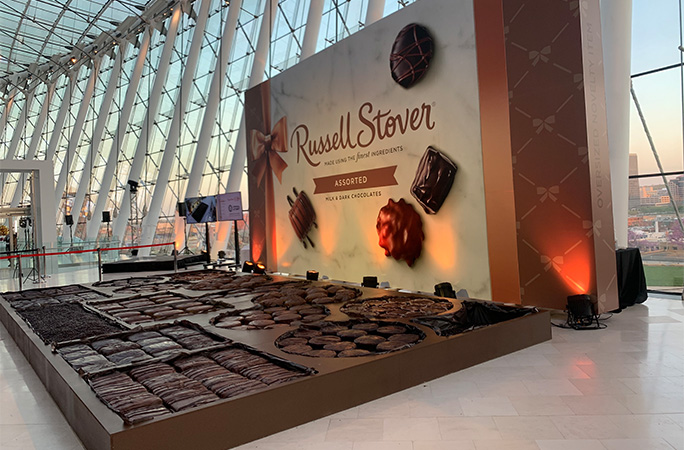
Imagine the look on that loved one’s face if you turned up at their door with the largest box of chocolates. On 17 April 2023 – rather late for Valentine’s Day, admittedly – US manufacturer Russell Stover Chocolate unveiled a 2,547.49-kg (5,616-lb 4-oz) box of chocs in Kansas City, Missouri, USA. Manna from heaven for loved-up cocoa-nuts! And for singletons: who needs a partner anyway – that’s more chocolate for you, right?
Find more stories about record-breaking edible things in our Food and Drink section.
Of course, many people prefer to say it with flowers. And when it comes to Valentine’s Day, one bloom is still the pick of the bunch. Red roses have long been a byword for full-on love – did you know that the rose is the oldest cultivated decorative plant? Documents dating back to 50 CE suggest that ancient Romans grew the flowers in vast plantations and local hothouses to ensure a year-round supply of medicinal extracts, cooking ingredients and ornamentation. These rose blooms were used to decorate buildings, furniture and people while petals were laid to create rose carpets and walkways.
In the past, different flowers, and their various colours, conveyed a whole range of meanings to those in the know. Whereas red stood for passionate love, pink implied a gentler form of amour. A yellow rose was a polite brush-off (“You’re a dear, dear friend! But just a friend…”). Beware the yellow carnation, though! It signified sniffy disdain for the would-be suitor.
May your day be as bright as this yellow rose bloom 😇#FlowerPhotography #YellowRose pic.twitter.com/4Z8tVkvVWm
— Kenji 🌸 delivering flowers every day 🌸 🐦 (@gontanokoneroku) January 22, 2026
Some of us might hope for a Valentine’s card (or two! Or three!) to pop through the letter box this year. It’s a tradition with a long heritage – some sources suggest that the earliest example dates back to 1415, when the French Duke of Orleans penned a romantic epistle to his wife from the confines of the Tower of London. The Duke’s love letter mentions Valentine, a saint who has been identified with 14 February since the early 5th century BCE. He’s most commonly identified with love and marriage, but Valentine covered a lot of bases, and is also the patron saint of plague and epilepsy. Oh, and beekeeping, for good measure.
A strong contender for the earliest Valentine’s Day card, as we’d recognize it today, is the one issued on 12 January 1797 by London publisher John Fairburn. It was artfully embellished with cupids, doves and flowers, and – unlike the anonymous cards we’re now used to – we know who it was sent by, and to. The recipient was Mr Brown of Dover Place, Kent Road, London, and the sender was Catherine Mossday, who wrote inside, “as I have something particular to say to you I could wish you make it all agreeable to come on Sunday next without fail”. (But did he go? And if he did, what did she tell him?)
The Victorians loved traditions, but delighted in subverting them too. About half of the Valentine’s cards from the era were “Vinegar Valentines”, for people whom the sender absolutely detested. Among the targets were liars, gossips, flirts, people who had the temerity to be unattractive (“In prison you ought to be doing some time, / For to wear such a face must be surely a crime”) and – in a mortifying sign of those times – even suffragettes. To add insult to – well – insult, the recipients paid the postage!
'Vinegar valentines' were popular during the Victorian era.
— Quite Interesting (@qikipedia) February 14, 2023
People would send these insulting cards to people they disliked. pic.twitter.com/Jlq4VPugFC
For cozied-up couples, loved-up movies make for a top night in. Stephen Chow’s fantasy adventure film Mei Ren Yu (aka The Mermaid; China, 2016) earned a total of $552,198,479 (£379,654) at the global box office, making it the highest-grossing romcom. Those of us who prefer our romantic movies leavened with a helping of tragedy, however, may prefer to settle down with the highest-grossing romance film: Titanic (USA, 1997) had taken $2,223,048,786 (£1.69 bn) worldwide as of 2 May 2025. Hollywood heartthrob Leonardo DiCaprio was a big part of that film’s success, and had also put in a heart-stopping turn alongside Claire Danes as the star-crossed lovers in Baz Luhrmann’s exuberant Romeo + Juliet (USA, 1996). Its $147,542,381 (£91,030,551) global box-office return to 14 February 1997 makes it the highest-grossing Shakespeare movie.
Whether you’re paired up or flying solo this year, GWR wishes you a Happy Valentine’s Day. And if you’re on your own, remember: there’s nothing to stop you from buying flowers and chocolates for yourself…
Header image: Photo by Matt Nelson on Unsplash