
Prince Bira of Siam, The Crystal Palace and the first televised motor race
Crystal Palace Park is a much-loved public space in south London, UK. Go there on a sunny weekend and you'll see joggers and families, games of pick-up football and a lot of excited dogs. You'll also see the ruins of a 19th century engineering megaproject, an ornamental lake surrounded by wildly incorrect sculptures of dinosaurs and a 1960s athletics training centre. It's one of those places where a lot of history has been crammed into a small space.
What you likely wouldn't notice is how oddly wide and well-graded the park's access roads and footpaths are. They follow broad, sweeping curves and have flat curbstones on the inside of corners. In some places there are still faded traces of paint on the stonework.
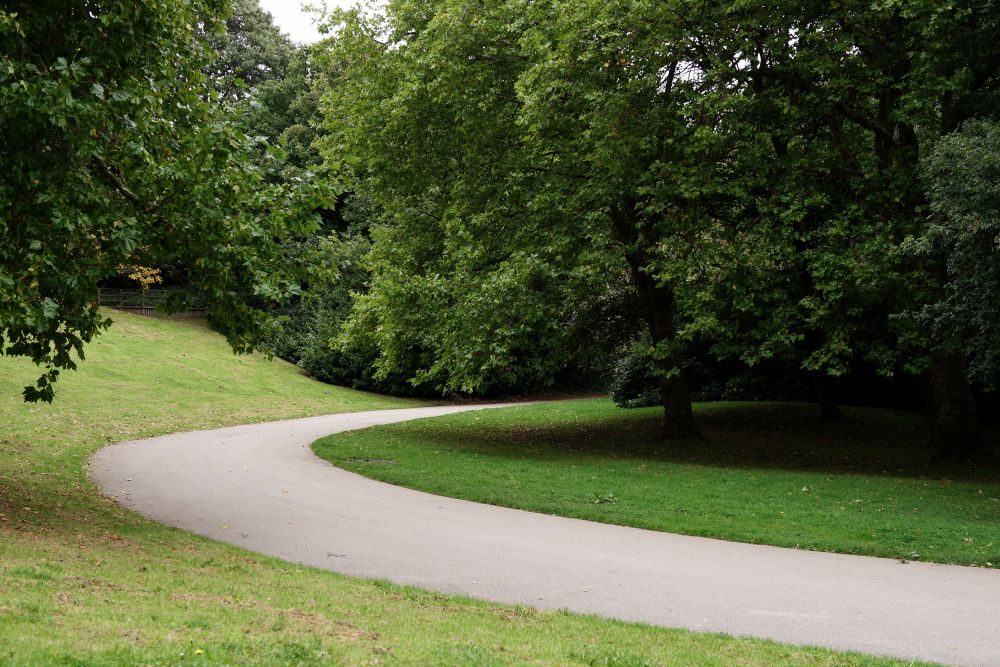
The quiet tree-lined footpath that was once "North Tower Crescent", a high-speed corner at the end of Terrace Straight. [Crystal Palace Park by Peter Trimming, CC BY-SA 2.0, via Wikimedia Commons]
The joggers probably don't know it, but their morning run takes them around the now mostly forgotten Crystal Palace Grand Prix Circuit, a series of tight tree-lined turns where, 89 years ago, the first televised motor race was won by an adventurous Thai prince.
The Crystal Palace
To give the appropriate context for this story, we're going to have to go all the way back to the Great Exhibition of 1851 – properly the "Great Exhibition of the Works of Industry of All Nations". This spectacular event was planned as a grand celebration of modern technology in general, and British technology in particular. It was effectively the first World's Fair, bringing together cultural and commercial exhibitors from all over the globe.
For five months in 1851, visitors could pay the five shillings' admission to see such marvels as the largest diamond in the world, several full size steam locomotives and even the Tempest Prognosticator – a device that apparently predicted the weather using bottles of leeches. (For more about Victorian Britain's obsession with the weather, click here).
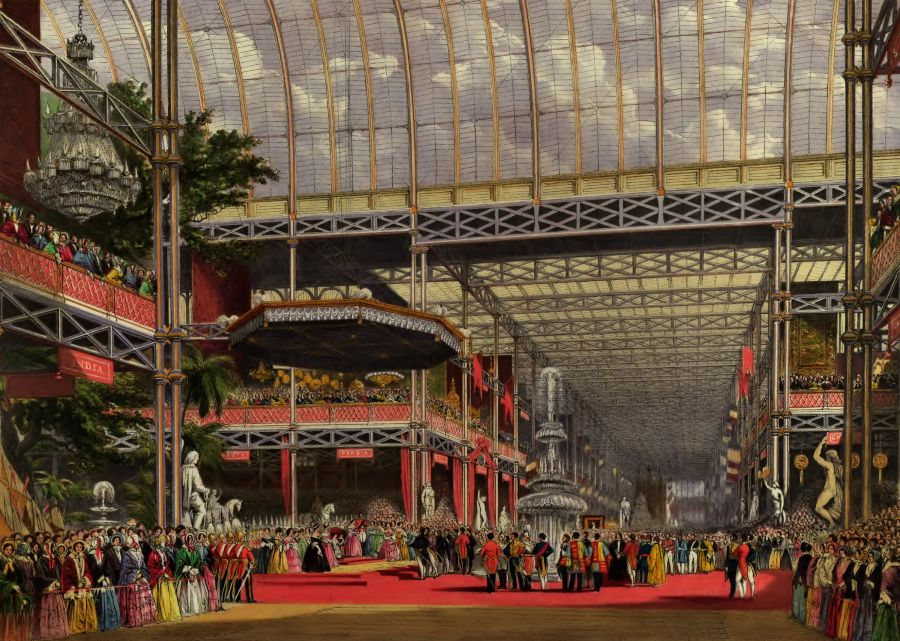
Queen Victoria and her entourage during the official opening of the Great Exhibition, looking down the North Transept of The Crystal Palace. [Public Domain/G Nash]
The greatest marvel of all, however, was the venue that held all these exhibits: a 990,000-square-foot (92,000-m2) glass-and-iron great hall called The Crystal Palace, which had been erected in the famous Hyde Park in central London. This state-of-the-art engineering wonder was 1,851 feet (564 m) long and more than 128 feet (39 m) tall. It was the most capacious building in the world at the time (a title that is now held by Boeing's main aircraft assembly plant in Everett, Washington, USA).
Relocating The Crystal Palace
The exhibition was a roaring success, but its organizers ran into the same problem as many subsequent World's Fairs: once the crowds were gone, and the exhibits packed away, what on Earth were you supposed to do with the building? The wealthy residents of Mayfair and Kensington wanted their park back, so the decision was made to dismantle The Crystal Palace and move it across London to a hilltop between the suburbs of Sydenham and Penge.
On this hilltop, The Crystal Palace was installed as a permanent exhibition centre and public attraction. It was served by its own dedicated train station and set within a large area of carefully landscaped gardens (what is today Crystal Palace Park). The whole thing was operated as a commercial venture, charging admission and putting on events – a kind of cross between a theme park, a exhibition centre and a Victorian pleasure garden.
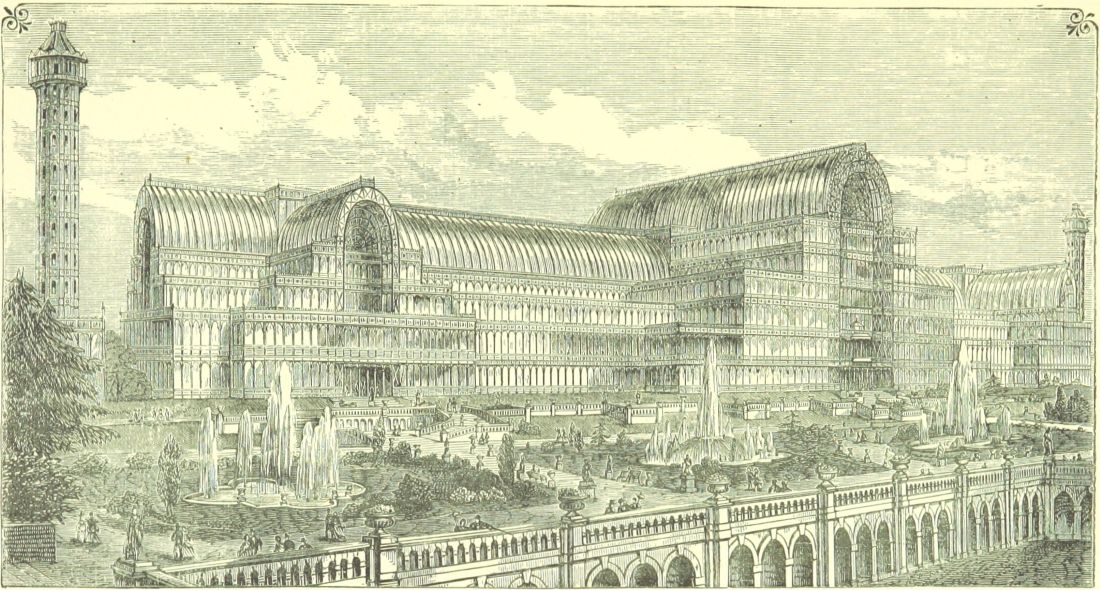
The Crystal Palace as it looked once installed on Sydenham Hill. Dismantling, moving and re-erecting the enormous glass-and-iron structure ended up costing more money than it had to build in the first place. [Public domain, via Wikimedia Commons]
The Crystal Palace hosted fairgrounds and festivals, concerts and cat shows; its stadium was the home of every FA Cup Final from 1895 to 1914, and several more international exhibitions were held on the grounds. Incidentally, the largest of these, the 1911 Festival of Empire, featured a "Parade of Giants" led by the then tallest man in the world, Frederick Kempster (click here for more on Fred).
The Crystal Palace's promoters were always looking for new spectacles to lure people in, and in the mid-1930s it was decided to dig up portions of the Victorian ornamental gardens to make room for a modern motor racing circuit. Work continued on this project even after the Crystal Palace itself burned to the ground on 30 November 1936.
The Crystal Palace Circuit
As originally laid out, the Crystal Palace Circuit looked like a scaled-down version of a modern Grand Prix racetrack. It packed nine or ten tight corners into a track length of just 2 mi (3.2 km), and the track itself was generally only 6–8 m (20-26 ft) wide. By way of comparison, the present-day British Grand Prix takes place at the 3.66 mi (5.89 km) Silverstone Circuit, which typically has around 13 m (42 ft) of passing space from kerb to kerb.
The home straight – where the main grandstands and the start/finish line were located – ran across the width of the park down at the bottom of the hill. The first corner marked the beginning of a steep climb called Maxim Rise, whose S-bends ran between the trees near the train station. From there, drivers had to get around South Tower Corner before going flat-out down the Terrace Straight with the charred ruins of the Crystal Palace on their left.
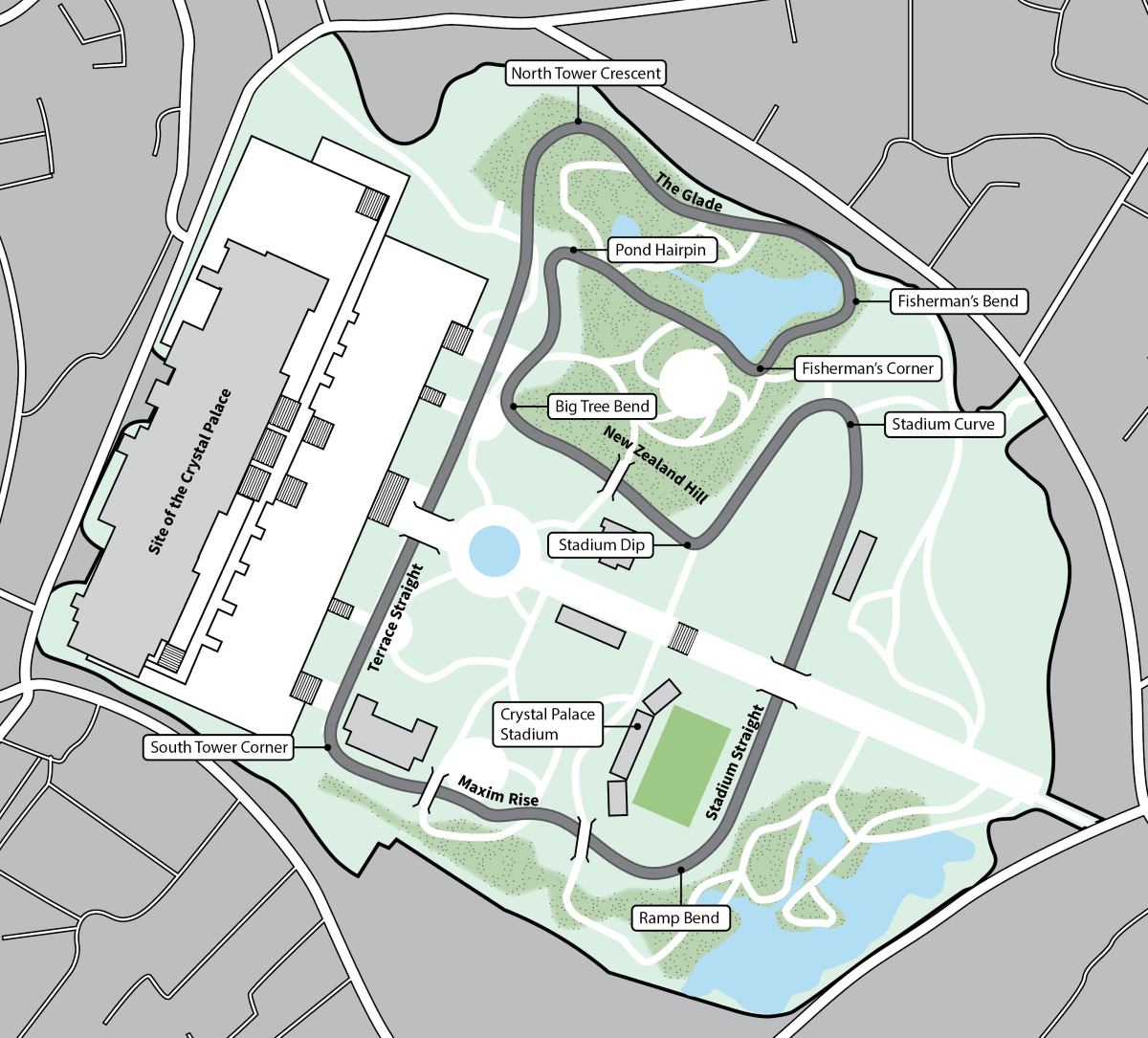
This was followed by a dense and technical section of the track where it dropped steeply downhill through an area of woodland, before making a series of sharp right-hand turns around one of the park's ponds. It climbed back up past a hedge maze and around a series of left hand turns and the New Zealand Pavilion (left over from the Festival of Empire) before dropping back down towards the home straight.
The track was famously unforgiving, and its tight turns caused frequent crashes. The first London Grand Prix, held on 17 July 1937, ended with one car overturned in a ditch, one stuck in some undergrowth at the bottom of an embankment and another in the pond. All this made for great racing, however, and the circuit's accessibility to Londoners meant that events attracted huge crowds.
Sports on the BBC
The track's proximity to central London also attracted the attention of the British Broadcasting Corporation, whose producers were on the lookout for exciting events to cover. The location was ideal for an outside broadcast, as not only was it close to central London, but its position on a hilltop would make for a clear radio link to the BBC's main transmitter at Alexandra Palace.
The head of the BBC's outside broadcast division, Seymour de Lobtiniere (last seen here in our story on the first live-broadcast ghost hunt), had been experimenting with live radio coverage of various sporting events. His hand-picked commentators had figured out how to effectively describe cricket, rugby, tennis and football, but making compelling radio out of a motor race no-one could see had proved more difficult.
On 2 November 1936, however, a new world of possibilities were opened up by the start of the first regularly scheduled television broadcast, a technological marvel that the BBC described as "a phenomenon which would have been hailed in any other age either as a miracle or as a piece of witchcraft".
Although TV shows could initially only be made in the BBC's studios at Alexandra Palace in north London, the need to provide live coverage of the coronation of King George VI (on 12 May 1937) fast-tracked the development of a system that would allow shooting on location.
The result was the Marconi-EMI Mobile Control Room (or MCR), a three-vehicle system that comprised a generator truck, a transmitter truck, and a mobile TV studio that could support three cameras and allow an on-site producer to overdub commentary and cut between feeds as needed.
Seymour de Lobtiniere arranged for motor racing to make its TV debut at the Imperial Trophy Race, which was to be held on 9 October 1937 as the last race of the year at Crystal Palace and the grand finale of the circuit's successful first season's racing.
White Mouse Racing
The conditions on the afternoon of 9 October 1937 were perfect for racing. It was a cool autumn day with light but overcast skies. The racers assembled were a typical pre-war assortment of serious privateer drivers, works-team professionals and gentlemen amateurs. Most of the cars and entrants were British, though there was a six-car delegation from Italian manufacturer Maserati, led by Carlo Trossi and Count Giovanni Lurani.
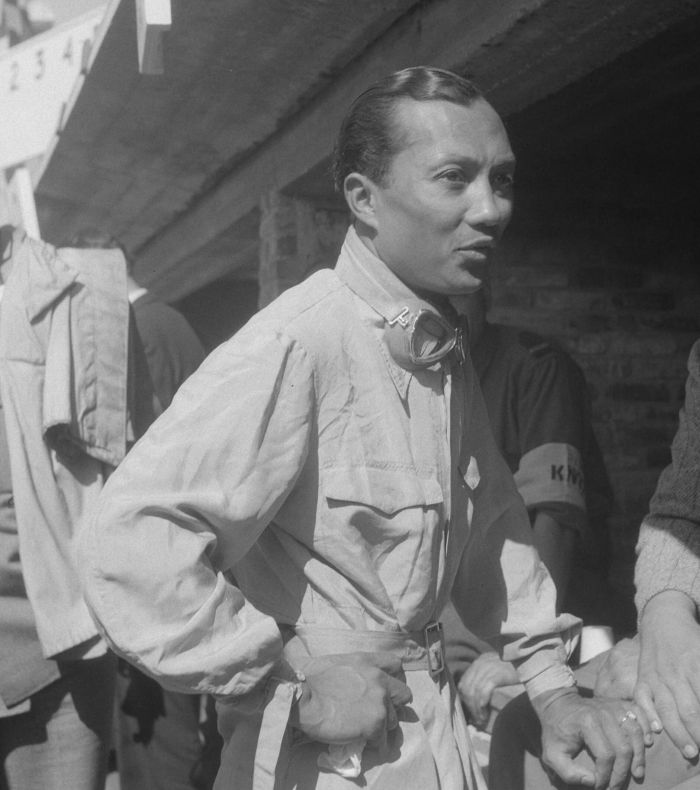
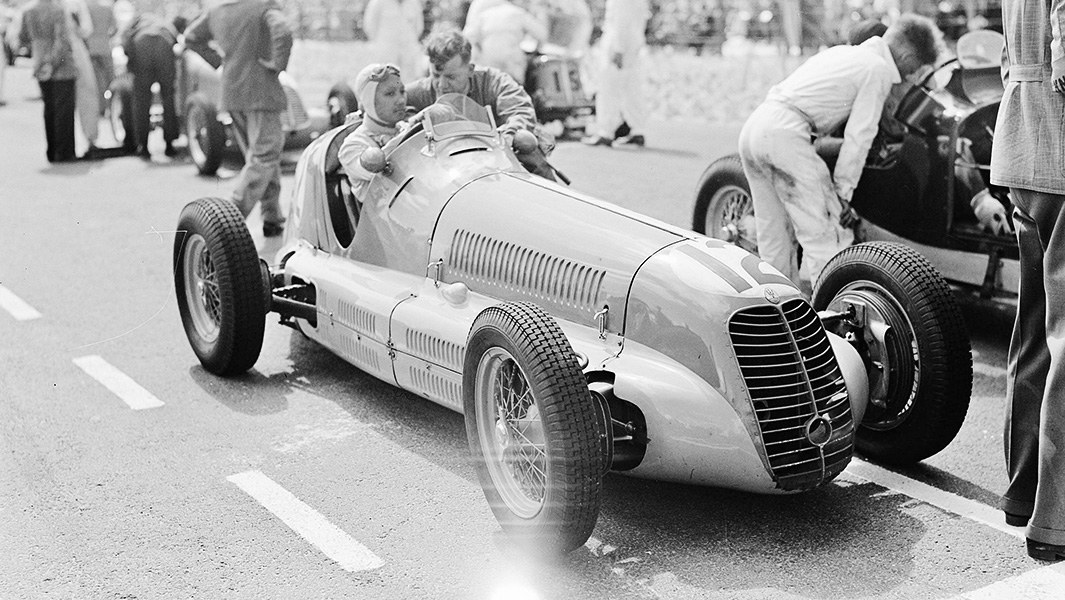
Prince Bira, pictured at a race in 1948. His racing overalls, like his cars, were typically sky blue. The colour scheme of sky blue with a yellow stripe was established as Thailand's official racing colours by Prince Bira. [Nationaalarchief/Public Domain/J D Noske]
The star of the show, however, was the man who entered the race as "B Bira" – a charismatic young member of the royal family of Thailand. His full name was Prince Birabongse Bhanubandh (or, Mom Chao Phiraphong Phanudet, using the modern transliteration system for Thai names). He had been sent to England for his education in 1927, attending the prestigious Eton College with the expectation that he would go on to study something respectable at Oxford or Cambridge.
The Thai royal family entrusted young Prince Bira to the care of his cousin, Prince Chula Chakrabongse, who had established the example Bira was to follow by attending Harrow School and then earning a degree from Trinity College, Cambridge.
As it turns out, however, placing responsibility for a 14-year-old on the shoulders of his 20-year-old playboy cousin isn't the smartest move. By 1935, the young Bira had abandoned Cambridge University to train as a sculptor, fallen in love with an English art student and developed a taste for wild parties and fast cars.
Conscious of his family responsibilities, Prince Chula of course acted swiftly to rein this in... Only joking, he instead decided to buy Bira a professional-grade racing car – an English Racing Automobiles R2B that Bira named "Romulus" – and they jointly started a privateer team called White Mouse Racing.
Bira was a charming and well-liked driver, and was also undeniably talented – he was the winner of the London Grand Prix that had been held at Crystal Palace earlier in the year. As the cars lined up on the starting grid, the spectators were looking forward to a high-speed showdown between Bira and his championship rivals Raymond Mays and Arthur Dobson (also driving ERA vehicles).
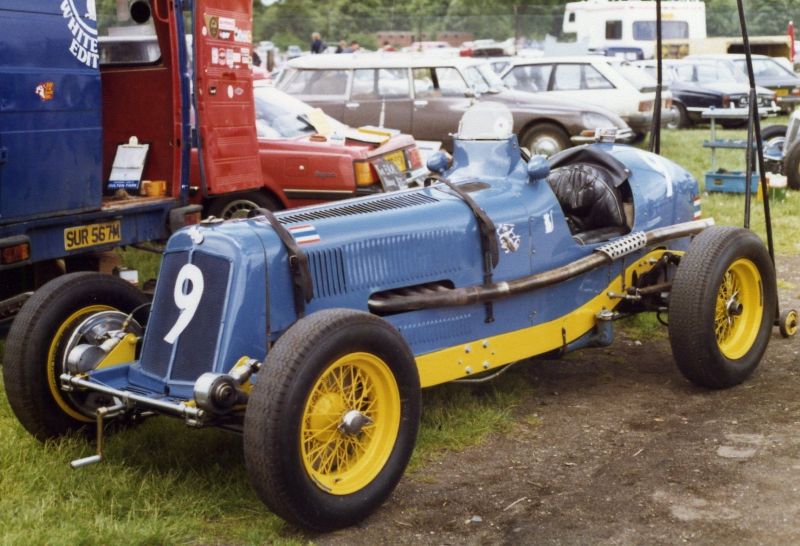
"Hanuman II", another ERA driven by Prince Bira for White Mouse Racing. The team bought this one in 1937 or 1938, but Bira was driving a different (though very similar) car at Crystal Palace. Note the silver relief of the Hindu deity that was the car's namesake – it's likely Bira made this himself, as he did with the custom hood ornaments on his Bentleys. [“ERA - Romulus” by John Harwood, CC BY 2.0]
The Imperial Trophy
The format of the event was well suited to TV. Because the Crystal Palace Circuit was too tightly confined to have a proper pit lane, races were staged as a series of "sprints". The TV broadcast began at 2:25 p.m. with half an hour carved out in the schedule for the introduction and the first qualifying heat – a 10-lap race that was won by Riley Motors mechanic & driver Percy Maclure.
The BBC then cut back to the studio for a gardening show, before returning to Crystal Palace for the second qualifiing heat, which was won by Carlo Trossi in his Maserati 4CM. After flipping back to the studio for a little light music with Eric Crozier and Eve Maxwell-Lyte, the headline event of the day began at 3.46 p.m..
Racing driver Andrew Jordan takes to the track in an ERA R4D, which was the big brother of the Bira's R2.
For the BBC technical crew in the MCR, this would have been a tense moment. The whole TV outside broadcast system was very much a prototype, built quickly and using often tempramental state-of-the-art electronics. While the cars lined up on the grid, loudly revving their engines as the mechanics made their final adjustments, the BBC control-room crew would have piled into the back of the van.
It was called a "control room", but that name is a little misleading. In reality, the "room" was a narrow corridor running down the centre of a converted single-decker bus. On either side of the passageway was a floor-to-ceiling wall of rack-mounted electronics, covered in knobs, dials and switches. At the far end of the corridor, up at ceiling height, there were a pair of small cathode-ray-tube television screens. All the rack-mounted equipment would have used glowing-hot vacuum tubes (or valves), so even on a brisk October afternoon, and with the doors open, it would have been swelteringly hot inside.
Cabling would have snaked out across the park from the van. Three sets of cables (unloaded from huge wooden spools) connected the MCR to the trackside cameras, while another set of cables went up to the commentator's booth in the grandstand, where F J Findon (editor of Light Car magazine) was talking the audience through what to expect.
All the switching and signal routing had to be done manually back then, and so there would have been several people crowded awkwardly into the windowless MCR, each managing a different set of dials and switches. At the front, the producer would have been looking up at the two dim black-and-white screens, watching the action.
The MCR was set up so that the left of the two screens was always showing the output to the broadcast van (what was being shown on TV sets all over southern England). The right screen could be switched between the feeds from the other cameras, allowing the crew to preview the shot before cutting over to the next view.
As the cars tore away from the starting line, the crew would have been anticipating their progress, flicking the right-hand screen to the next camera as the cars passed the last one. People in the van would have been talking tyo the camera operators, who all head headsets, giving them instructions on how to follow. As the leading cars came into view on the right screen, the producer would flick the switch that sent that feed to the broadcast channel on the left.
The race
On the track, the two favorites (Bira and Dobson) were pulling away from the rest of the field. The powerful but heavy Maseratis were falling behind as Dobson pushed as hard as he could to close the gap Bira had opened up early in the race.
Article from 20 Oct 1937 The Bystander (London, Greater London, England)
By the final lap, Bira and Dobson were taking the corners practically wheel-to-wheel while the third place driver, Charles Goodacre (who had led early on), was trailing around half a lap behind. The crowds gasped as the pair slid around corners, coming within inches of colliding as they closed on the finish line. In the end Bira won by less than half a car-length, finishing in a time of 31 min 58.5 sec (0.3 seconds ahead of Dobson).
A cheering crowd stormed the paddock and carried Bira away on their shoulders, scuppering the BBC's plans to conduct a post-race interview. Star British driver Dick Seaman, who had done a demonstration run earlier that day in his works-team Mercedes-Benz W125 (a 200-mph behemoth that was far too much car to actually race at Crystal Palace), had been roped in at short notice to talk to Bira on camera.
As the commentator signed off on the first televised motor race, passing back to the studio feed at Alexandra Palace, the sweaty technicians in the MCR breathed a sigh of relief and shouted up to Dick Seaman (who was standing on the roof) that he wouldn't be needed after all. Reportedly the last thing viewers at home heard was Dick Seaman end the broadcast with a relieved, if slightly premature, "Thank God for that".
Header image: Prince Bira on the starting grid at the 1948 Zandvoort Grand Prix in his Maserati 4CLT. He would go on to win this race. Bira remained an active privateer driver into the mid 1950s, earning a total of 8 career points in the early seasons of the Formula 1 World Championship. [Nationaalarchief/Public Domain/J D Noske]