


The rise and fall of auto polo, America's most dangerous sport
It is 9 July 1902, and the well-heeled ladies and gentlemen of the Dedham Polo Club in Massachusetts, USA, have gathered to watch a sporting demonstration by one of their leading members. Joshua Crane Jr., the athletic son of a wealthy Boston businessman, has invented what he believes is the future of sport.
In a paddock on the edge of the polo field, where the ponies would usually be marshalled before a game, Joshua – a tall, muscular man in his early thirties – is tinkering with an automobile. Beneath the gaze of Boston's social elites, Joshua puts the machine noisily into gear, gives his polo mallet a few quick swings and sets out on to the field.
He gave an exhibition of his skill in running the machine with one hand and making a pretty series of strokes with a polo mallet, knocking the ball the length of the field as cleverly as he could from a polo pony.
At the end of his run, Mr Crane rapped a backhander, and then in a jiffy made a dazzling turn at speed with his automobile, and was on the ball again for a run to the other end of the field.
Mr Crane also successfully tried some fancy shots between the wheels of his machine, and altogether gave a remarkable performance.
- Fall River Daily Evening News, 11 July 1902.
The old chaps were, of course, baffled by the whole thing, but the younger members saw something exciting. A way to merge the sport they already played with the exciting world of their new motorized toys. One commentator stated, "it is only a question of time when the automobile will supplant the pony". Word of this demonstration, and the idea of auto polo, spread fast.
Some sporting context
Before we go on with this story, we should pause for a moment to explain a few things. First of all, it's probably worth giving a very rough introduction to the sport of polo, which isn't a game many people are likely to have seen on TV or remember from school (unless it was a really, really fancy school).
At its most basic, polo can be described as a ball game broadly similar to hockey or soccer. There's a field, two teams (four players each) and the aim is to get the ball between the posts of the other team's goal. The most goals scored at the end of the game wins.
The details of how the game is played are very different from soccer or hockey, however. The field is about six times the size of a soccer pitch, and it needs to be this big because all the players (and the two umpires) are on horseback. The ball can only be hit with long-handled wooden mallets that players swing one-handed while also holding the reins of their horse.
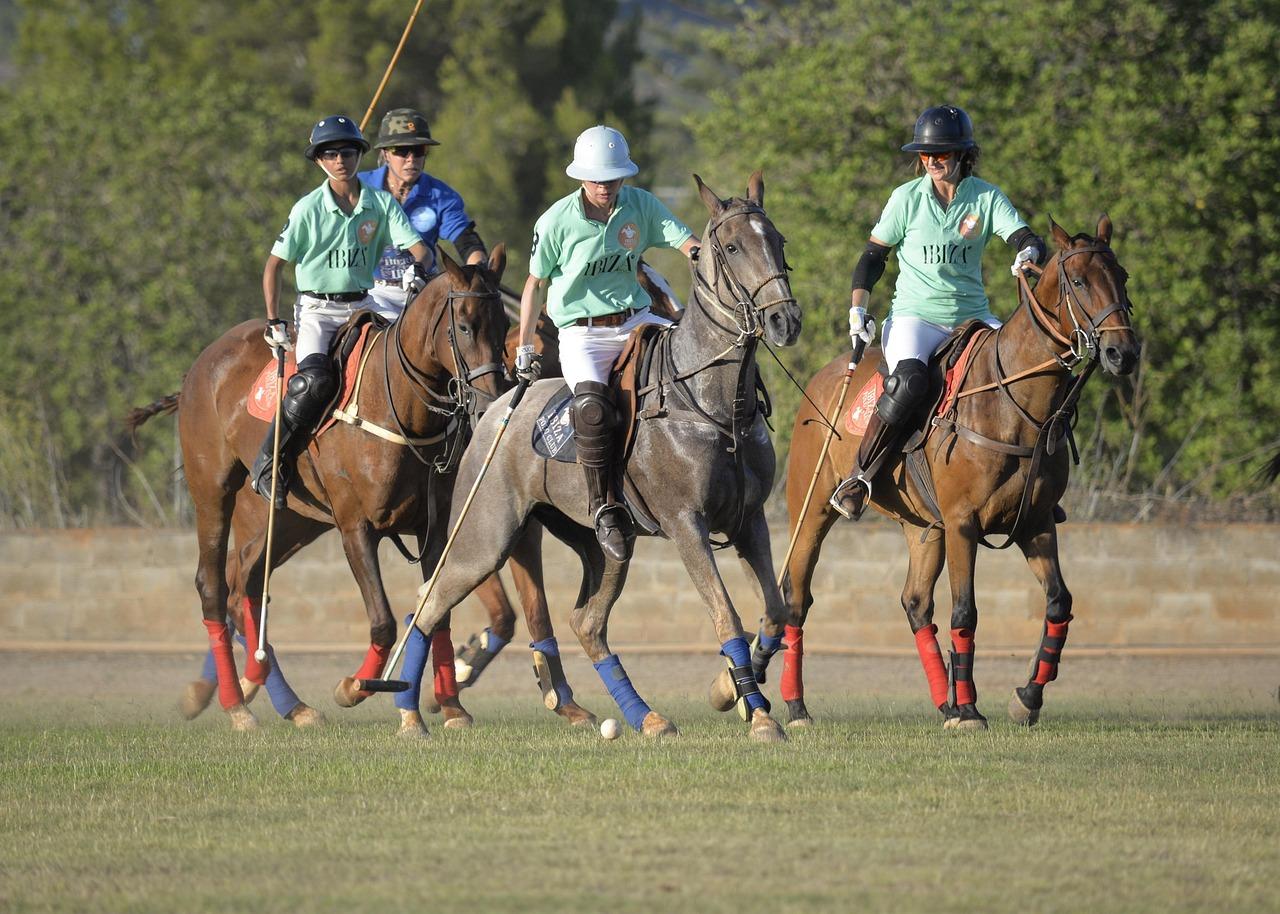
The horses used in polo are called "ponies", because there used to be size restrictions on the mounts players could bring (mounts plural, you need four horses per player as they change them at the end of each quarter, or "chukka"). Those restrictions don't exist anymore, but the naming convention has stuck. [Image by Iatya Prunkova from Pixabay]
We should also mention that early automobiles bore little resemblance to the cars we see on the road today. They weren't simply our cars, but made using old-timey materials and techniques – they often used completely unfamiliar control schemes and layouts. In one model you might steer with a tiller, like on a boat, and accelerate by pushing a lever; in another the engine might be in a separate, wheeled housing that towed the passenger compartment behind it, like a horse and carriage.
Joshua Crane performed his demonstration using "a big touring machine", but it was immediately recognized that a small "runabout" with high seats and the engine underneath, would be better suited to the task.
The beginnings of the sport
The first auto polo match took place at the Ardsley Polo Club in Tarrytown, New York, only a few days after Joshua Crane's demonstration. It's not clear if Crane was involved in this game, but he was certainly the inspiration for it.
A witness wrote: "The mechanical steeds behaved well, responding nimbly to the lightest touch on the handle bars, starting and stopping with amazing and sometimes embarrassing suddenness", adding "there were no bad accidents, though there were plenty of collisions".
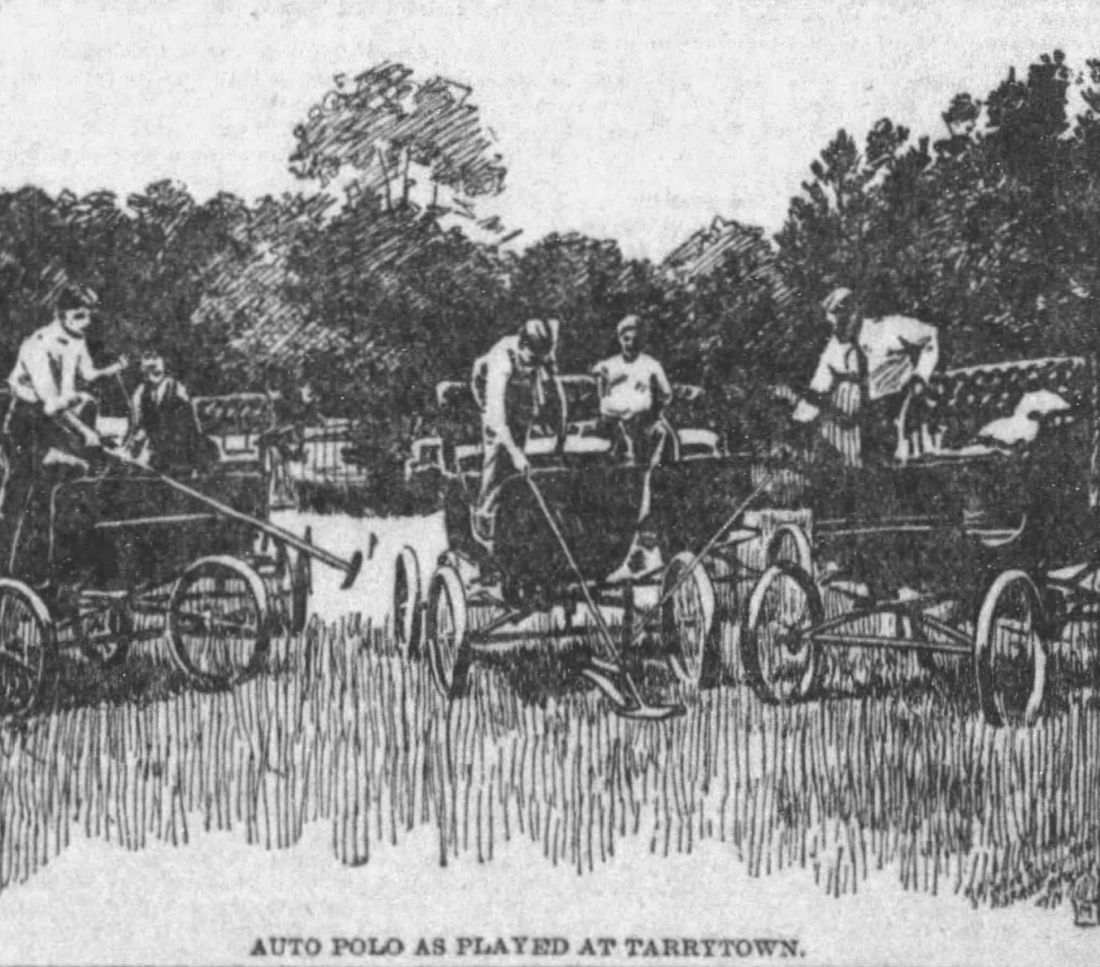
A illustration of the first auto polo match. Note the tiller-style steering controls on the cars. [Public Domain/Kansas City Star]
From the outset it seems that other players had come up against a problem, which is that they were not Joshua Crane. The inventor of auto polo seems to have been one of history's natural athletes, an all-rounder with both the talent and the determination to excel at whatever he set his mind to.
He was a three-time national tennis champion, one of the best polo players in the country, an expert yatchsman, a golfer who competed at the US open and – for a season – head coach of the Harvard Crimson football team. He was, in short, the sort of person who makes really difficult things look deceptively easy.
"Concussed Millionaires"
Unsurprisingly, auto polo did not seem destined for the big time. The more adventurous members of various polo clubs in New England seem to have given it a go over the summer of 1902, but the skill level required to just manage basic gameplay (the equivalent of being able to reliably hit a tennis ball over the net) was impossibly high for many players.
Furthermore, the cost of mistakes was exorbitant – even for people rich enough to be members of a Gilded Age polo club. Early 20th century automobiles were hand-made machines that cost the equivalent of hundreds of thousands of dollars in today's money. They were delicate and getting them repaired could take a long time.
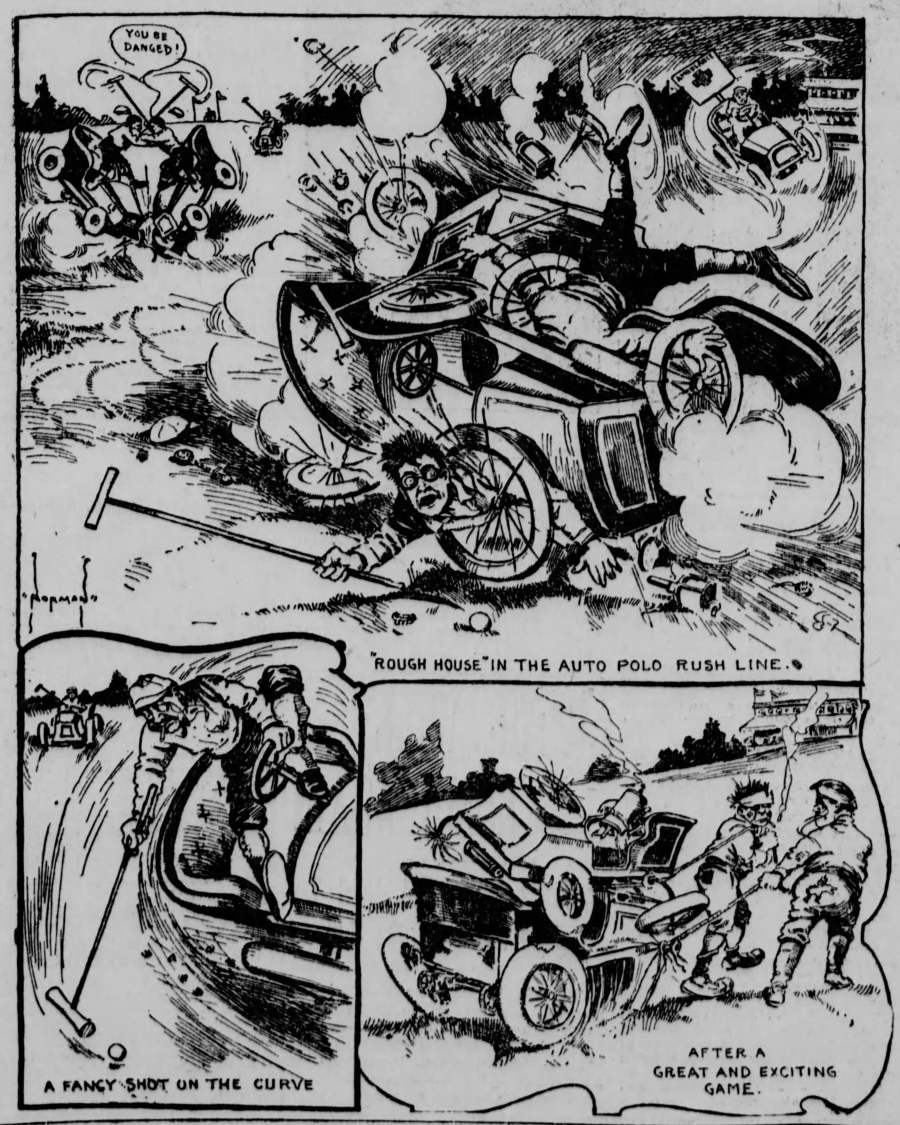
A newspaper cartoon from 1902, showing how auto polo was viewed in the public imagination. [Public Domain/Boston Post]
The reaction to the sport from the general public was also scathing. Automobiles were already widely disliked as dangerous toys for the ultra-rich, and were all-to-often deadly when driven through residential neighbourhoods where no-one – especially children – had any frame of reference for something that could move that fast. A writer in the Boston Post articulated the general attitude as follows:
At least the public will hail it with a long-distanced joy, for now will appear the much wished for opportunity to condense the growing tendency of stagnant millionaires in [...] the manly art of dissection of the common people [...] by limiting them to a field exclusively to be occupied by themselves, over the fence of which the lower five may take a peep if curiosity should get the better of discretion.
In such an enclosure the festive moneybags may cavort and carom their death-dealing weapons to their hearts content. [...] So long as it lures the desperate Vanderbilt roadster and the other four hundred iron demons off the highways, the public hasn't a kick in complaining.
-Boston Post, 13 July 1902
It was predicted that the sport would die out "after the hospitals become congested with concussed millionaires", and that seems to be more or less what happened. Enthusiasm seems to have dropped off quickly, and the fad had faded by the end of 1902.
The revival
This was not the end of auto polo, however. The sport was revived in the early 1910s by car salesman and motor-racing promoter Ralph Hankinson in Kansas City, Missouri. The introduction of the Ford Model T in 1908 had significantly lowered the barriers to entry to all motor-sport, and these newer cars were capable of higher speeds and quicker turns than the upholstered, carriage-like vehicles of 1902.
Hankinson's key innovation was a significant tweak to the rules. In his version of Auto Polo each vehicle was crewed by a driver and a "malletman", splitting the tasks of operating the vehicle and striking the ball. Hankinson also specified that the cars be stripped down to just their sub-frame, with only a driver's seat, some footplates for the malletman and a simple roll-bar (as a concession to the idea of safety).
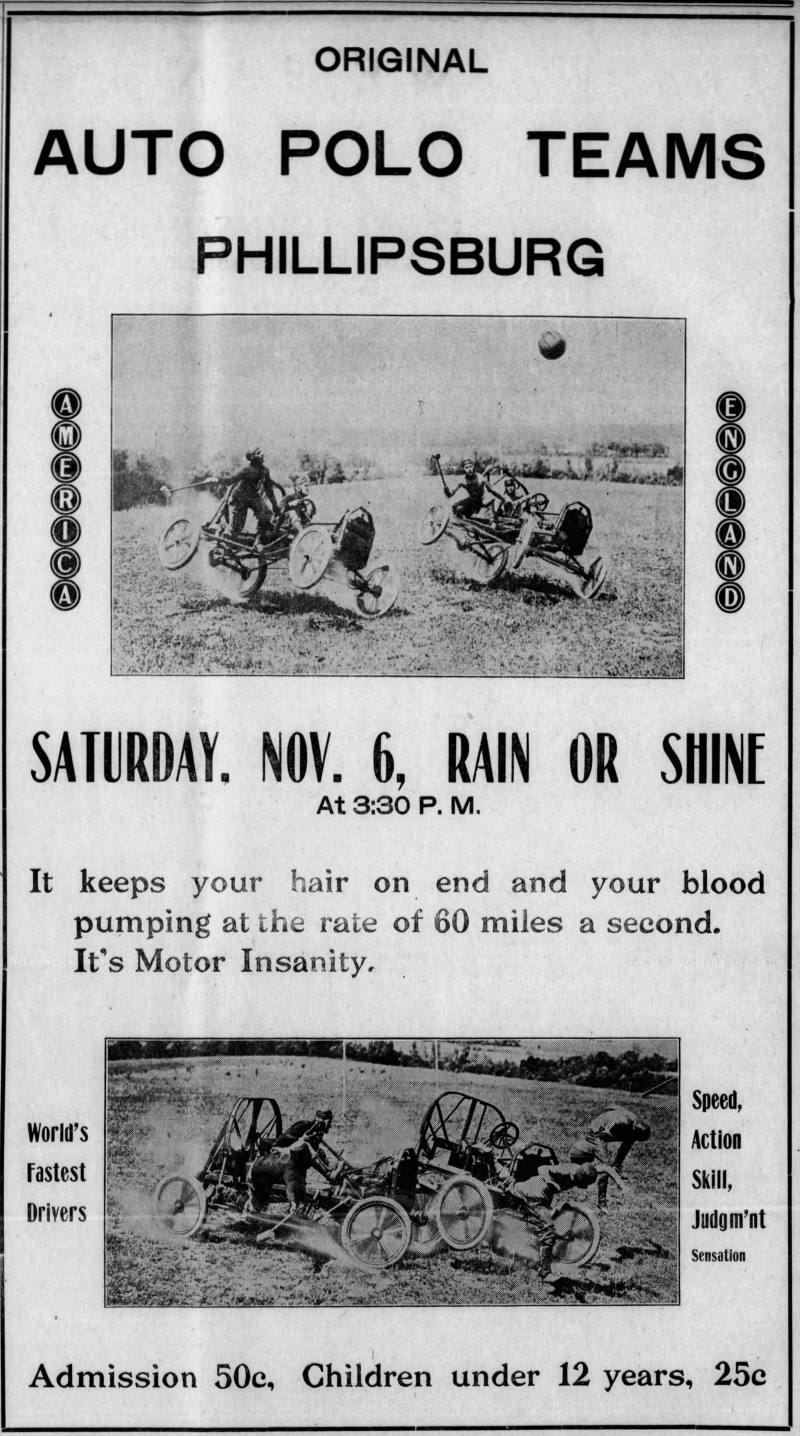
The poster for the 1915 international fixture between the English and American auto polo teams. I've not found any mention of auto polo in the British press, so I have my doubts about how English the English team actually were. [Public Domain/Phillipsburg News]
The game appears to have been played primarily in the form of exhibition matches, usually put on as entertainment at major events such as state fairs. There were a few games billed as serious competitive fixtures (including the first international match, which pitted teams of American and British players against each other in 1915), but it remained primarily a novelty.
The popularity of auto polo seems to have begun to wane for a second time during the Great Depression, along with other similarly destructive entertainments (such as deliberate train-wrecking). Given that cars have only gotten bigger and more enclosed since then, it doesn't seem likely that auto polo will ever make a comeback.
But who knows, perhaps the rise of the self-driving car will allow for a new generation of "concussed millionaires" to take the field, wielding mallets from the beds of their Cybertrucks.
For more record-breaking sports stories click here.
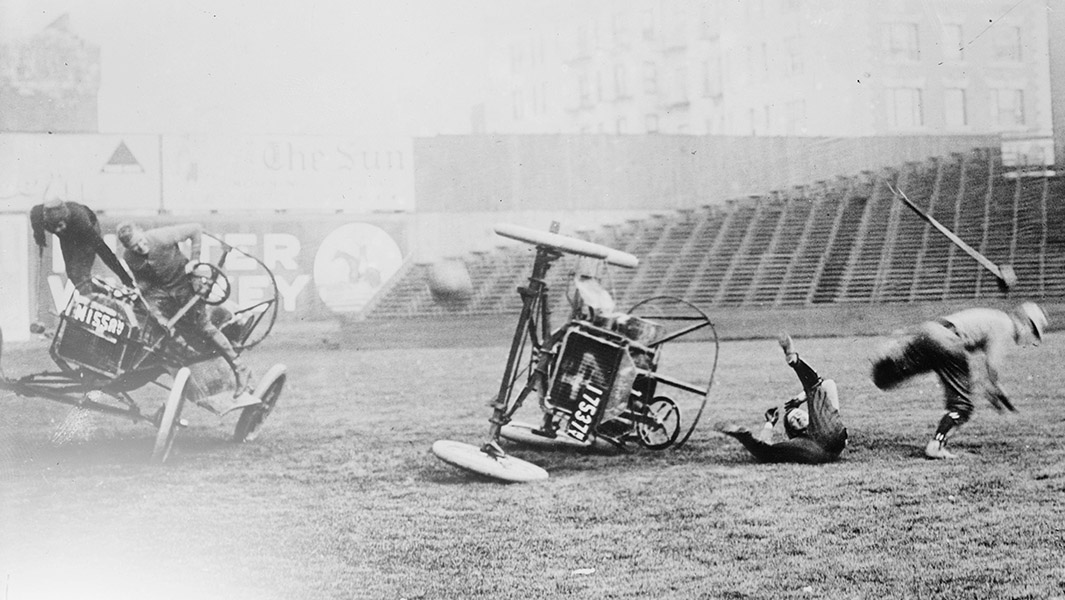
Header image: A crash at an auto polo game in the early 1910s. Given the general lack of motion blur and the empty stands, it's likely this was a staged shot playing up the chaos of the games for publicity. [Penta Springs Limited / Alamy]