

Extraordinary emeralds: 5 records about the world’s most famous green gem
You’ll quickly notice that Guinness World Records 2027, launching worldwide on 10 September, has a distinct colour theme going on…

This year, the book’s cover is jam-packed with record holders of a green persuasion, ranging from animals and plants to mythical beings. (Put your memory to the test with our fun green record pairs game here.) But not all of the green heroes in the latest book are living entities.
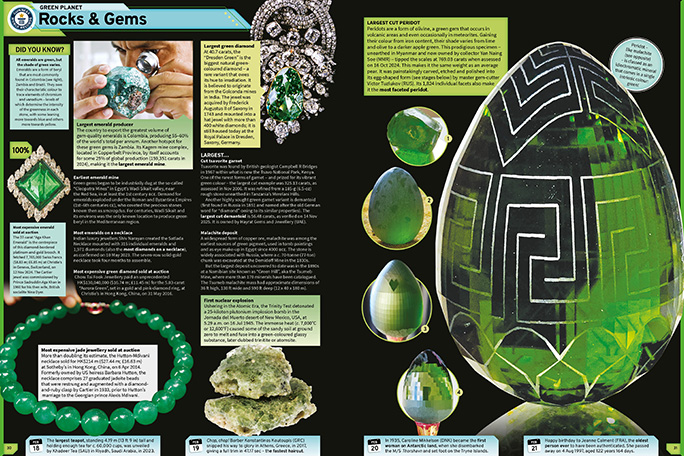
Indeed, one of the bespoke features explores green-coloured rocks and gemstones – of which there are more than you might think – that have in some way surpassed their counterparts. Inspired by that, here we turn the spotlight on to arguably the best-known green gem of them all: the emerald.
First of all, a bit of the science behind these stunning stones. Emeralds are part of the beryl family with the chemical formula Be₃Al₂Si₆O₁₈. Other jewels in this group, making them emerald siblings, include the vibrant-blue aquamarine and rose-pink morganite.
Emeralds’ green colouration is the result of trace amounts of elements such as iron, chromium and vanadium, which slightly alter the makeup of the beryl as it forms over millions (and sometimes even billions) of years.
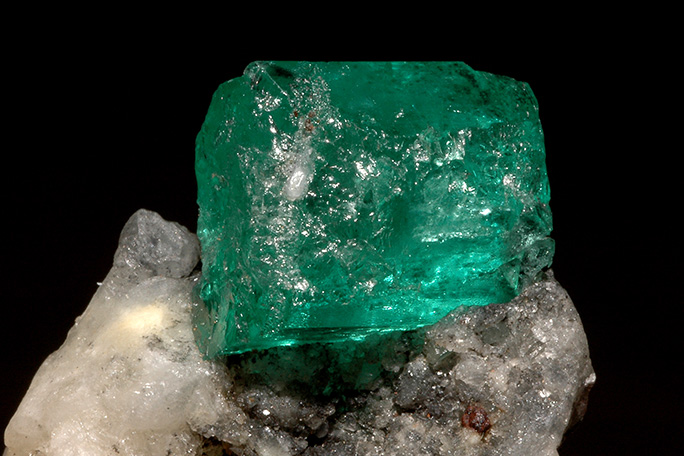
Credit: Géry Parent
While all emeralds are certainly green, the shade of green varies dramatically. Some are pale, while others are almost opaque; some occupy the yellow-green end of the spectrum and others the darker blue-green zone. The most sought-after examples are pure vivid green, leaning more towards blue than yellow.
Scoring 7.5–8 on the Mohs scale, emeralds are considered “moderately hard” when it comes to resistance to scratching (note that diamonds are the hardest mineral, with a Mohs score of 10 out of 10).
However, internal “jardins” (i.e., fractures and inclusions) means that emeralds are notoriously brittle under pressure or when knocked so must be treated with care, both when being carved and worn.
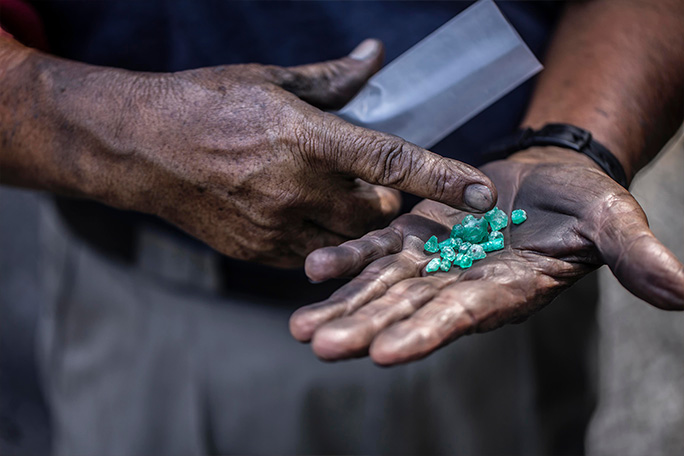
The majority of gem-quality emeralds are mined in Colombia. Credit: Jeff Cremer/Shutterstock
There are three primary countries where emeralds are currently mined: Colombia, Zambia and Brazil, though large specimens have also been found in other locations such as Madagascar (more on that later). The former constitutes up to 55% of annual high-quality emerald exports, making it the largest exporter of the stone, though that hasn’t historically been the case (see earliest emerald mine below).
In homage to the emerald (the birthstone for May), here are six records in brief from the GWR archives that these green wonders have claimed:
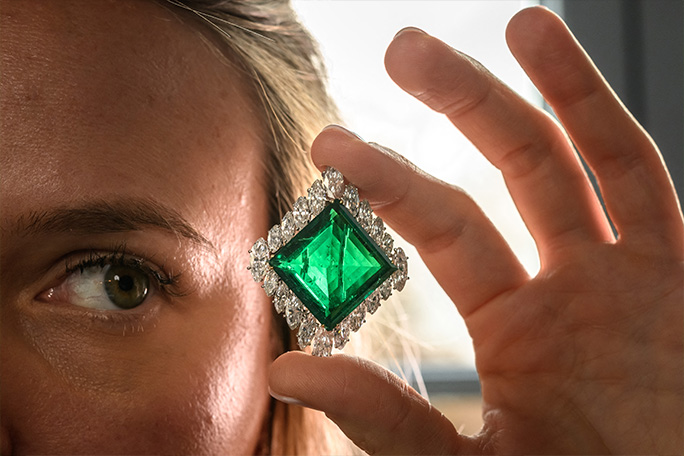
The Aga Khan Emerald and diamond brooch sold for more than $8.8 m (£6.8 m) in 2024. Credit: Fabrice Coffrini/AFP via Getty Images
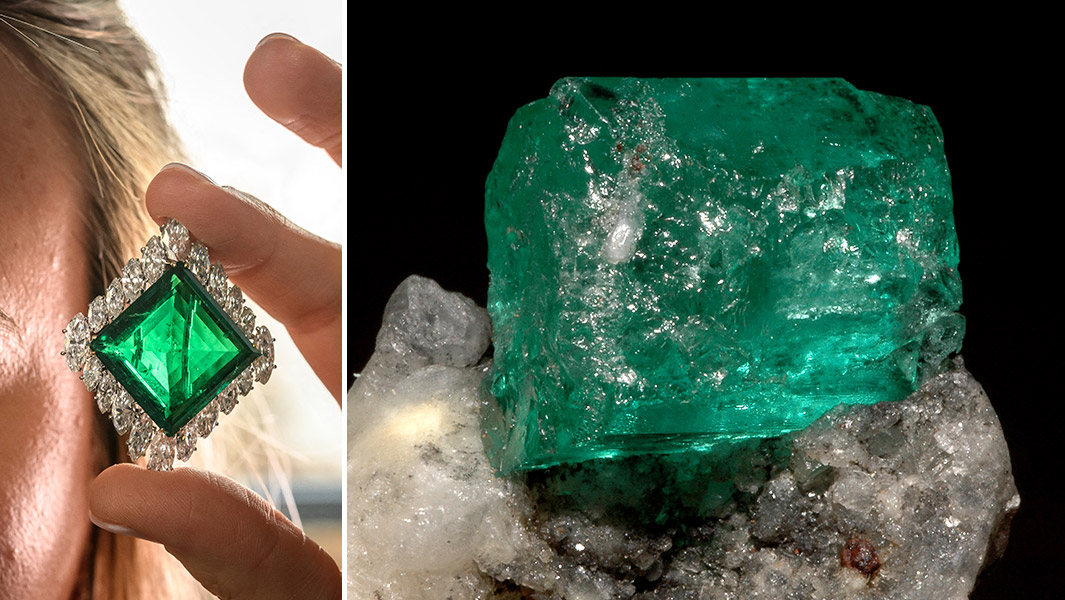
Most expensive emerald sold at auction
The highest price realized for a single emerald is 7,765,000 Swiss francs ($8.83 m; £6.85 m) – including buyer’s premium – for the 37-carat Aga Khan Emerald. It is the centrepiece of a diamond-bordered platinum and gold brooch which sold to an anonymous telephone bidder at Christie’s in Geneva, Switzerland, on 12 November 2024. The Cartier brooch was commissioned by Prince Sadruddin Aga Khan in 1960 for his then wife, British socialite Nina Dyer.
It’s not the first time that this emerald has set sales records. It previously sold at this same auction house in 1969 to raise money for animal welfare causes; at that sale, it was purchased by French jewellers Van Cleef & Arpels for 900,000 Swiss francs ($205,486).
Earliest emerald mine
The first-known emerald mine dates to the late 1st century BCE at Wadi Sikait, a mountain valley in eastern Egypt near the Red Sea coast. Though its origins lie in the final years of the Ptolemaic Dynasty (hence why the site is often informally referred to as “Cleopatra’s Mines”), the mining of green beryl here particularly skyrocketed in the 1st to 6th centuries CE under the Roman and Byzantine Empires, who referred to the precious stone as smaragdus. Research outlining Wadi Sikait’s long mining history was published in the journal Geoscience Canada in 2004.
A number of other mining sites occur in Egypt’s Eastern Desert area, including at Gebel Zabara, Wadi Nugrus and Wadi Gimal. In ancient times, the region was known as Mons Smaragdus (“Emerald Mountains”).
The earliest recorded mention of smaragdus mining in Egypt is in the encyclopaedic work Geographica, dating to c. 24 BCE, written by the Greek historian Strabo.
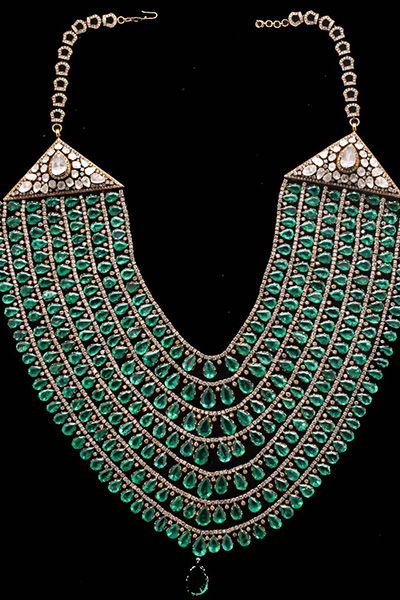
The Satlada Necklace features a record-breaking 315 emeralds (along with 1,971 diamonds)
Most emeralds on a necklace
The Satlada Necklace, created by Shiv Narayan Jewellers of Hyderabad, India, is bejewelled with 315 emeralds, as verified on 10 May 2023. The 41-cm-long (1-ft 4-in), 18-karat gold necklace weighs in at 566.890 g (1 lb 3.9 oz). If all those emeralds weren’t enough, it also features 1,971 diamonds (the most diamonds on a necklace).
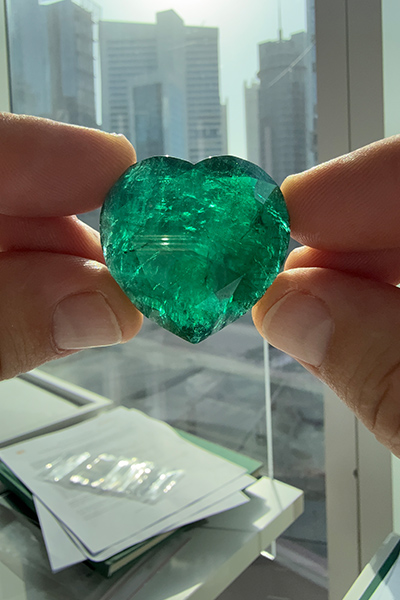
Largest heart-shaped emerald
With great skill, professional gemstone cutter Filip Mlynarcik (Slovakia), who holds records for refining many beautiful jewels, gave an emerald a romantic twist by shaping it into the form of a heart. The finished piece weighed in at 126.33 carats as confirmed in Dubai, UAE, on 4 September 2026.
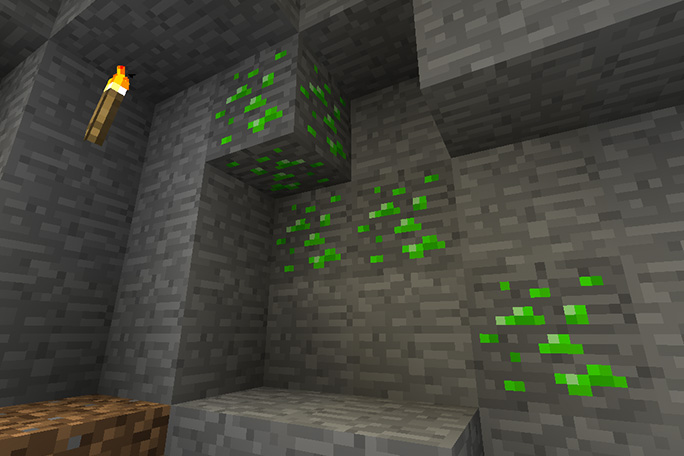
Rarest ore block (Minecraft)
It’s not only in real life that emeralds come with a high cachet – it’s even spread into the virtual universe of Minecraft. In a typical 16 x 256 x 16 “chunk” of terrain generated in the game (equating to 65,536 blocks), only 0.2 will be Emerald ore – and that will only be found in hilly or mountainous areas.
Deepslate Emerald Ore is even rarer still. Another contender for this title is Deepslate Coal, which only exists in a very narrow layer between Y levels 0 to -8.
Header/thumbnail credits: Fabrice Coffrini/AFP via Getty Images; Géry Parent