
Wrecking trains for fun and profit: the story of Head-On Joe Connolly
As an editor at Guinness World Records, I go down a lot of research rabbit holes. It's one of the hazards of the job – you load up the Newspaper Archive to check someone's date of birth, and then suddenly it's 9 p.m. and you're now obsessed with the story of armed gang of former chorus girls in Gilded-Age New York.
One day, I'll get round to telling the story of the Red Auto Gang. [Public Domain/The Buffalo Times]
Sometimes I get lucky though, and these records-research tangents turn out to be records in their own right. This is the story of one of those happy accidents, which will be featured in Guinness World Records 2027.
The Tallest Man on the Midway
A few years ago I was searching through old newspapers trying to find information about Albert Kramer (tallest man from 1921–33 – read about him here). More specifically, I was looking into his time with Clarence Wortham's Travelling Show – an organization that operated the "Midway" (circus-like entertainment section) at various state fairs and public events around the USA in the 1910s and 1920s.
These enquiries led me to an advert for the 1920 Minnesota State Fair. I think it's worth pausing to take a look at this masterpiece, though sadly the archival scan hasn't reproduced the main artwork very well.
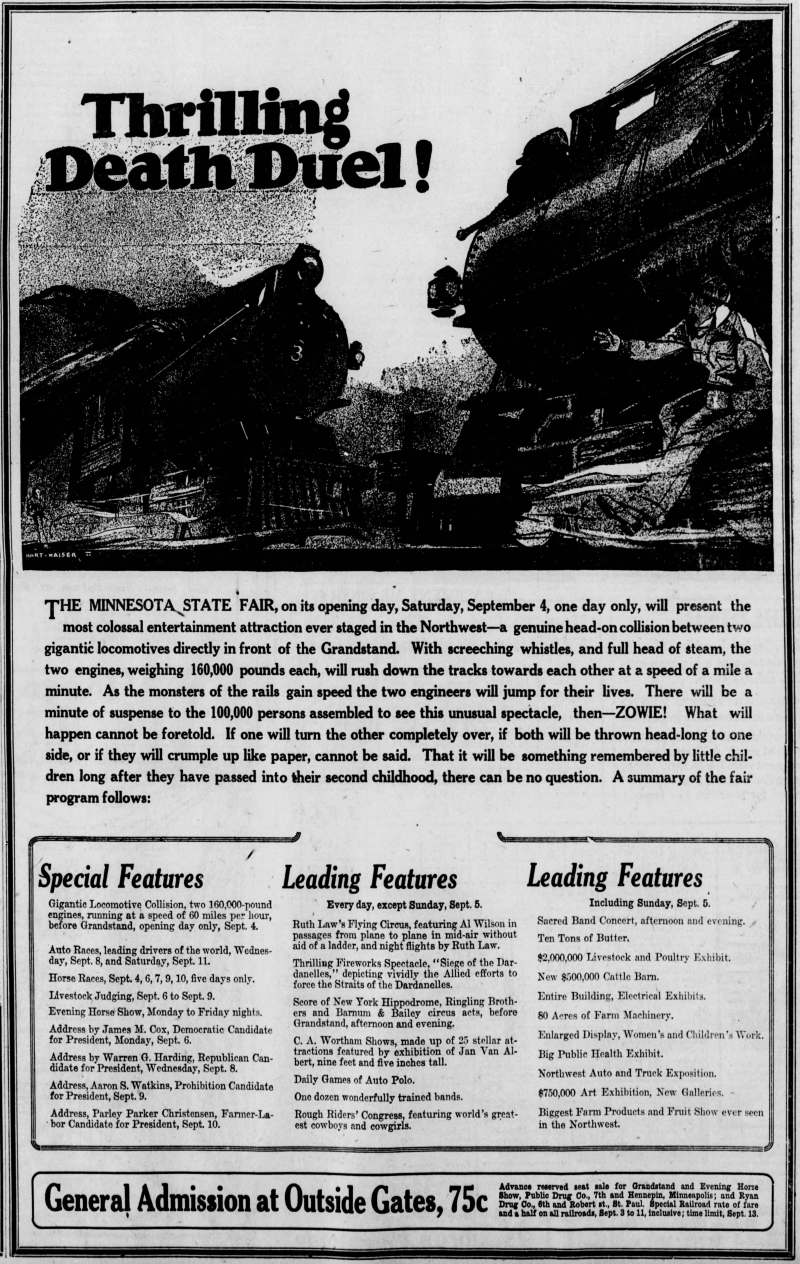
ZOWIE indeed [Public Domain/Minnesota Star Tribune]
Now in theory, the bit I'm supposed to be looking at is down in the small print, middle column: "exhibition of Jan van Albert, nine feet five inches tall" (he was actually 7 ft 9.5 in, but such is life in the circus). However, I think you'll agree that it is quite hard to not get distracted by, well, everything else.
They've got auto races every day, appearances by Ruth Law's Flying Circus, there are daily games of Auto Polo (another story for another time), and they even have "Ten Tons of Butter"! (It doesn't say what was to be done with all that butter, just that there was ten tons of the stuff). But above all that is the "THRILLING DEATH DUEL" of a "GIGANTIC LOCOMOTIVE COLLISION"!
Now, I had records to write up and pages to edit, but you can't walk away from something like that.
The Train Wreckers
As it turns out, the spectacle of two trains being smashed into each other was not unique to the 1920 Minnesota State Fair. It was in fact a pretty standard opening-night act for events like this. Between the 1890s and the 1930s, train-wrecking was a legitimate profession and hundreds of locomotives (and more than a few bystanders) were sacrificed in the name of entertainment.
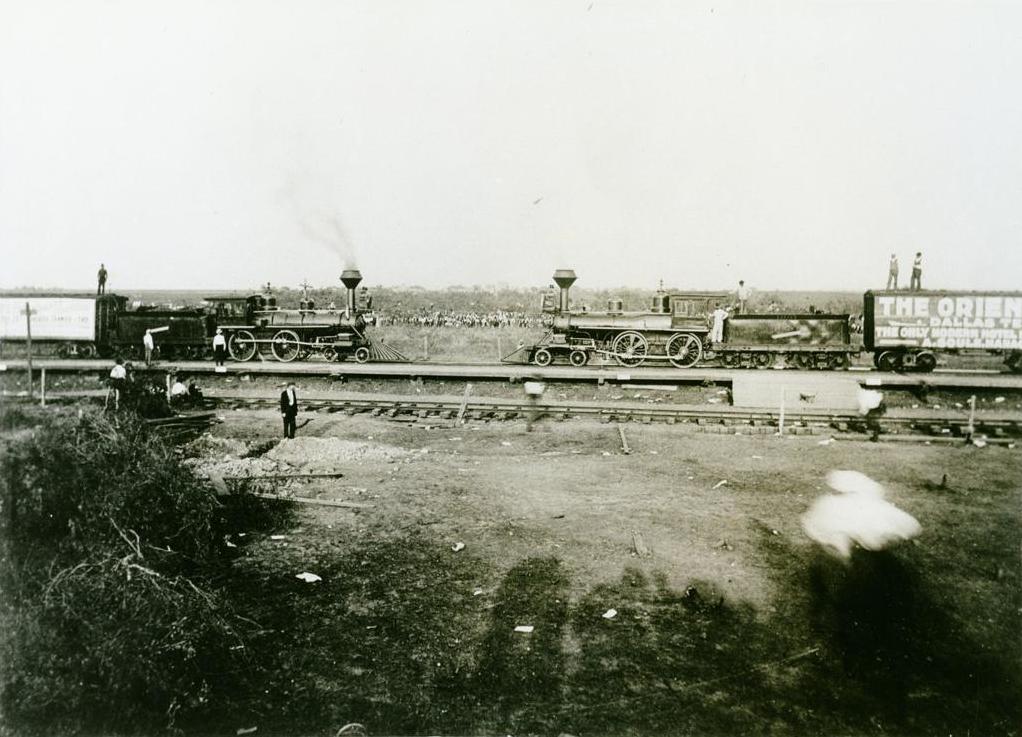
This pre-show picture was taken at the infamous CRASH AT CRUSH (a name like that needs all caps), a publicity-stunt train wrecking that happened on 15 September 1896 in Texas, USA. [Public Domain/Wikimedia Commons]
The biggest name in this peculiar industry, and the man who still holds the record for most trains wrecked, was a promoter by the name of Joseph Connolly, better known as "Head-On Joe". He was most likely the organizer of the Minnesota State Fair's collision, and was responsible for 73 such events (and 146 destroyed locos) over the course of a career that spanned from the 1890s to the 1930s.
Meet Head-On Joe
Details about the life of Joe Connolly are hard to come by (pictures are non-existent), and like to many of the great entertainers, he was an unreliable narrator on the few known occasions he spoke to the press about himself. According to surviving records – collected by historian James J. Reisdorff in his book, The Man Who Wrecked 146 Locomotives – it seems that Connolly was a native of Iowa, USA, and started his career as theatrical manager and/or carnival barker. He was seemingly inspired to try his hand at train wrecking after witnessing a deliberate wreck in Columbus, Ohio, on 30 May 1896.
In a 1933 interview with the magazine Railroad Stories, Head-On Joe said, "somewhere in the makeup of every normal person there lurks the suppressed desire to smash things up. So I was convinced that thousands of others would be just as curious as I was to see what actually would take place when two speeding locomotives come together."
How the wrecking business worked
Joe Connolly's first deliberate train wrecking took place in Des Moines, Iowa, on 9 September 1896. It established the basic procedure he would use for all his future events, which was more safety conscious (given late-19th-century standards of what constituted "safety") than those of his rivals.
A length of track was laid down adjacent to the grounds of the Iowa State Fair and two locomotives were acquired from the local railroad company. The crowds were charged 50 cents to enter the viewing area, but were kept in a fenced off area a "safe" distance from the tracks. Railroad engineers backed their locomotives up to the farthest extent of the track, built up the steam pressure and then set them in motion, jumping clear as they picked up speed.
The speed of the collisions fell between 30 and 60 mph (48–96 km/h), depending on the locomotives Connolly was about to source, and the length of the track he was permitted to build.
It sounds crazy, right? If nothing else, it's hard to imagine how the economics of these events could possibly have worked – locomotives were (and are) incredibly expensive and complex pieces of industrial machinery. A modern standard-gauge locomotive costs somewhere in the region of $4–6 million and takes several months to build, and you'd need two of them! Also, would that many people really be willing to pay what was then the best part of a day's wages to watch a train crash?
The answer to this question was apparently an emphatic yes.
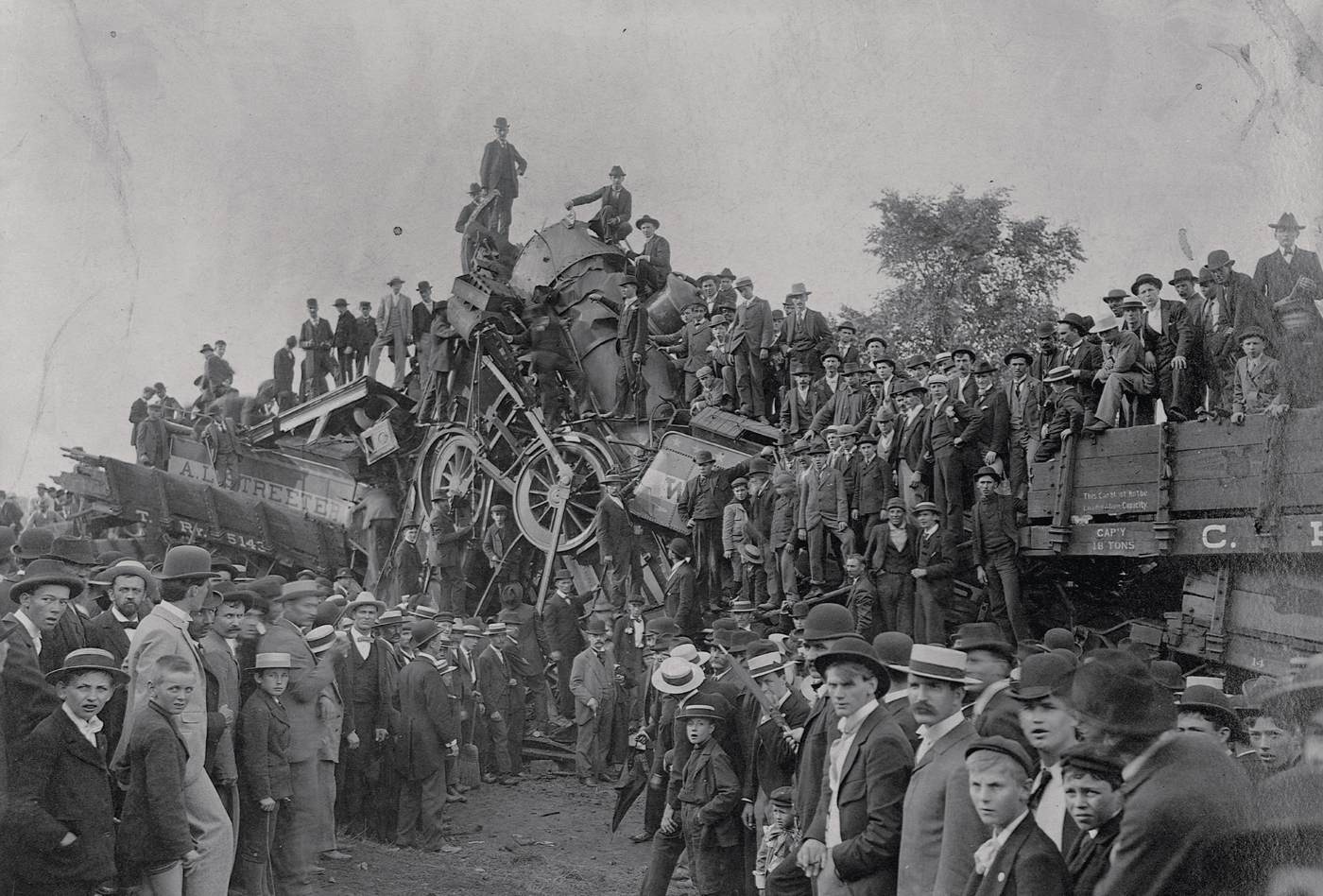
Souvenir hunters scramble over the aftermath of a train wreck in Lancaster, Ohio, in 1896. Definitely looks perfectly safe, right? Also, there is only one person in the picture who has made the scandalous decision to go hatless to a trainwreck. [H.F. Pierson/Library of Congress/Corbis/VCG/Getty Images]
Also, as it turns out, locomotives and rolling stock weren't that expensive. Technology advanced rapidly in the early 20th century, so equipment became obsolete quickly and could be bought for more-or-less scrap value. You had the upfront cost of laying the track, but this impermanent permanent way didn't need to be made to a particularly high standard (if the track failed, then it just meant that one of the trains would wreck slightly earlier than planned).
As for the dangers? Well, people back then were accustomed to a much higher level of just generalized, ambient peril than we are today. As an minor illustration of this point, while researching this story, I consistently struggled to pick out newspaper stories of Joe Connolly's train wrecks from just regular (often fatal) train wrecks involving trains in public service. Even if I limited my search to stories published within a few days of one of Head-On Joe's events, there would often still be at least one headline about a grisly railroad accident or level-crossing smash-up mixed in.
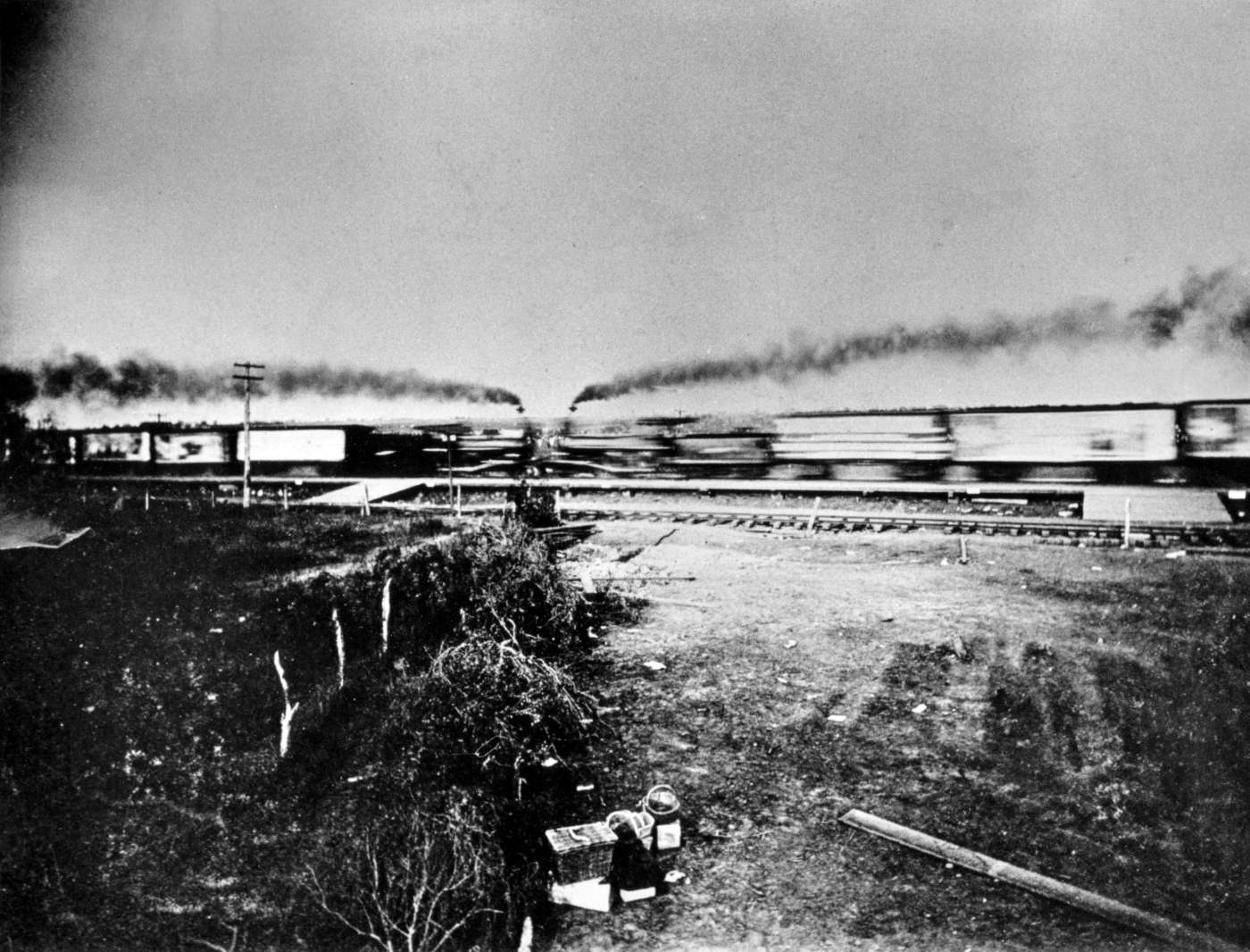
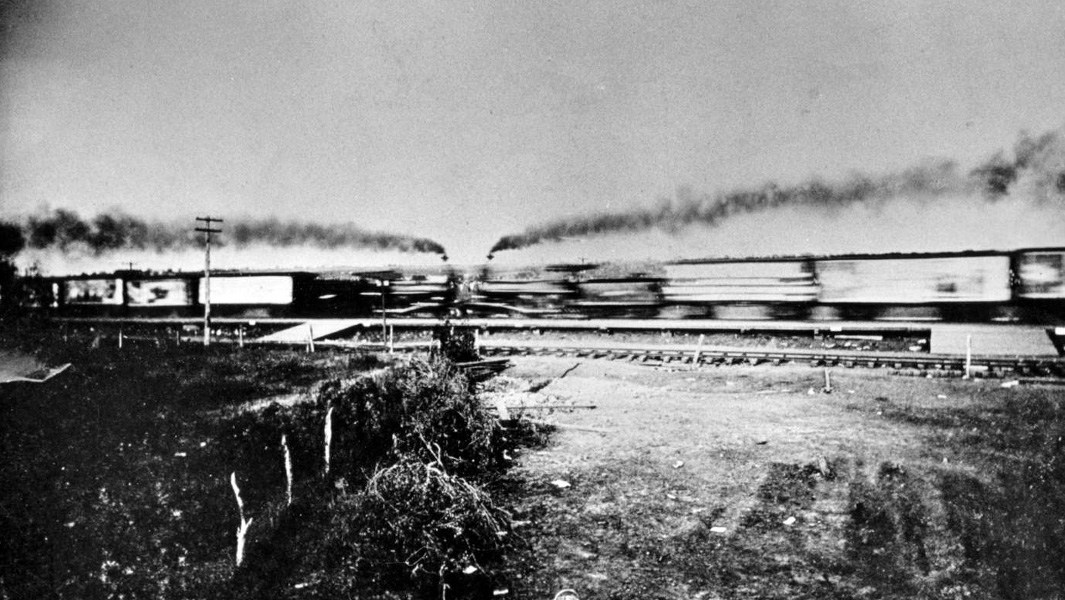
The iconic image of the Crash at Crush, moments before the trains collided. Also, moments before the photographer, Joe Deane, lost an eye to a flying piece of shrapnel. [Public Domain/Wikimedia Commons]
Counting the takings
The Iowa train-wrecking drew around 20,000 paying customers, and boosted attendance to the state fair considerably (between 50,000 and 70,000 attended the fair that day). It cost a reported $8,500 to stage the wreck (around $336,000, adjusted for inflation to 2025), but netted more than $10,000 (c.$396,000) in direct gate receipts, plus greatly boosted food & drink sales. Connolly was paid $3,558 (c.$141,000) for his work.
Over the next 36 years, Connolly would repeat this basic format all over the United States. He would often spice things up by writing the names of opposing political or social positions on the two locomotives (Wilson vs Taft; Gold Standard vs Silver Standard, Evolution vs Creation, etc.), with supporters cheering their chosen train towards its destruction.
This last detail is fascinating to me, and feels like a metaphor for something, though I'm not sure what. Neither train could win, after all. People might cheer for one train or another, but the clash of opposing trains (and the ideas they were associated with) never resulted in anything more decisive or constructive than an explosion and a pile of twisted metal.
The Final Wreck
Tired from years of cross-country travel, Connolly decided to put on one last wreck in Des Moines, Iowa – returning to his hometown and where his career had started. Here, on 27 August 1932, he brought all the stagecraft he'd learned from his years of wrecking to bear.
The two locomotives were accompanied by a single old wooden passenger car, one labelled "Hoover" and the other "Roosevelt" (it was an election year), each packed with fireworks, small bombs and other incendiary devices.
The crowd cheered as the two locomotives screamed towards each other, their whistles jammed open. Small explosive charges spaced out along the track went off at shorter and shorter intervals, acting like a sort of drum-roll as the trains picked up speed.
Remarkably, archival (though sadly silent) footage of Head-On Joe's last train wreck exists online.
The trains met, as so many had before, in a cloud of flying debris and screeching metal. As the dust settled, Joe calmly said "Well, that's that" and walked away.
The age of the professional train wrecker ended shortly after. With the great depression ravaging America, state fairs could not draw the crowds they once did, and the spectacle of such wanton destruction rubbed people the wrong way. The last deliberate wreck, held on 30 June 1935, was a disappointing failure and what little press attention it garnered was negative. As a result, it seems unlikely that Joe Connolly's record will ever be broken.