


Why the record for longest log jam will probably never be broken and how it even happened
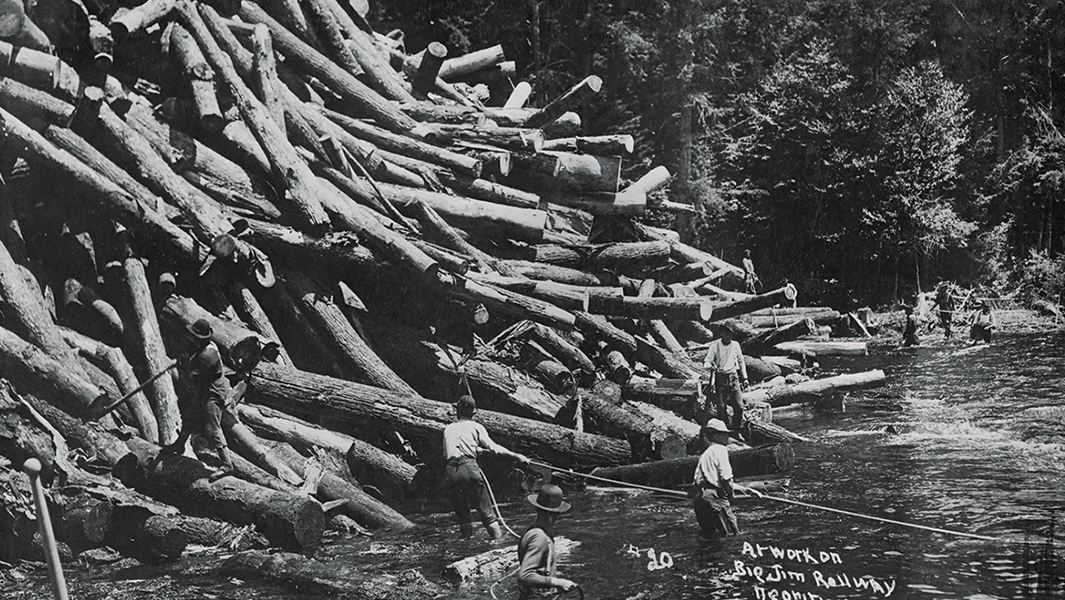
I have a fascination with long-standing Guinness World Records titles – the sorts of categories where you genuinely can't imagine a set of circumstances that might lead to the record getting broken.
These aren't common on our database. One of the things that I learned, early on in my time at GWR, is that the march of human progress and human competitiveness eventually catches up with almost every superlative, no matter how impossible or unbeatable it might have seemed at the time.
There are a few though, here and there, that I don't think will ever fall. They're typically superlatives that represent the pinnacle of some now-obsolete technology, the height of a particularly weird fad or the peak of an economic frenzy whose circumstances can't be repeated.
One of these records is the largest log jam, a man-made disaster-in-waiting that loomed over the city of Chippewa Falls, Wisconsin, USA, for six weeks in the spring of 1880. It was the largest and most devastating example of a phenomenon that was commonplace in late 19th century America and Canada, but is hard to comprehend today.
Non-metaphorical log jams
When the lumberjacks first arrived in the American Midwest, they encountered a landscape almost entirely covered by forest. In Wisconsin alone, there was an estimated 47,000 square miles (121,000 km²) of old-growth forest – meaning that an area about the size of England sat beneath a canopy of trees.
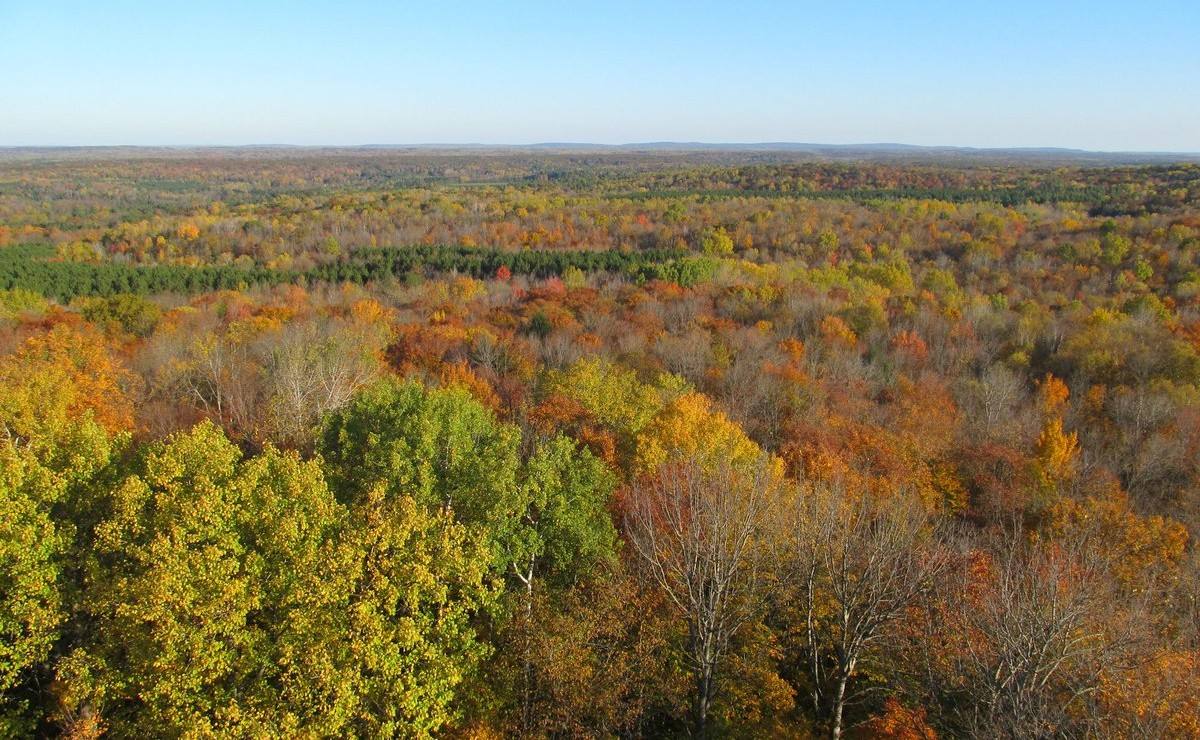
The view from a fire lookout tower in Wisconsin's Chequamegon-Nicolet National Forest. Having recovered significantly over the last century, forest once again covers about 26,000 square miles (68,000 km²) of the state. [Public Domain/US Forest Service]
Logging companies began arriving in this region in the mid 19th century, and quickly developed a workflow built around the region's many large rivers. They would establish temporary camps in the upper reaches of rivers, where trees were felled, stripped of branches and rolled downhill into the river. From there they would be floated to sawmills in towns downstream.
This flow of timber was managed by teams of workmen, known as "river pigs" or "river drivers", who built dams and booms to steer the logs around obstacles and used long hooked poles to free them when they got stuck. Even with these precautions, the variable water levels on the rivers meant that the occasional log-jam was an accepted risk of the lumber business.
(Incidentally, "River Pig" is just one example of a now-lost lexicon of lumberjack speak. These men worked in a world of boom walkers, bull punchers, steam donkeys and flume herders. They had a whole language and culture that has now largely died out.)
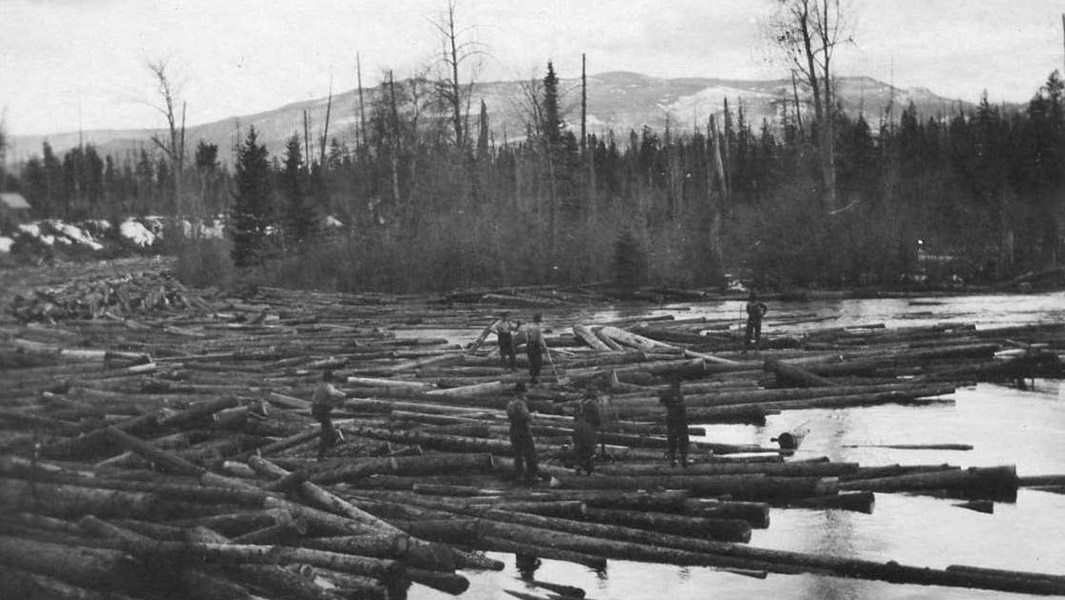
A group of river pigs pick apart a log jam in Montana, USA, in 1915. [Public Domain/US Forest Service]
A log jam could be a tremendous, terrifying sight. For several miles the river would be transformed into a jagged field of telegraph-pole-sized logs, tangled together at crazy angles. The whole thing would groan and creak from the massive pressure of the water backed up behind it, occasionally erupting in an explosive cacophony of cracks that launched shattered shards of wood and even whole logs high into the air.
When log jams occurred, the lumber companies would dispatch working parties of river pigs to try to break up the obstruction. These men would use ropes and cables, pulled by tugboats or static steam engines, to wrench sections of the jam free. If this failed, lumbermen sometimes resorted to blasting away sections of the jam with dynamite.
Occasionally, as was the case in 1880, the crews were unable to free the logs before the river level rose again, transforming the jam into a fast-moving wall of white water and 3-tonne trees.
The jammedest jam
So how big was the 1880 log jam? Well here's a contemporary report, made in late May when the low water levels made the whole thing seem fairly benign –
A very strong pen picture would fail, utterly fail, in conveying an idea of its appearance to the reader. Fancy the entire width of a large stream from bank to bank, seven miles in length, and much of the way from bottom to surface, filled with logs piled one upon another, no water visible, so that one might walk from shore to shore dry-shod, upon the mass of unmovable logs, firmly wedged together, and you have but a faint idea of the situation above Chippewa Falls. It is estimated that over 200,000,000 feet of logs have accumulated in this, the largest log jam ever known on Earth.
- The Saint Paul Globe, Monday 31 May, 1880.
(A quick note on measurements. When the reporter says "feet", they're likely referring to "board feet". Confusingly, a board foot is a measure of volume, not length, equal to a sawn plank one foot long, one foot wide and one inch thick. So when they say "200,000,000 feet of logs", they're referring to a mass of tangled timber that represented a potential 471,947 cubic metres of sawn timber.)
For context, that's a stack of planks the size of a Manhattan city block and half the height of the Empire State building. And that's just the volume of finished timber – the actual logs, including all the bark and wastage that would have been burned, would have occupied far more space.
The log-jam breaks
On 13 June 1880, a week of heavy rain finally brought the end of the massive Chippewa Falls log jam. Here's a contemporary account from a reporter on the scene:
The dams at Yellow River and Point Creek gave way, one after the other, the flood bringing along the enormous masses of logs which had been thought securely fastened. The first rush brought about one hundred and fifty million feet. The jam over the great dam, at this place, covering the full width of the dam and river with a roaring, seething rushing mass of logs and drift.
The logs were in all kinds of positions. So steep is the river, and so great was the flood and so numerous were the logs, that they tumbled end-over-end and plunged and jumped in every direction.
Very soon they crowded against the covered bridge, which was eight hundred and fifty feet long, and pushed the structure off from its piers into the raging flood over the falls beneath, where it was crushed into kindling wood as easily as if made of shingles.
– The Pantagraph, Tuesday 22 June 1880
The tide of debris swept away huge swathes of the city of Chippewa Falls. While all this was going on, the townsfolk were preoccupied by the task of building a temporary dam on the outskirts of the town, as the sheer force of the floodwaters was at risk of redirecting the river into a new channel, leaving Chippewa Falls high and dry.
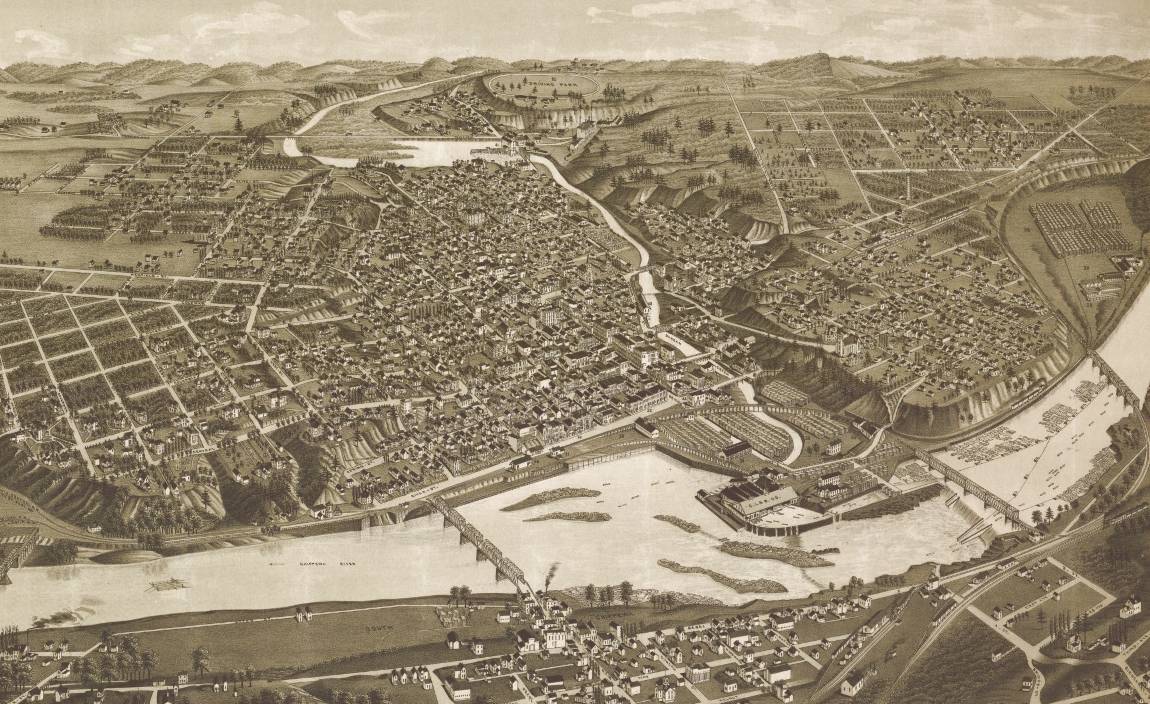
A pictorial map of Chippewa Falls from 1886. The town's lumber mills can be seen in the centre of the map, and the various rafts of logs and booms for directing their flow on the Chippewa River can be seen on the right. [David Rumsey Map Collection, David Rumsey Map Center, Stanford University Libraries]
The end of the log-jam era
Although there were a few more large log jams between the 1880s and the 1920s, none even reached the same size as the great Chippewa Falls jam of 1880. As the old-growth forests dwindled, the scope for such large-scale clear-cutting forestry ended with it.
In places where large scale forestry continued, it became increasingly mechanised, with trucks and trains taking the place of the river pigs and their lumber hooks. Today, people are concerned with managed forestry and the preservation of what old-growth forest with still have, so we can be fairly confident, and glad, that this record will remain unbroken.
Header image: A group of river pigs pull logs from a large log jam in Wisconsin in 1890. [Corbis via Getty Images]