


Sanga Kushim: Why the first person in recorded history was an accountant
Around 5,120 years ago, in the Mesopotamian city of Uruk (near present-day Samawah, Iraq) there lived a clerk. This clerk worked for the Temple of Inanna, a large civic institution, where they managed the stores for the temple's brewery.
This clerk's name was Kushim. In the grand scheme of things, they were perhaps not the most exciting or important person. They did not lead armies, or rule nations, or speak for the gods, but they did write things down. And it's for that reason that Kushim, Sanga of the Temple of Innana, is the earliest named human being – the first person in recorded history whose name we still know today.

Kushim's name and title, as they appear on ancient clay tablets. The little flag that designates them as a "sanga" or senior administrator isn't always present.
To understand how this ancient accountant has endured through history while all their contemporaries have been forgotten, we need to learn a little about the history of writing and the reasons it emerged.
Why write things down?
Before cities and agriculture, the world was relatively simple. People had stuff and sometimes they traded that stuff with other people, exchanging food for furs, or tents for tools. No-one needed to record these transactions because they were straightforward, carried out in person and probably involved people who knew each other.
Once farming came along, however, the world started to get more complicated. Take as an example, the production of beer – which was Kushim's business. Beer is a useful thing for a society to make because the brewing process kills off any bacteria that might be in the water, and the alcohol and acids inhibit the growth of any new ones. If lots of people are living in close proximity – and sharing the same potentially contaminated water supply – beer is very important stuff.
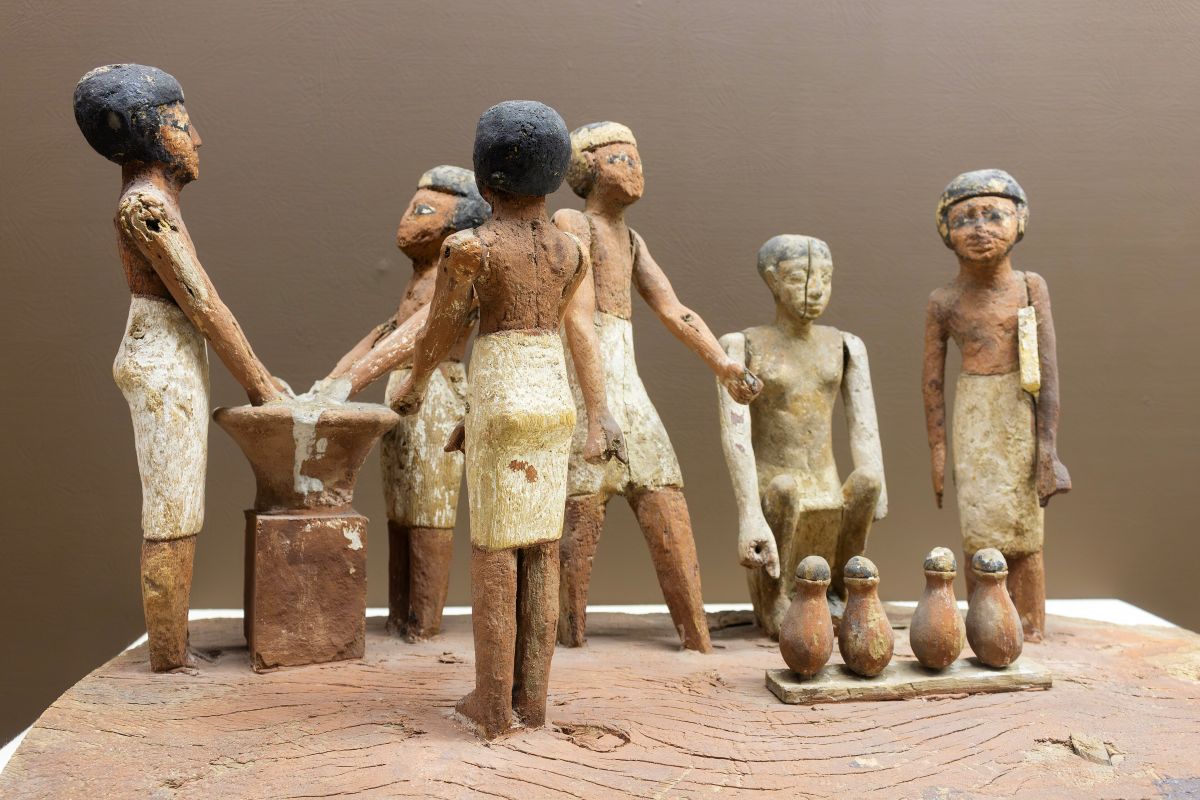
This wooden model, found in an ancient Egyptian tomb, shows various steps in the brewing process. The figures on the far left are mixing the mash in a large pot, while the others are counting the stoppered jars of beer. [CC BY-SA 4.0/Wikimedia Commons/User:The_Wub]
Ancient beer recipes required four main ingredients, however, which had to be brought together in one place in the right quantities. You needed barley, malt (partially germinated grain, typically wheat in ancient recipes), water and yeast. (Some recipes also probably involved sugars such as honey or dates). You also needed specialized equipment and skilled brewers who knew how to put all these things together.
What that means is that a brewer needed to get barley from a farmer who grew barley, and malted wheat from a farmer who grew wheat. If they were making beer on a large scale (which Kushim's temple very much was) then they were going to need to talk to the farmers (lots of different farmers spread over a large area) at the beginning of the growing season, securing agreements to grow a specific amount and deliver it at a specific time.
As you may be thinking, this is a lot of information to hold in your head. It also requires a lot of trust to be placed on your own memories and those of others.
Ancient accounting
It is thought that writing probably began with something like simple tally marks to record counts of objects. It then expanded to include symbols to denote what the count referred to, and then symbols to explain what actions might be associated with those counts. So from "three", to "three sacks of wheat", to "three sacks of wheat delivered".
During the time that Kushim was working, their culture's writing system had advanced beyond tallies but it doesn't seem to be have been what we'd think of as a full written language. It was instead a sort of shorthand used by accountants. As the person who knew how to record things on clay tablets with a stylus, Kushim was a skilled, specialised worker. Like that one person in the office who is really, really good at Excel.
The first historical figure
We know Kushim's name because it appears on a series of clay tablets, 18 in all, which were excavated by archaeologists digging in the ruins of the Mesopotamian city of Uruk. Historians were able to figure out that these tablets represented a record of supplier contracts and inventories related to operations at a brewery.
Although the information isn't recorded using a full-featured written language, it does use elements that would later be incorporated into the Sumerian cuneiform alphabet. Based on the resemblance of the symbols used in Kushim's mark to later cuneiform letters, they've been interpreted as the phonemes "Ku" and "Šim".
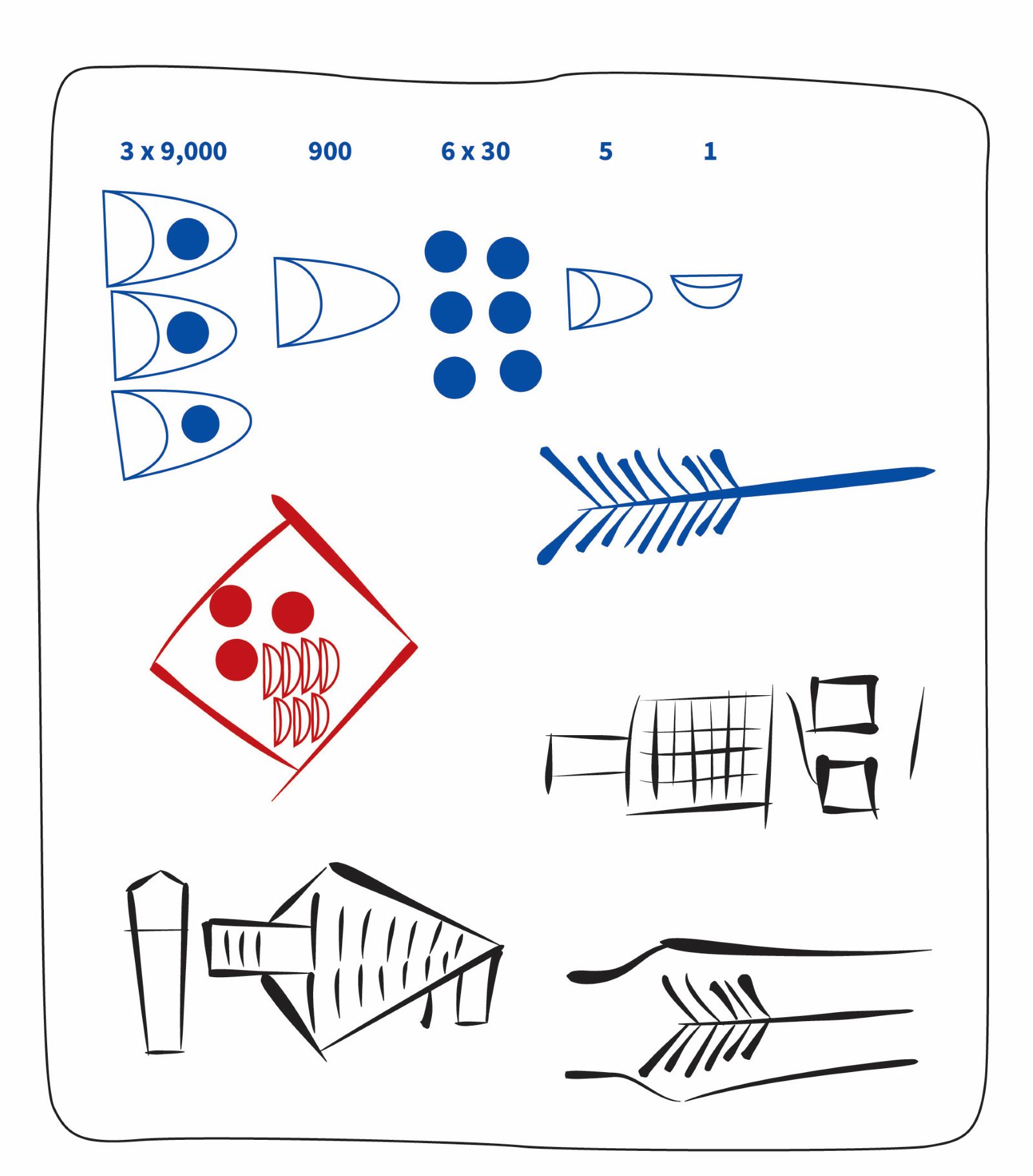
Here's a simplified reproduction of a tablet Kushim signed their name to (known as Uruk III, MS 1717), colour coded to show the different elements. The cluster of symbols at the top are a number (I've added what they represent above them). The grain symbol below means the number is a quantity of barley.
The total adds up to 28,086 units. Each unit represented a measure of about 3 kilograms, meaning that the total quantity Kushim was handling was about 85 tonnes of barley (that's a lot of beer!).
The number in the diamond is a span of time. They used a slightly different numbering system for time and barley, but it adds up to 37 lunar months.
The other two symbols are not known for sure, but it is suspected they might be the symbol for a brewery (it looks a bit like a chimney if you turn it sideways) and the other (barley in a pot?) has been interpreted as "beer".
Taken all together it can be read as "28,086 units barley, to be delivered over 37 months to the brewery of the Temple of Innana for the production of beer. Signed, Kushim".
The places that Kushim's mark appears are consistent with the idea that they were signing-off on, or taking responsibility for, the accuracy of the transactions recorded on each tablet. Incidentally, some of the tablets feature calculated totals recorded on the back, which are accompanied by a symbols that can be read as another name – "Nisa". Some have argued that this may have been Kushim's boss.
All this means that while we don't know who ruled over Uruk, or who spoke for the goddess Inanna, we do have one small window into the world of ancient Mesopotamia. We can see it throuh the eyes of a person who spent their days taking notes, counting stock and, presumably, drinking beer.
It is true that history is written by the victors, but it's also true, perhaps more importantly, that history is written by the people who write things down.
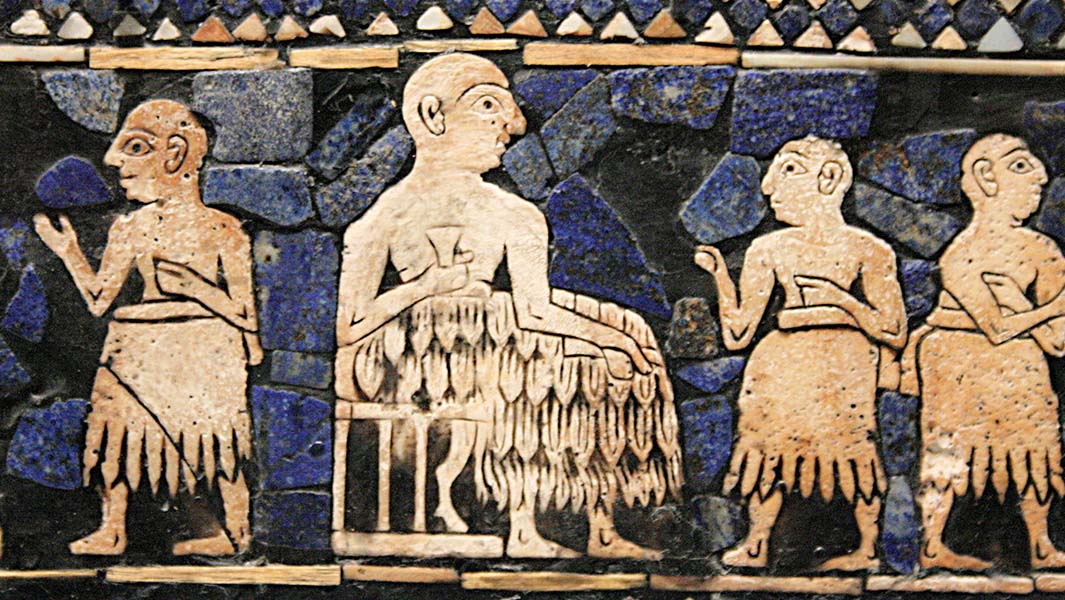
Header image: A carved mosaic showing the King of Ur, possibly Ur-Pabilsag, who ruled over Mesopotamia around 2550 BCE. That's about 500 years after Kushim's time, but depictions of the earlier Uruk culture are thin on the ground. [CC BY-SA 3.0/Wikimedia Commons/User:Pataliputra!]