


Teenage engineer builds world's smallest robot arm - his second record-breaking creation
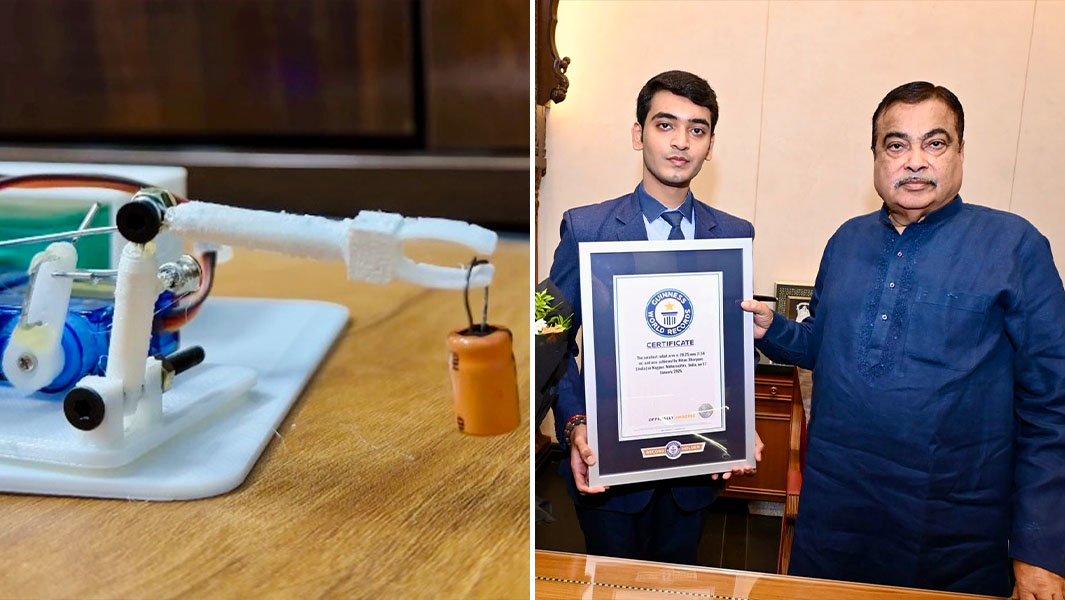
Breaking a Guinness World Records title is no small feat, something that Hiten Dharpure (India) knows all too well.
The 17-year-old student from Nagpur, Maharashtra, claimed his latest title by creating the world’s smallest robot arm on 17 January.
Eager to bring more micro-engineering record titles to India, Hiten told us: “I have a personal goal to challenge myself by setting a new global innovation record every year.”
During Hiten’s research on extreme miniaturisation, he came across the previous record holder, Kelton Serra (USA), who achieved the title on 16 May 2024, with a robot arm measuring 44.49mm (1.75 in). Hiten’s record-breaking attempt was over 5 mm smaller, measuring just slightly bigger than a paperclip at 39.25 mm (1.54 in)!
Hiten knew that one of his main goals of the record attempt was “to prove that ultra-precision micro-manufacturing does not require a big, high-level laboratory. Complex, macro-level mechanics can be shrunken down and built right from a humble home workspace.”
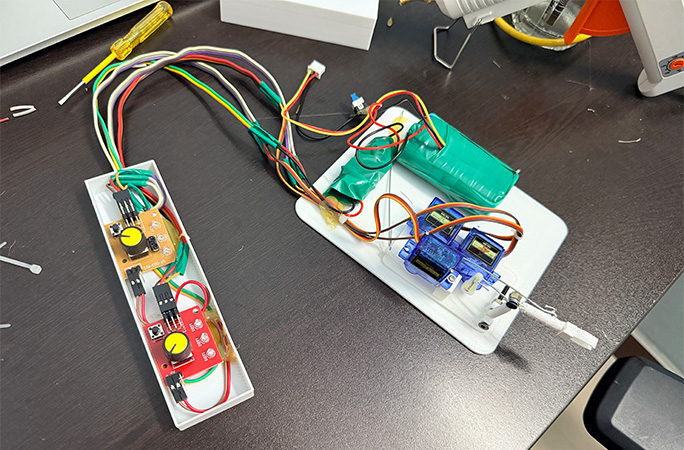
With this in mind, Hiten took time to source “readily available components to prove that world-class innovation can be achieved using accessible technology.”
He began sketching his design out, and two months later he had a fully functional prototype. When asked about his experience creating the world’s smallest robot arm, he told us: “I started by designing the mechanical skeleton from scratch using advanced CAD software. Once the digital simulation looked sound, I 3D-printed the housing and baseplates.
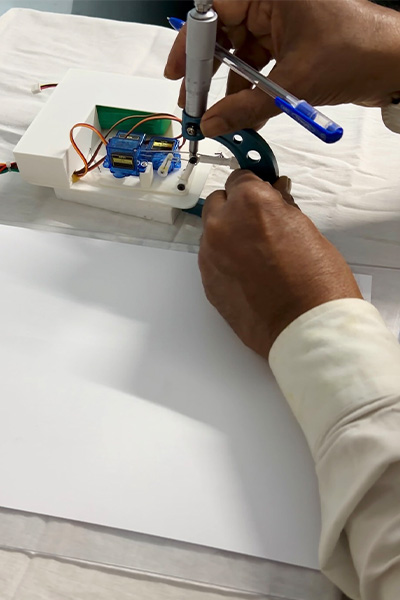
“On the electronic side, I wrote the logic and synchronization code in C/C++ for Arduino microcontrollers to ensure the PWM (Pulse Width Modulation) control module could accurately drive the arm's movements.”
Hiten’s incredible feat was completed from the familiarity of his family home, where he stays with his parents. “They are my biggest supporters and have always encouraged my curiosity, even when my room turned into a cluttered micro-engineering lab,” he joked.
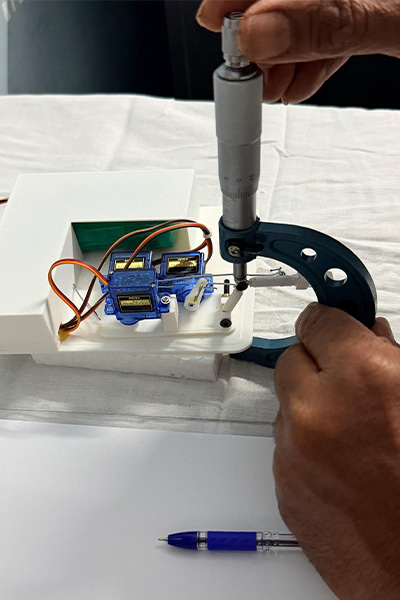
He completed the entire project from his home workspace, although he did admit that physical space was his biggest enemy.
He said: “Fitting the control module, intricate wiring, and actuators into a 39.250 mm frame was incredibly frustrating at times. I went through countless failed prototypes. Often, if I made the 3D-printed structure too thin to save space, it would become brittle and snap under the torque of the motors.
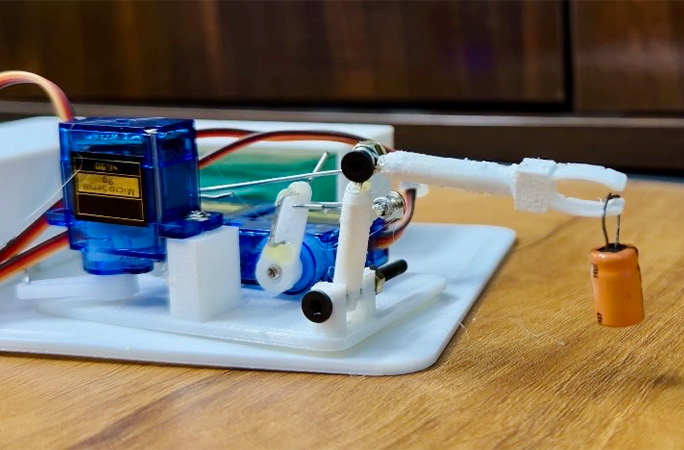
“Other times, the internal housing was so cramped that the micro-servos wouldn't synchronize perfectly. Every snapped part taught me exactly which fraction of a millimetre needed to be adjusted in the next CAD file.”
Head to our Science and Technology page for more record-breaking innovations.
Hiten’s design is an incredible personal achievement for him but may also stand as a critical and positive development for several industries. He explained that in the medical field, micro-robotic technology like his creation may become useful during surgeries, and in another industry such as electronics, it may aid the manufacturing of microchips due to ultra-precision.
His determination is clear as he also holds the record for smallest weather station, which he broke on 22 April 2025. The design measured 74 mm (2.91 in) long, 44 mm (1.73 in) wide, and 60 mm (2.36 in) high, which is small enough to fit in the palm of your hand! His weather station technology can measure key environmental parameters such as humidity, temperature and air pressure. Hiten told us that his design was “heavily focused on sensors, miniaturized circuitry and processing data.”
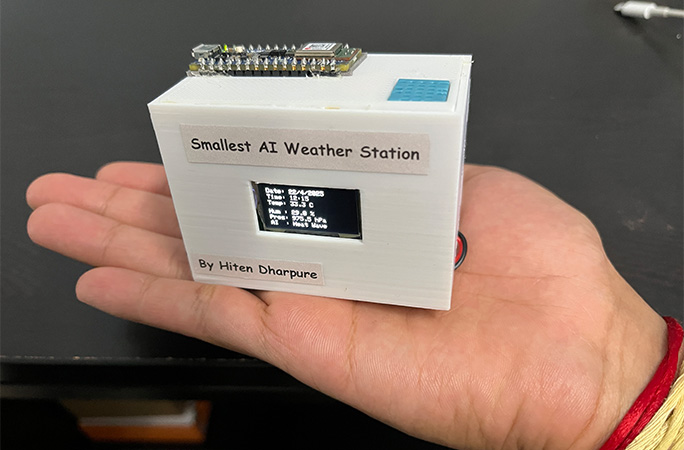
Now a two-time Guinness World Records title holder, Hiten’s mechanical feats were rather different to create. He told us: “The robotic arm required mastering physical and electromechanical torque. Building something that doesn't just process information, but physically mimics the 3-axis movement of industrial massive robots, actually reaching, securely pinching, and transporting tiny objects without dropping them, brought entirely new mechanical challenges that the static weather station didn't have.”
With a passion for AI, robotics and electronics, Hiten’s talents do not stop there! He recently created an offline Indian Sign Language (ISL) translation mobile application called HastaVaani to aid with communication gaps.
Hiten also shared with us some pictures of a recent meeting with Shri Nitin Gadkari, the Union Minister for Road Transport and Highways for the Government of India, in Nagpur, who he was very proud to meet and show his GWR certificates.
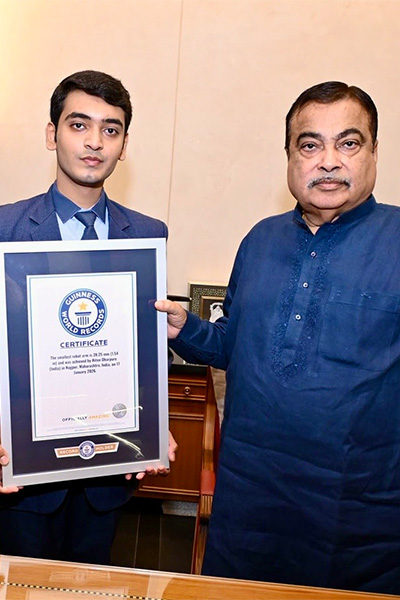
There is no doubt that Hiten’s projects hold the potential to make an impact on our future, and we can’t wait to see what he gets up to next!
He left us with some parting words: “I hope this inspires other young people in STEM to realize that with patience and accessible technology, they can innovate on a global scale.”