

How did burning shoes and flying sheep lead to the first hot-air balloon?
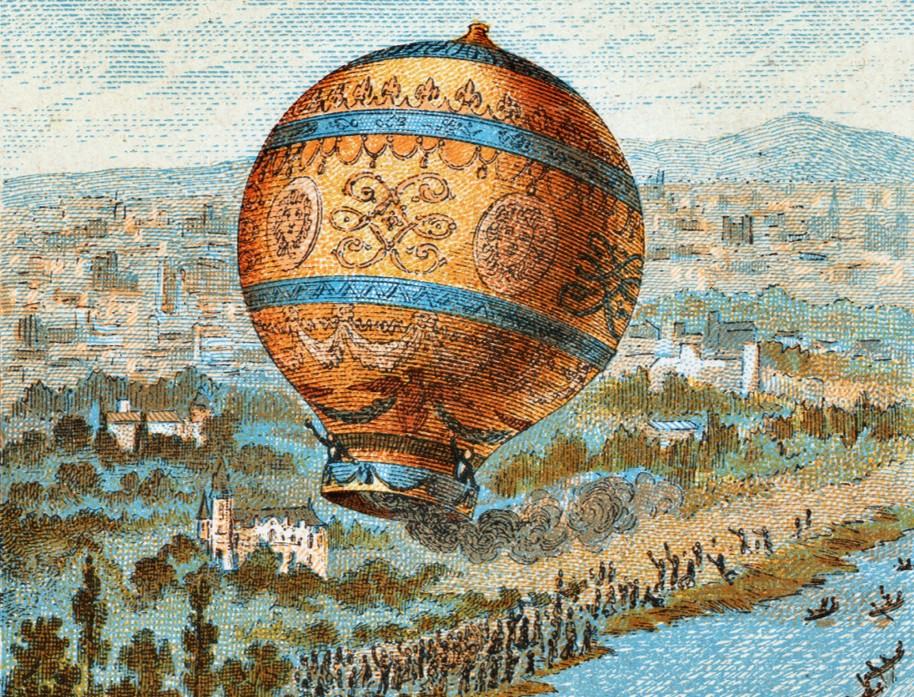
On a brisk autumn morning in 1783, a battalion of courtiers and ladies-in-waiting emerged from the rooms of the Palace of Versailles, near Paris. To an onlooker in the building's upper floors, the women would have seemed like animated silk flowers, all shimmering fabric and powdered hair. Around and between them moved frock-coated gentlemen and uniformed servants. From their high perch, this imagined witness would have been able to see how everyone subtly orbited the woman at the heart of the group.
Queen Marie-Antoinette of France was taking a walk.
The group moved through the fastidiously maintained ornamental gardens, walking towards a strange and wonderful sight. On a terrace near the palace was an enormous, 23-metre-tall sphere of paper, brightly coloured and swaying in the wind.
At the base of the balloon, a group of workmen were throwing fuel onto a great bonfire. Supervised by two guests of King Louis XVI, Joseph and Etienne Montgolfier, the palace's groundskeepers stoked the flames with baskets of wet straw, soggy wool, spoiled meat and old shoes.
The royal walking party lingered on the edge of the terrace for a few minutes, watching this bizarre scene and recoiling from the foul smell, before turning around and bustling back to the palace.
In honour of Bastille Day, we're returning to the story of how humans first took to the air over France, which is stranger than you might expect.
The Montgolfier Brothers
It all starts with the Montgolfier brothers, Joseph and Étienne. They were from a wealthy family of paper manufacturers based in the town of Annonay, about 75 km (47 mi) south of Lyon, France. Both were educated men, and like many from this era, they were fascinated by the rapid pace of scientific discovery described in the Journal of the Royal Society and in the writings of "natural philosophers" such as Joseph Priestley, Henry Cavendish and Antoine Lavoisier.
The preceding two decades had seen a revolution in scientific understanding of chemistry. The elements we would today call oxygen and hydrogen had been isolated, and their properties were beginning to be understood. Well-publicized experiments had demonstrated that hydrogen had a much lower density than air, and that it might potentially be usable as a lifting gas.
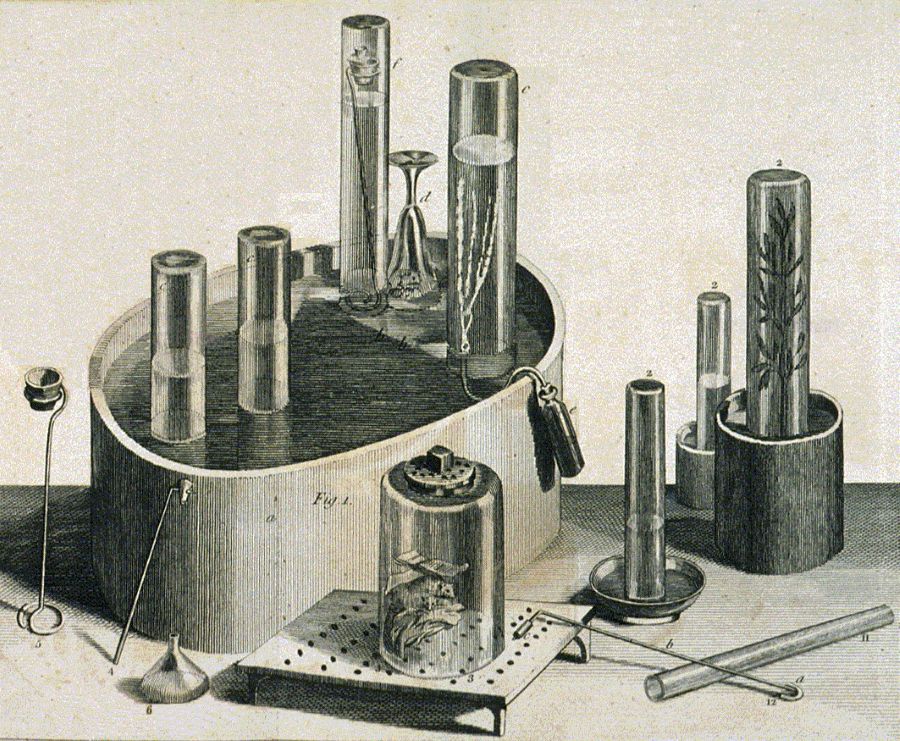
A typical experimenter's set-up from the time, showing various immersion tanks and vacuum flasks. We should pause for a moment and thank French scientist Antoine Lavoisier for saving us from having to call hydrogen "phlogiston" and oxygen "dephlogisticated air" (the names Cavendish used). [Public Domain/Wikimedia Commons]
This point in scientific history is where the Montgolfier brothers started their work. In 1781 or 1782, they started carrying out small-scale experiments, initially using dense paper (which they had a bottomless supply of) to try to contain "inflammable air". These failed, as did their follow-up experiments with silk and other fabrics, because the hydrogen would seep out through the pores in the material.
In later accounts of their work, this is described as the point where one of them had a flash of inspiration on seeing something – either a shirt that had been hung up to dry, a piece of discarded paper, or a burning ember – rising through the air above a fire. So the story goes, they realized at that moment that hot air, which is easier to contain than hydrogen, would work just as well.
This is not true. The actual course of events is much stranger.
Building the first hot-air balloon
The Montgolfiers came to believe that flames produced, in addition to smoke, some previously unknown lifting gas, perhaps related to hydrogen. After some peculiar experiments, they concluded that this gas was produced in the largest quantities by burning very smoky fuels, and settled on a combination of damp straw and wool. By the time of their famous demonstration flights, the human tendency to see patterns in noise had led them to add spoiled meat and piles of old shoes to the fuel mixture, as this apparently improved performance.
The first Montgolfier balloon was constructed by Joseph in November 1782, while he was staying in Avignon. He made a simple gas-bag from six diamond-shaped silk panels, leaving a hole at the bottom. He then burned some paper beneath it and watched as it rose to the ceiling of his apartment.
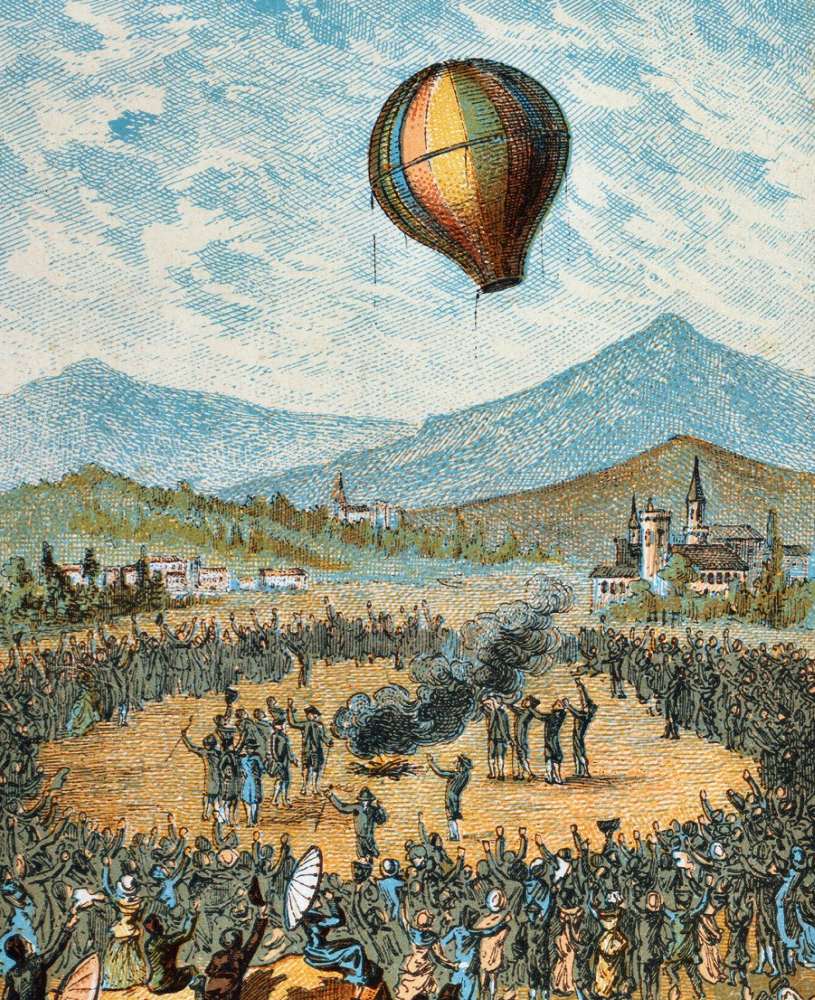
The first large-scale Montgolfier balloon. [Public Domain/Wikimedia Commons]
On his return home, he repeated the demonstration for his brother, Etienne, and the two of them immediately set to work making a larger balloon. After a few more tests, on 5 June 1783 the brothers undertook a public demonstration of a 650 m3 (22,980 cu ft), 10.6-m-wide (35-ft) spherical balloon, which they launched from the town square in Annonay in front of an awestruck crowd.
Going to Paris
News of this feat quickly spread to the French capital, and the brothers were asked to repeat their demonstration for the Royal Court at Versailles.
On 19 September 1783, the Montgolfiers' latest balloon was transported to Versailles and filled by the smoke from the usual bonfire of strange things (this was the day that Queen Marie-Antoinette went to view the process, but was driven back by the smell). After that, a cage containing three animals – a sheep, a rooster and a duck – was attached. The aim was to figure out whether or not living creatures could survive the journey.
The balloon rose an estimated 520 m (1,700 ft) into the air and flew for around eight minutes. The sheep, duck and rooster became the first living creatures to take flight in a man-made craft.
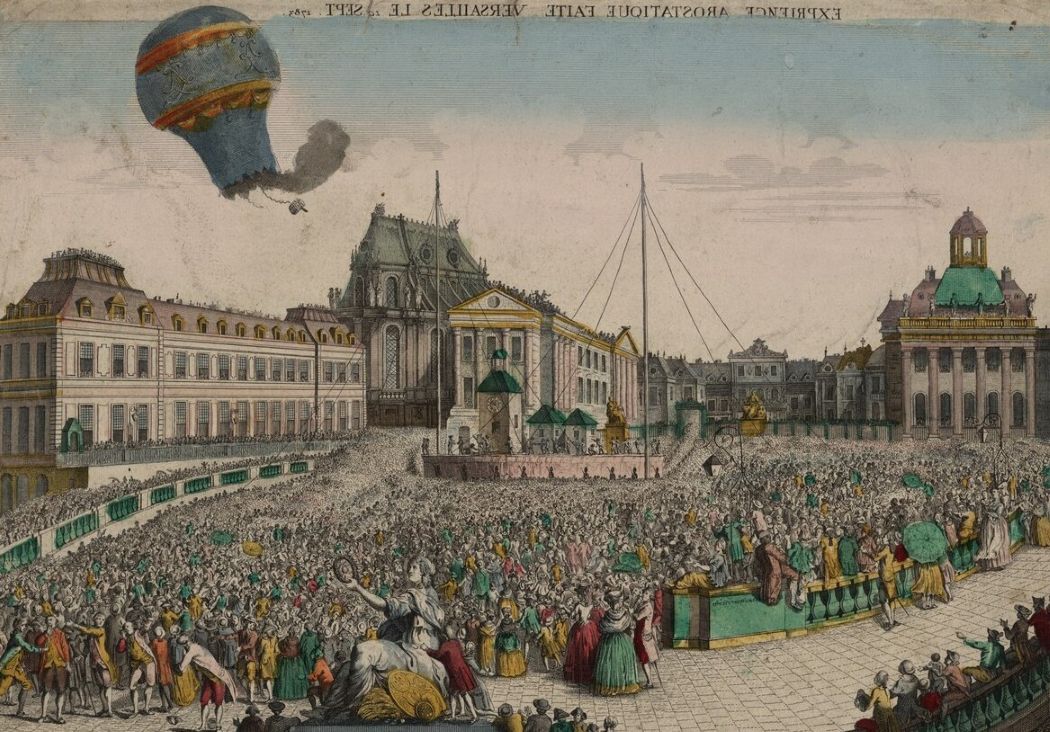
The sheep was called Montauciel ("Climb-to-the-sky"). History does not record the name of the duck or the unfortunate rooster. [Public Domain/Wikimedia Commons]
The first person to reach the wreckage of the balloon – some two miles away across the countryside – was an adventurous young courtier and scientist called Jean-François Pilâtre de Rozier. He found the cage smashed open and empty, but the sheep was soon spotted grazing in a nearby field. The duck was also unharmed. The rooster had an injured wing, and this was the subject of some considerable speculation until several witnesses confirmed that they had seen the sheep kick it while the balloon was being filled.
The first human flights
With flight having been proven to not cause sudden death, the brothers received permission from King Louis XVI to attempt a crewed flight. Initially, Louis insisted the crew should be a pair of condemned prisoners, but Pilâtre de Rozier used his aristocratic connections to claim the honour for himself.
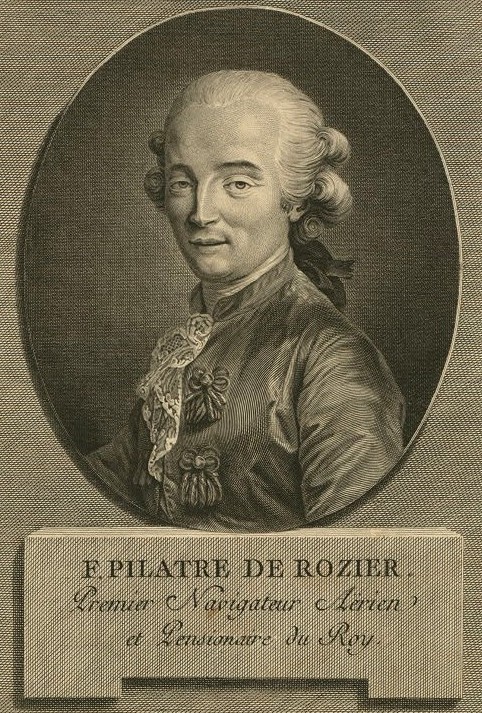
Here's Jean-François Pilâtre de Rozier. The important thing to know about him is that his party trick was huffing a lungful of flammable gas and then breathing fire out of his nose like a dragon. [Public Domain/Wikimedia Commons]
Working with their friend, wallpaper magnate Jean-Baptiste Réveillon, the Montgolfier brothers built a new balloon from sturdy fabric and paper that measured around 23 m high and 15 m wide (75 ft x 49 ft). There was a narrow walkway around the neck of the balloon, where de Rozier was to stand. It was made from light wicker and around 1 m (3 ft 3 in) wide with a low handrail. An iron brazier was fitted inside the neck of the balloon, and portholes were added to allow de Rozier to add fuel from the walkway.
On 15 October 1783, the balloon made its first tethered flight in the yard of the Réveillon's wallpaper factory on the Rue du Montreuil. It rose to a height of 25 m (84 ft), amazing the crowds in the streets around the factory. By feeding more fuel into the brazier, de Rozier was able to keep the restraining ropes taut for 4 minutes 25 seconds, technically making the first human flight – though the tethers would have inhibited the sense of wonder.
A more ambitious series of test flights followed on 19 October. Now feeling fairly confident in his ability to control the balloon's flight, de Rozier reduced the number of tether ropes to just one. The people of Paris were stunned to see the brightly coloured balloon rise to around 80 m (262 ft) – higher than the towers of Notre Dame cathedral – and stay there for 8 minutes 30 seconds. A further two test flights that day saw de Rozier rise to roughly 100 m (325 ft), this time with passengers. A man called Giroud de Villette was on the first, and the Marquis d'Arlandes, an army officer, was on the second.
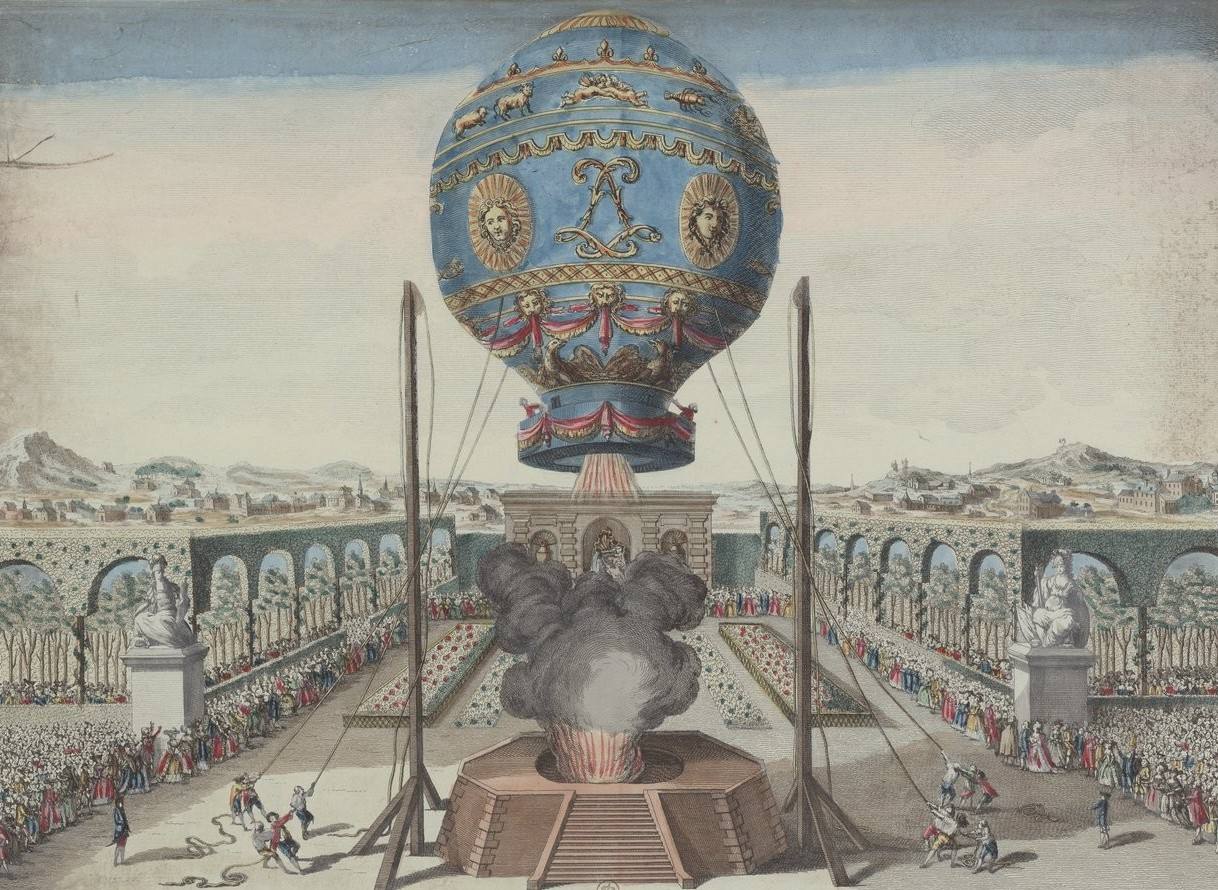
The tethered balloon in the gardens of the Réveillon factory. [Public Domain/Wikimedia Commons]
(By this time the balloon was apparently fuelled by straw soaked in alcohol – we have to assume that at some point Pilâtre de Rozier or one of the other scientists in Louis XVI's court had explained the working principle of the hot-air balloon to its inventors.)
The first free flight in a balloon
Louis XVI, had been closely following the news of the Montgolfiers' experiments, and offered the grounds of one of his palaces, the Château la Muette, as the launch point.
On 21 November 1783, the two pilots – Pilâtre de Rozier and d'Arlandes – climbed into the narrow walkway that wrapped around the neck of the balloon, and at 1:54 p.m. the balloon lifted off. The crowd at the launch site included the King and Queen, as well as various high-ranking members of the royal court. It also included American founding father Benjamin Franklin, who was there both because he was the American Ambassador to France but also because he was one of the leading scientists of the age (everyone needs a hobby, I suppose).
The climb was initially quite slow, reportedly because d'Arlandes was so shocked by the sight of the massed crowds in the streets below that he forgot to keep stoking the brazier. After being reminded of his job by Pilâtre de Rozier ("if you keep staring at the river you'll be bathing in it soon"), both men stoked the fires and the balloon climbed into a current of air that bore them south east across the Seine.
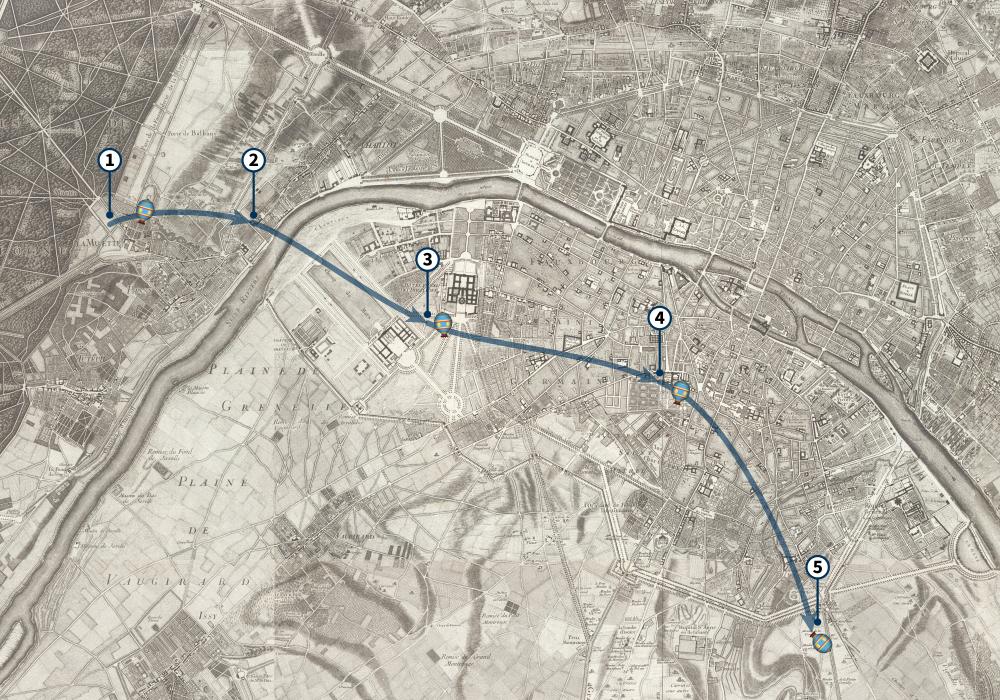
Here's the approximate route of the first untethered flight, based on d'Arlandes' description. It's overlaid on a map of 18th-Century Paris, to give you an idea of what sort of terrain they were passing over.
- The launch station was located in a meadow to the west of the Château de la Muette, on the edge of the Bois de Boulogne.
- The first landmark d'Arlandes mentions is the Convent of the Visitandines in Chaillot, which they passed over just before they crossed the river.
- Having crossed the Seine close to where the Eiffel Tower now stands, the balloon passed between the Hôtel Royal des Invalides and the École Militaire, turning to the east as it went.
- The balloon travelled over the Jardin du Luxembourg, before turning again to the south east
- The crash-landing took place on the Butte-aux-Cailles, apparently between two prominent windmills. We've drawn it as being between the Moulin de la Fortune and the Moulin de Livry, but that's a guess.
[Background map: David Rumsey Map Collection, David Rumsey Map Center, Stanford University Libraries]
A few years later, d'Arlandes would write a detailed and surprisingly candid account of this flight, which was marked for him by a mixture of wonder and terror (mostly terror). Unable to see each other, de Rozier and d'Arlandes spent the trip shouting at the top of their lungs, and frantically piling fuel into the brazier to keep the basket clear of the rooftops below. The creaking and snapping sounds from the paper-and-silk balloon – which was rapidly disintegrating under the strain – terrified d'Arlandes, and he was continually yelling for de Rozier to let them land.
Although he and de Rozier were the first people to ever look down on the world from the sky, they did not dare give the view more than the occasional quick glance. They were mostly concerned with stoking the brazier and using wetted sponges to put out the numerous small fires that were being lit by burning embers making contact with the paper balloon.
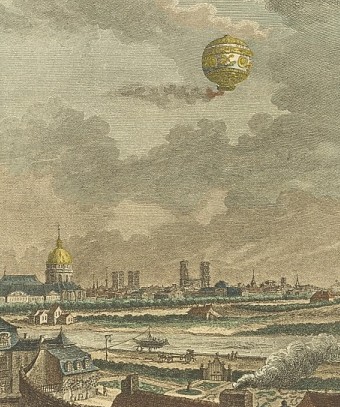
A contemporary illustration, showing the balloon flying over the spires of Paris. [Public Domain/Wikimedia Commons]
The two men came down in a field between two windmills on a ridge called the Butte-aux-Cailles, overlooking the Bièvre River (south of the present-day Place d'Italie in the 13th Arrondissement), having completed the first untethered flight by humans. They'd been in the air for a grand total of 25 minutes, and only travelled about 24 km (15 miles), but their adventure had achieved a dream that people had long considered impossible and kick-started the field of aviation.
For more Science & Technology stories, click here.
Header image: Public Domain/Wikimedia Commons.