


Gus the T. rex roars into the record books after securing unprecedented auction bid
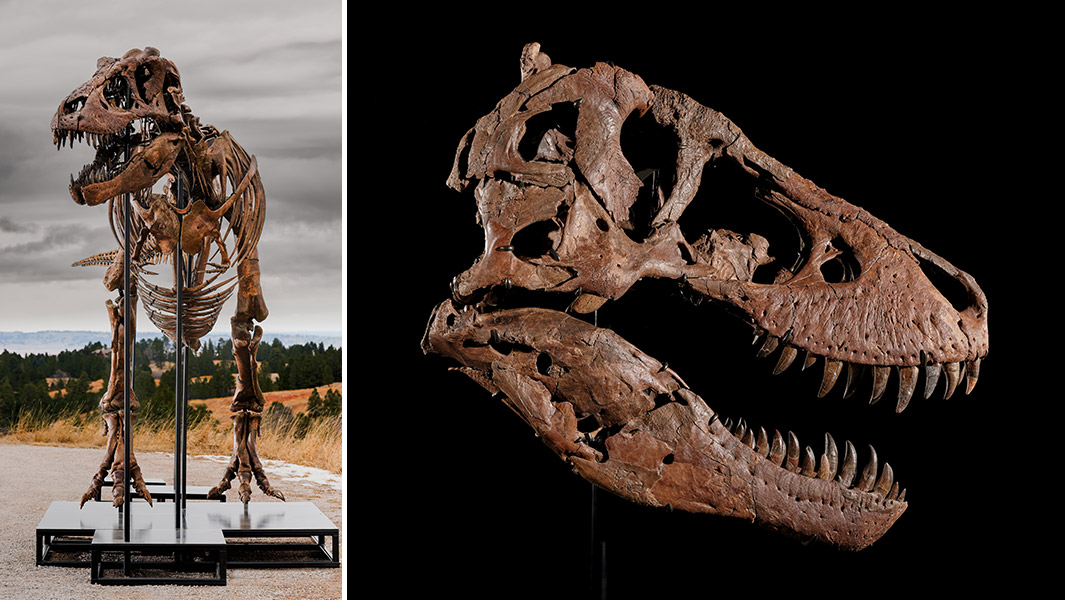
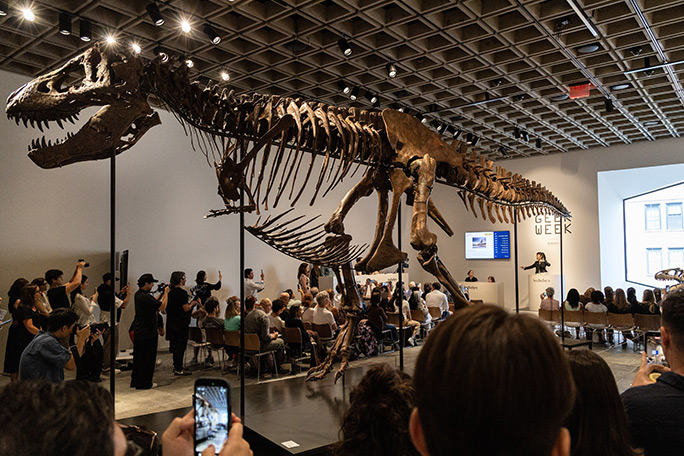
One of the most complete and well-preserved specimens of T. rex ever found became the most expensive dinosaur sold at auction when it went under the hammer at Sotheby’s in New York City, USA, on 14 July.
Credit: Sotheby's / Matthew Sherman
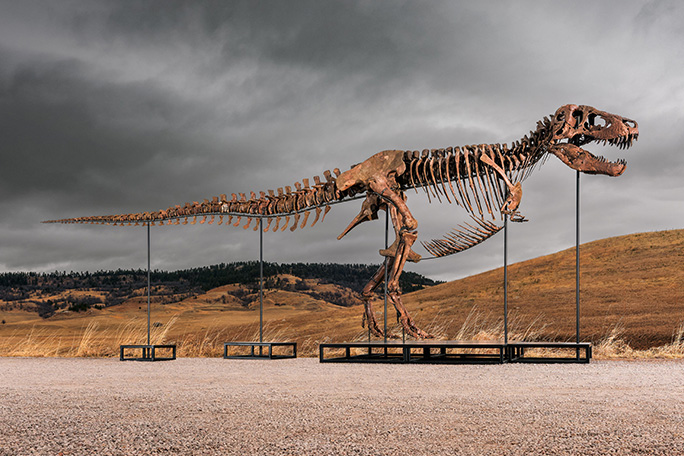
Nicknamed “Gus” – in honour of the late cattle rancher Gary “Gus” Licking, whose land the extraordinary skeleton was discovered on – the prehistoric predator’s remains fetched $50.1 m (£37.5 m; €43.9 m), including buyer’s premium, after a ferocious seven-way bidding war.
This was double the pre-sale estimate the skeleton had been expected to fetch. The final buyer for now has chosen to remain anonymous.
Credit: Courtesy of Sotheby's
This means that Gus becomes the first dinosaur in history to surpass the $50-m mark at auction. The previous holder was a remarkably intact Stegosaurus skeleton nicknamed “Apex”, which claimed a then-record hammer price of $44.6 m (£34.4 m; €40.9 m) on 17 July 2024, also at Sotheby’s auction in New York City, USA.
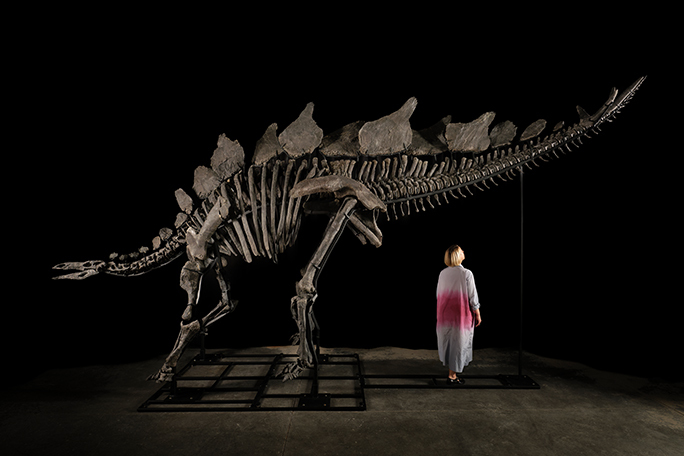
Apex the Stegosaurus, which sold for $44.6 m in 2024. Credit: Sotheby's / Matthew Sherman
What makes Gus so valuable is that not only is he a representative of probably the most iconic dinosaur species to have captured people’s imaginations, but that his size and condition are extremely rare in the palaeontological world.
Gus is one of the largest and most complete T. rex skeletons ever to come to light, only rivalled by the likes of historic specimens such as “Sue” (housed at The Field Museum in Chicago) and “Stan” (displayed at the Natural History Museum in Abu Dhabi). Fittingly, both of these are former holders of the record for most expensive dinosaur bones.
Showing how much the market for natural-history exhibits is booming in recent times, Sue made $8.36 m (£5.10 m) in 1997, while Stan raised the bar significantly to $31.85 m (£24.57 m; €27.08 m) in 2020.
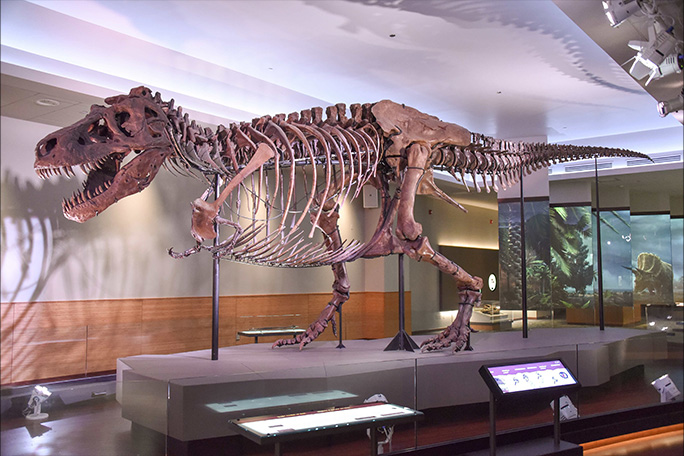
Sue at The Field Museum in Chicago, Illinois, USA, is around 90% complete by total bones and was also found in South Dakota. Credit: Wikimedia Commons / Evolutionnumber9
Sue – who like Gus was unearthed in South Dakota, though back in 1990 – does remain the most complete T. rex skeleton, comprising around 90% of her original bones. At 12.5 m (41 ft) long, she is also a contender for the largest T. rex skeleton, though a rival (Scotty) – perhaps pushing 13 m (42 ft 7 in) from snout to tail tip – did emerge in 2019.
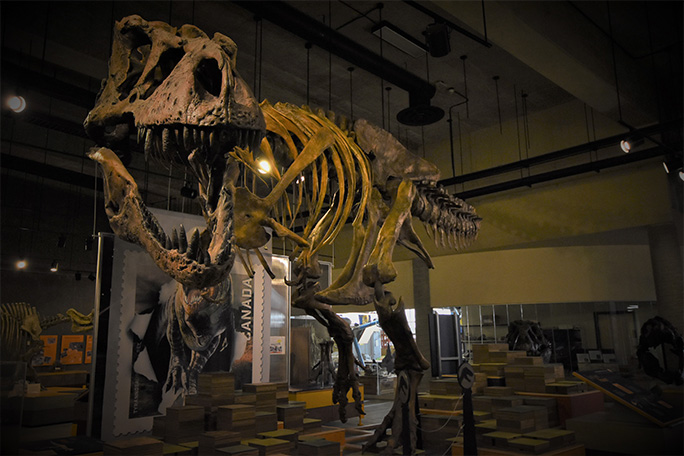
At 13 m (42 ft 7 in) long, Scotty may be the largest T. rex skeleton ever found. Credit: Amanda Kelley
While Gus’s skeleton represents only around 61% of the total original bones by number, this increases to 80% by bone mass. Gus’s skull in particular is very impressive, containing about 82% of the original bones – including most of the formidable teeth that this hunter is known for, each of which can measure up to 30 cm (12 in)!
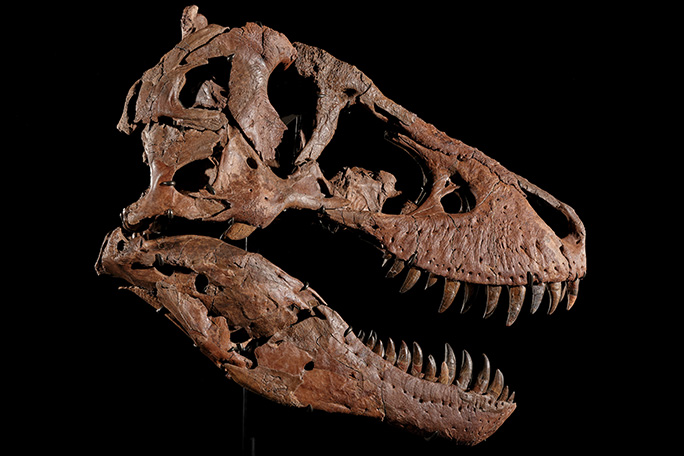
Gus's skull is remarkably intact, with 82% of its original bone structure. Credit: Sotheby's / Matthew Sherman
Combined with off-the-charts jaw musculature, they would have once dispensed the strongest bite for a land animal at an estimated 53,735 Newtons – which for context is more than three times greater than the strongest bite measured in a modern-day saltwater crocodile (today’s heaviest reptile).
Other rarely seen bones that Gus boasts over many of his T. rex brethren are a furcula (wishbone) and two remarkably intact feet. Once all of the bones had been mounted to recreate the dinosaur as it would once have stood in life, Gus measured in at 11.6 m (38 ft) long and 3.8 m (12 ft 6 in) tall, with a more-than-1.2-m-long (4-ft) skull.
Gus was unearthed in Harding County, South Dakota, USA – which sits within a region long regarded as a dinosaur-fossil hotspot. The very first documented Tyrannosaurus rex remains were unearthed in neighbouring Montana by famed fossil hunter Barnum “Dr Bones” Brown in 1902.
Over the course of three scorching summer seasons in 2021–23 (the only time that the dig site was fully accessible) Gus’s bones were painstakingly collected and cleaned by fossil hunter Thomas Heitkamp and his team, who Licking had enlisted to make a prospective survey of his land.
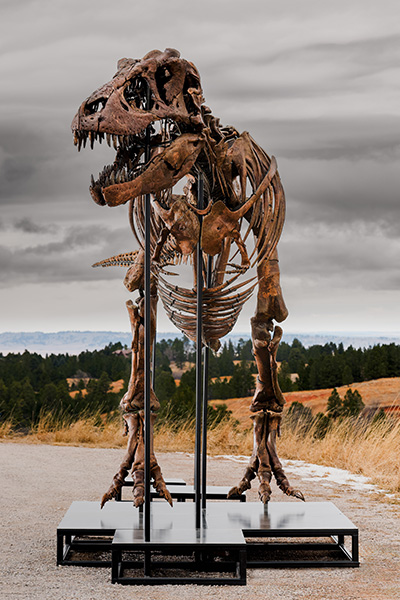
Gus's mounted skeleton stands 3.8 m (12 ft 6 in) tall, akin to a large bull African elephant. Credit: Sotheby's / Matthew Sherman
The cattle farmer – who sadly passed away just a year into the excavation process – had been aware of fossilized bones and teeth on his 6,500-acre (2,630-ha) ranch for many years and decided to join forces with Heitkamp to explore the full potential of what might lie beneath the surface.
As it turned out, Licking suggested that they start on the very site where Gus would eventually be found – which speaks to the intimate knowledge of his land, along with a decent pinch of serendipity!
Given the astronomic rise in demand for well-preserved dinosaur remains – particularly superstar species like the T. rex – while Gus’s purchaser has so far not disclosed their identity, it’s not to say that Gus has now disappeared for good. There’s a strong possibility that he could eventually be put on public display at a museum where the masses can marvel at his majesty in all its Jurassic glory. Fingers (and tiny arms) crossed!
For more record-breaking stories about amazing animals, check out our dedicated Animals news page.