


The first alien abduction and the great Mystery Airship Flap of 1896
Today, as I'm sure you know, is World UFO Day.
Well, it's arguably World UFO Day. As with everything in the world of ufology, not everyone can agree on the details. Some say it should be today, marking the anniversary of the day in 1947 when American pilot Kenneth Arnold coined the term "flying saucer" to describe something unexplained he saw in the sky. Others argue that it should be on 2 July, which was the day in 1947 when something mysteriously crashed on the outskirts of Roswell, New Mexico.
Now, Guinness World Records does not take an official position on the existence of aliens, or their possible visits to Earth. We do, however, deal in hard evidence and objective measurements, which makes having records related to UFOs a little tricky.
If someone comes to us claiming to have met more aliens than anyone else (an application we've had come in a few times), there's not really anything we can do – if they don't have proof, we can't give them a record. (Also, if they did have proof, we'd be a very odd choice of organization to contact first).
We are committed, however, to using records (our firsts and -ests) as a lens through which to view the world, and while alien visitors may or may not exist in reality, they do most definitely exist as a cultural phenomenon.
The question is, when did that cultural phenomenon first appear? People have made arguments for various peculiar descriptive passages in medieval chronicles and ancient texts, but none of these make any clear reference to the idea of aliens. They typically frame whatever strange phenomenon they're describing in a mystical or religious context. They belong more in the realm of fantasy than science fiction, in other words.
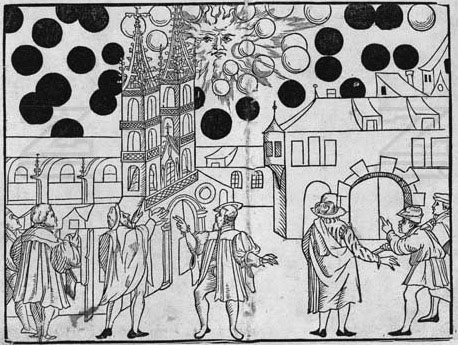
It's Ye Olden Teletubbies!... Or something. This is an illustration of what is generally termed an "aerial phenomenon" seen over Basel, Switzerland,in 1566. [Public Domain/Wikimedia Commons].
The Great Airship Flap
For the origins of what we'd today recognize as UFO lore, we have to look instead to the "Mystery Airship" panic of 1896. This was a bizarre episode in American history where newspapers (from all over the country, but primarily in California) carried fantastical stories of enormous flying machines buzzing cities, abducting random strangers and generally causing mayhem. This is, you have to remember, several years before the invention of the first practical airship and eight years before the Wright Brothers' first flight.
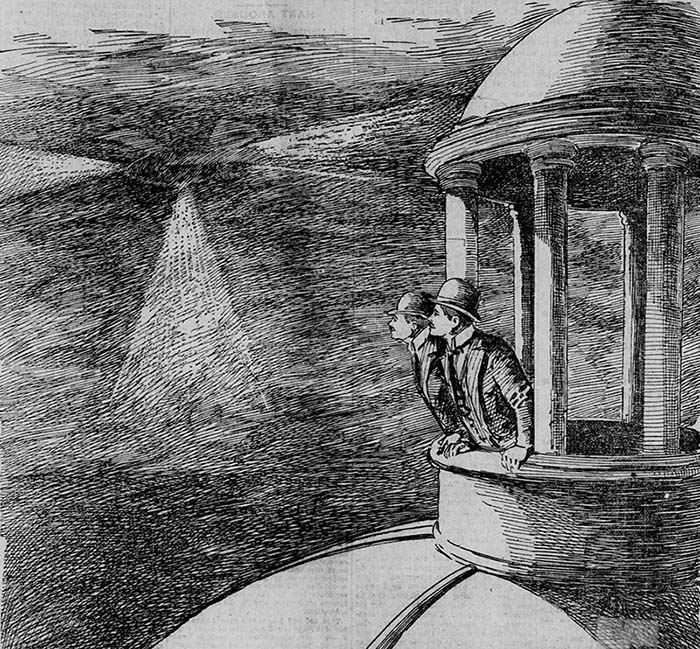
This illustration shows the sighting over Sacramento, California, that seemingly kicked off the Great Airship Flap. [Public Domain/The San Francisco Call Bulletin]
This sounds a lot like a modern UFO flap ("flap" is the technical term used to describe a seemingly connected run of UFO sightings), but there's an important difference. At least at first, these mystery airships – which reportedly appeared in the skies over locations as far separated as San Francisco, Dallas and Chicago – were described as being piloted by humans, not aliens. They were the presented as the work of secretive-genius inventors akin to Jules Verne's Captain Nemo, not men from Mars.
Martians in the Orange Groves
That was until 27 November 1896, when a remarkable story appeared on the front page of The Evening Mail of Stockton, California. Readers opened their paper to the following triple-decker headline:
THREE STRANGE VISITORS
Who Possibly Came From the Planet Mars
Seen on a Country Road by Colonel H. G. Shaw and a Companion
What follows is generally agreed to be the earliest published "alien encounter" narrative – a purportedly true story in which a person claims to have met people from another world. It was penned by a Colonel H. G. Shaw, describing what present-day UFO researchers could call a Close Encounter. It's quite long, but remarkable enough to be worth quoting at length. It begins:
"Wednesday afternoon I went out to Lodi and Lockeford in company with Camille Spooner, a young man recently arrived from Nevada. I went to the places mentioned in quest of material to form an exhibit to represent this county at the Fresno Citrus Fair.
We left Lodi on the return trip, I should judge, shortly before 6 o'clock, and we were jogging along quietly when the horse stopped suddenly and gave a snort of terror.
Looking up we beheld three strange beings. They resembled humans in many respects, but still they were not like anything I had ever seen. They were nearly or quite seven feet high and very slender."
My first assumption on encountering this narrative was that it was a short story – American newspapers of this era often published short-form fiction or serialized novels, and didn't always do a good job of labelling them as such. A bit of digging, however, confirmed that "Colonel H. G. Shaw" was a real person – Henry Glenville Shaw (1843–1907), formerly of the 125th Ohio Infantry. He was a decorated Civil War veteran, former newspaper editor and business leader in the San Joaquin Valley (where this account takes place). Camille Spooner (1871–1923) was seemingly less notable, but does appear in Nevada census records from the period.
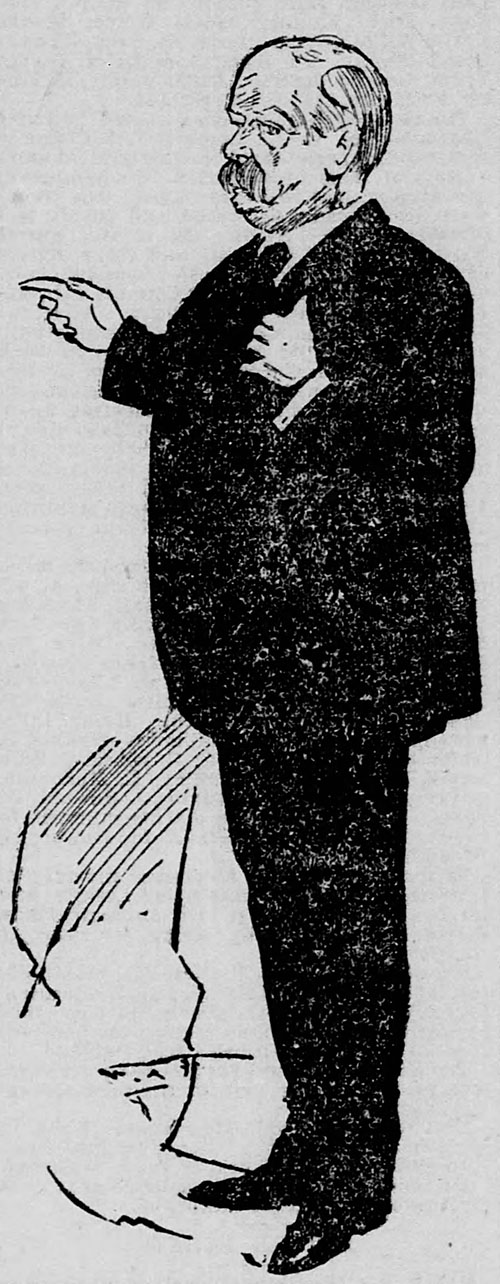
A contemporary illustration of Colonel H G Shaw. I mean, does this look like a man prone to flights of imaginative whimsy? [Public Domain/The San Francisco Call Bulletin]
Moreover, the work they were doing (collecting promotional material from citrus farmers around Lodi) had been mentioned in another newspaper that week, so the basic details all seem to be grounded in reality.
The Martians up close
That's not the end of the account, however, far from it. This wasn't just a passing sighting of something strange on the road. Shaw claims to have gotten up close to these mysterious strangers, and while he could not understand their "warbling" speech, he was able to make a close examination:
"their hands were quite small and delicate, and that their fingers were without nails. Their feet, however, were nearly twice as long as those of an ordinary man, though they were narrow and the toes were also long and slender. [...] As one of them came close to me I reached out to touch him, and placing my hand under his elbow, pressed gently upward, and lo and behold I lifted him from the ground with scarcely an effort.
[...]
They were without any sort of clothing, but were covered with a natural growth hard to describe; it was not hair, neither was it like feathers, but it was as soft as silk to the touch and their skin was like velvet. Their faces and heads were without hair, the ears were very small and the nose at the appearance of polished ivory, while the eyes were large and lustrous. The mouth, however, was small and it seemed to me that they were without teeth."
The strange airship
Henry Shaw goes on to describe the mysterious creatures seemingly examining him with some sort of light-based-device, and then attempting to abduct him by bodily carrying him away (a task they proved to be far too weak to achieve). He ends by describing the craft they returned to.
"Well, after trying in vain to move either of us they turned in the direction of the Woodbridge canal, near which we were, and as they flashed their lights towards the bridge we beheld a startling sight. There, resting in the air about twenty feet above the water, was an immense airship. It was 150 feet in length at least, though probably not over twenty feet in diameter at the widest part. It was pointed at both ends, and outside of a large rudder there was no visible machinery.
We followed them as rapidly as possible, and reached the bridge as they were about to embark. Without a little spring they rose to the machine, opened a door in the side, and disappeared within. I do not know of what the affair was built, but just before it started I struck it with a rock and it gave no sound. It went through the air very rapidly and expanded and contracted with a muscular motion and was soon out of sight.
I have a theory, which, of course, is only a theory, that those we behind were inhabitants of Mars, who have been sent to the Earth for the purpose of securing one of its inhabitants. I feel safe in asserting that the stories being told by certain San Francisco attorney are clumsy fakes, and should not be given credence by anyone."
Boring explanations
So what on Earth did we just read? We take our silliness seriously here at GWR, so lets set aside, for a moment, the notion that this is a wholly true account of an actual meeting with aliens. If nothing else, newspaper records seem to suggest that Colonel Shaw was back at work, representing his neighbours at the Fresno Citrus Fair within a week, which doesn't seem like the actions of a man who has just had an Earth-shattering revelation about the nature of the universe.
It's also not a confused or ambiguous experience (like a mysterious light in the sky, or a figure half-glimpsed in the space between waking and sleeping). So it was either wholly real (which, as I've said, seems wildly unlikely) or it was a deliberate hoax. The latter explanation is also backed up by the fact that it was published on 27 November, which was the date of Black Friday (the day after Thanksgiving) that year – typically a very slow news day.
This leaves the question of why he would have published a hoax? My personal suspicion is that this was a piece of satire, some sort of parody or joke whose meaning is hard to figure out without knowing the political and cultural context of the time. Humour doesn't age well, and this sort of fantastical parable ages even worse (I mean, did you know that a large section of Gulliver's Travels is actually an extended comic riff on British parliamentary politics under Prime Minister Robert Walpole?). The final sentence of the article, in particular, seems to be a pointed dig at someone specific.
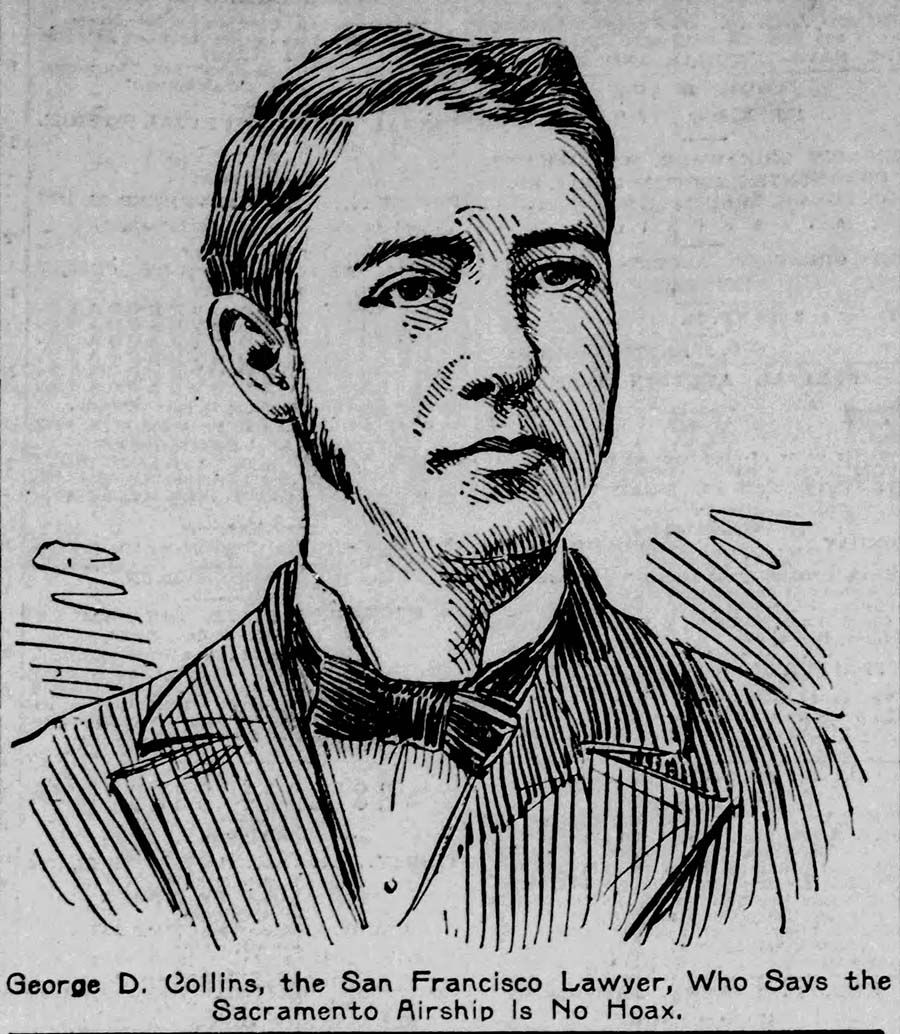
And by someone specific, I mean this guy. He had been shopping around a story about a mysterious "client" who had invented an airship in the weeks previous. I don't know what the cause of the beef was, but H G Shaw seems to have taken a strong dislike to the man. [Public Domain/The San Francisco Chronicle]
My best guess is that Shaw was writing in response to other newspapers' "Mystery Airship" stories, intentionally writing something as outlandish as he could think of as a way of taking what he saw as absurd fabrications to their logical conclusion.
Or is it aliens?
That said, perhaps I'm wrong, perhaps Colonel Shaw really did see something amazing on the outskirts of Stockton, California, on 25 November 1896. The idea of aliens had been mentioned by a few prominent scientists and writers in the 1890s (astronomer Percival Lowell had been publishing his theories about Martian "canals" and other signs of civilization for a few years), but they were hardly a commonplace part of popular culture. Furthermore, there's something fascinatingly, well, uniquely weird, about the description Shaw provides.
One thing in particular that I find striking is the detail and variety of sensory description in the account. Shaw talks not just of how the Martians looked but also how they sounded, how they felt to touch and how heavy they were when he lifted them. Also, the whole episode takes place in a well-described real-world location that maintains a sense of orientation and place.
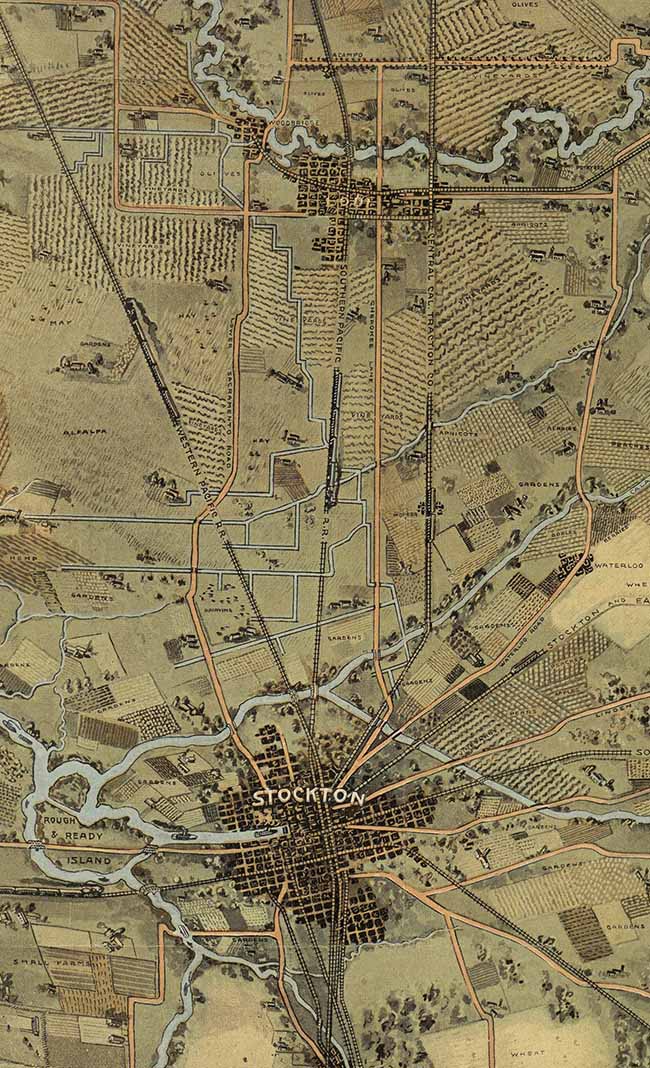
A detail from a 1910 map of the area, showing Stockon (at the bottom) and Lodi (at the top) and the two roads that connected them at the time. The landscape in 1896 would have looked broadly similar. Phillip Merlo from the San Joaquin County Historical Society told me the description places the encounter on Cherokee Road, where it crossed the Woodbridge irrigation canal the north of the Calaveras River. [Public Domain/David Rumsey Map Collection]
Typically, when people are making things up they struggle to reproduce those sorts of details consistently – there's a whole law-enforcement investigative technique built around this fact, called "cognitive interviewing", which works by getting suspects to do things like focus on what they could hear, or how someone smelled, or retell their story backwards. When things didn't happen, people get confused in their second or third retelling. So if it's a completely made up story, it's at least a convincingly told one.
As for the seeming lack of reaction from his community, well, perhaps in an age that had seen the development of marvels such as electric lights, motor cars, x-rays and the telegraph, the idea of aliens didn't seem that strange or outlandish.
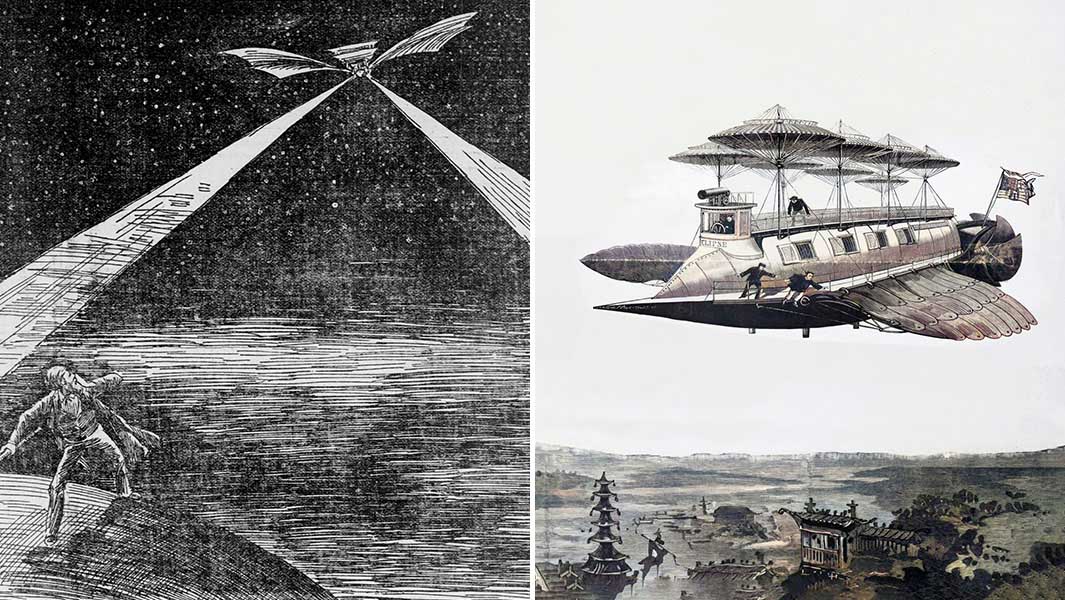
Header images: (Left) A contemporary newspaper illustration of a reported airship sighting, April 1897 [Public Domain/The Saint Paul Globe]. (Right) An illustration from one of the 1880s children's stories starring boy adventurer Frank Reade [Chronicle/Alamy]