


King and Queen of Everest extend their records for climbing Earth’s highest peak
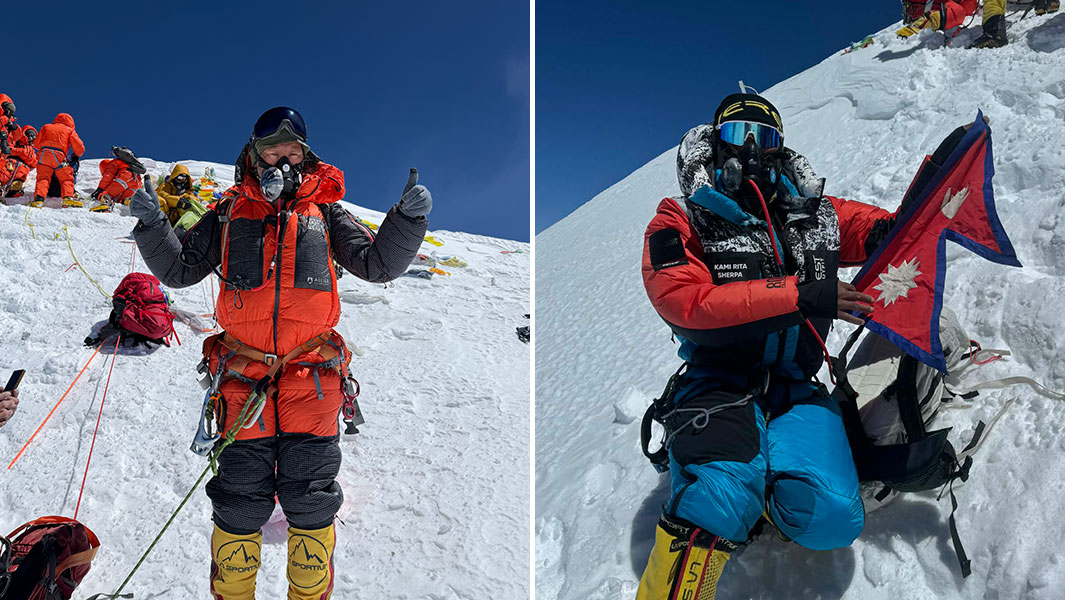
On 17 May, Nepali mountain guides Kami Rita Sherpa and Lhakpa Sherpa achieved the extraordinary, reaching the summit of Everest (aka Sagarmāthā or Chomolungma) – the world’s highest mountain, soaring to 8.848.8 m (29,032 ft) above sea level.
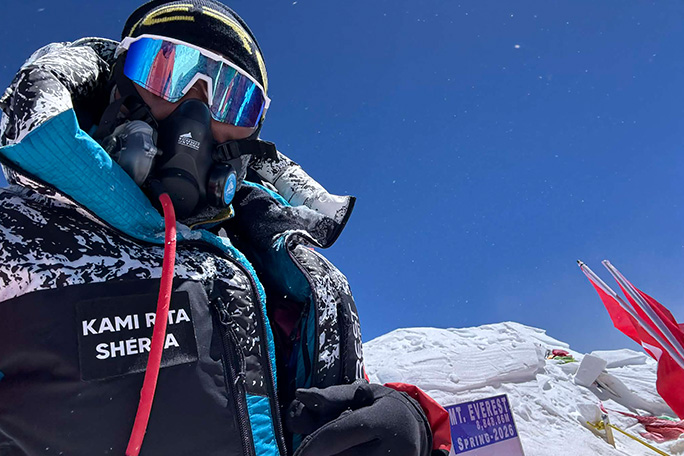
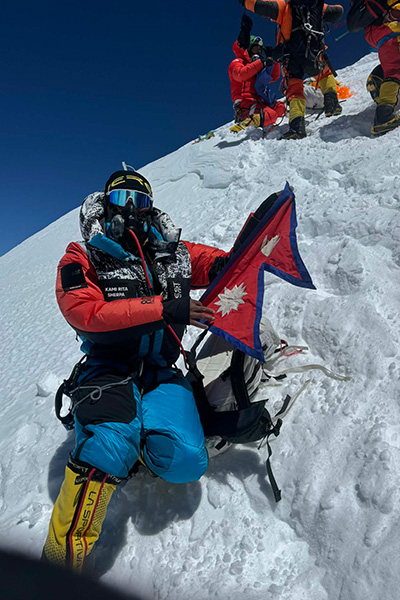
Kami Rita Sherpa at the summit of Everest for the 32nd time on 17 May 2026
What makes their successful expeditions even more incredible is that this was not the first time – not by a long shot – that they had stood upon that hallowed perch above the clouds.
While for most climbers, venturing to the “top of the world” is a once-in-a-lifetime achievement, these record-breaking alpinists are far from “most climbers”. Indeed, they have both just extended their records for most ascents of Everest.
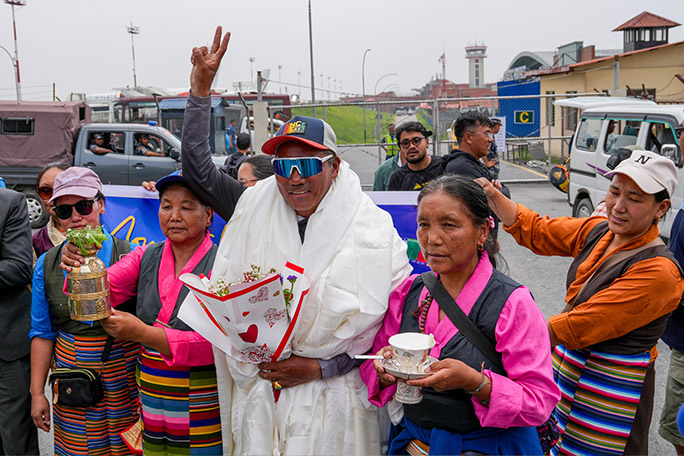
Kami Rita Sherpa on his return to Nepal's capital, Kathmandu, after his 32nd ascent. Sunil Pradhan/Anadolu via Getty Images
At 10:12 a.m. local time, Kami Rita – aged 56 – logged his 32nd summit. He first climbed Everest back in 1994, at the age of 24, and has made the gruelling journey nearly every year since when it’s been permitted, some years more than once!
There’s a close contender hot on the heels of Kami Rita’s crown in fellow Nepali guide Pasang Dawa Sherpa. He scaled Everest twice in May this year, taking his tally of ascents of the highest mountain to 31.
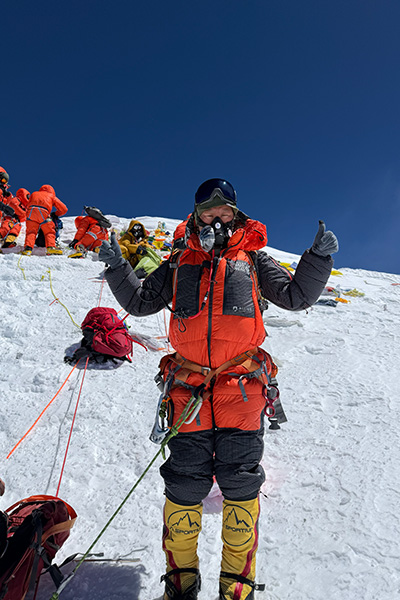
Lhakpa Sherpa at the summit of Everest for the 11th time on 17 May 2026
Lhakpa, who was born in Nepal but spent many years in the USA raising a family, meanwhile, was topping the monumental mountain for the 11th time; she reached the apex at 9:30 a.m. She completed her inaugural Everest ascent in 2000, which as with this year's expedition took the south route via Nepal.
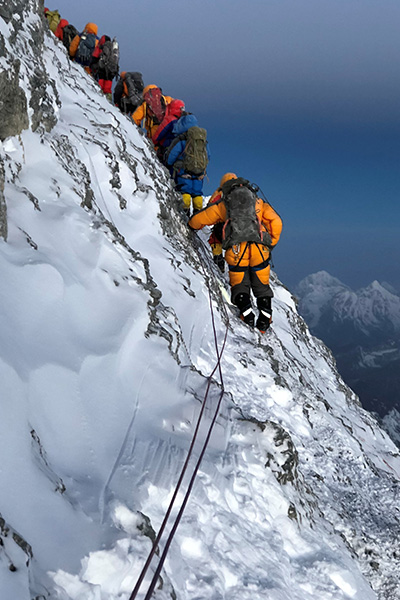
Lhakpa climbing on the north side of Everest in 2018, during her ninth ascent
Her nine other climbs to date – the last of which was in 2022 – have all been up the northern side of the peak in Tibet, China. She actually retired from mountaineering after her sixth ascent of Everest, but after a 10-year hiatus returned in 2016 to since add five more to her count.
While she may be the most prolific female summitter of Everest, Lhakpa has never allowed herself to become complacent: “Each time, I am guiding a different climber, so it feels different every time. The ice has melted significantly, especially in sections like the South Col. The mountain has changed. But my mindset is the same. I love the mountain.”
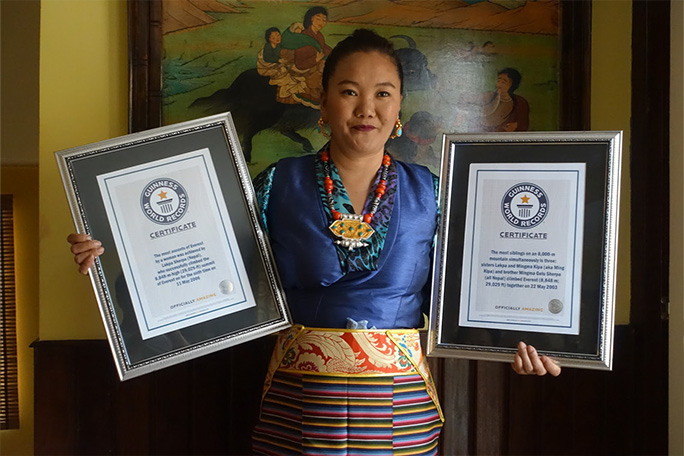
Proud Nepali Kami Rita views his long-held record as a symbol of pride not just for him but for all his country – he’s happy that his superlative climbing career has put Nepal and the Sherpa people on the map for a global audience.
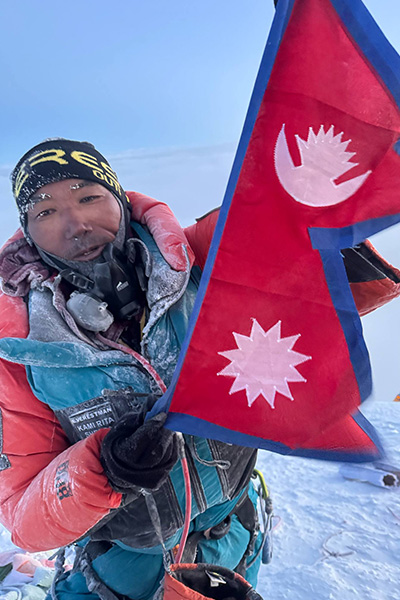
Kami Rita atop Everest for the 31st time on 27 May 2025, at the age of 55
It’s worth noting that Sagarmāthā (as it’s known in Nepal, translating roughly as “Mother Goddess of the Sky”) is extremely sacred to those born there. This is particularly so for the indigenous Sherpa whose culture, history – and even biology – has become inexorably intertwined with living (and thriving) at high altitudes in the Himalayas.
As Kami Rita told GWR, even with 32 ascents under his climbing utility belt, it never gets any easier: “The climb is challenging every time as each new ascent brings a new form of challenge like the changes in route, weather, team dynamics etc. It might seem easy, but it is tough.”
As sombre proof of this, it mustn’t be overlooked that most years there will tragically be a number of deaths among both those attempting to fulfil their life ambition and those hired to facilitate that dream – sherpas such as Kami Rita and Lhakpa. It truly remains one of the most formidable feats of mountaineering and one that should never be undertaken lightly or without a lot of preparation and respect for nature.
Lhakpa is extremely proud of how far her community has come in the last couple of decades. “When I was climbing in the 2000s, Sherpas didn’t have proper technique and skills,” she told GWR. “But now, look, the Sherpas lead the entire way, from route opening to rescues. No Sherpas means there would be many more bodies on Everest. With time, Sherpas have grown even stronger on Everest. They are mountain soldiers.”
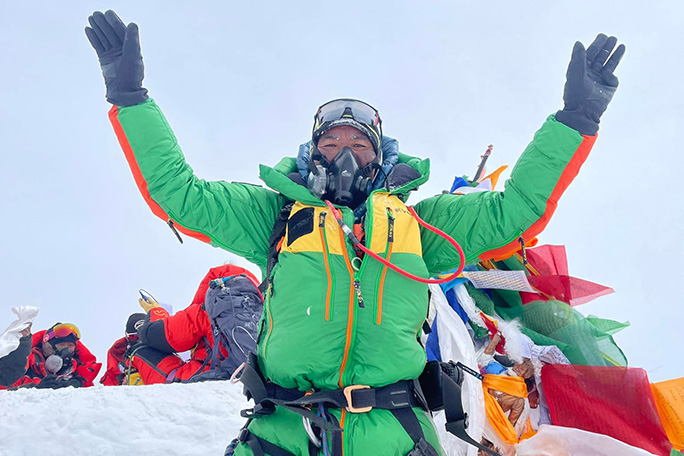
Kami Rita at the summit for the 28th time on 23 May 2023; he had scaled it for the 27th time just six days earlier
In the more than three decades that Kami Rita has been guiding people up Everest (and other lofty peaks), a lot has changed. “In the last few years, the number of climbers has risen drastically. I look back to realize that during 1994/95 the highest number of climbers on Everest would be around 70. It’s now 400-plus.
“This spike might be partly because of more and more climbers’ passion to complete the 8,000ers challenge [i.e., scaling all 14 peaks that stand higher than 8,000 m/26,247 ft], so the number of climbers increasing is not just seen on Everest but across almost all 8,000er mountains.”
Indeed three days after Kami Rita and Lhakpa completed their ascents, on 20 May, Everest saw an unprecedented 274 people push for the summit from the Nepali side.
That does not take the outright title for most ascents of Everest in one day, however. On 23 May 2019, when factoring mountaineers on both the southern Nepali route and the Tibetan side, the total came to 354. By contrast, in 2026, the Tibetan side was closed to foreign climbers, resulting in a lower overall total.
For Kami Rita, this direction of travel is not particularly a positive one. He expressed his concerns about overcrowding and the risks this poses when talking to reporters in Nepal’s capital, Kathmandu, on returning from his 32nd ascent. “It was very crowded this year compared to last year. There is a need for authorities to control this number.”
The big question is, does Kami Rita think he has a 33rd ascent, or beyond that, still in the tank? He’s certainly not ruling it out, though clarified that in the world of guiding it’s largely out of his hands. “The rise in climber numbers has brought a different challenge as it’s hard managing a big group,” he explained. “Guides have to take care of a large number of climbers compared to previous years which is tricky at high altitudes.
“It all comes down to if climbers ask for Kami Rita to be their guide. If someone personally requests for my guidance on Everest, I’d be happy to lead again. I’m not as motivated to make more summits just for myself. We are guides. We mostly do not climb for ourselves.”
We put the same question to Lhakpa on whether she has plans to return to Everest in the years to come and her response was pretty resolute: “I struggled a lot to climb Everest. I did house cleaning and many other jobs just to be able to climb mountains. Now my children are educated, settled abroad and all grown up. They tell me, 'Mama, you can do whatever you like.’
“I meet my friends in the mountains. I could go and settle in the USA, but that is not who I am. That would be too boring for me. I’m a climber, and climbing is what fills my soul, so I can’t leave this. I also have my hiking business and I'm taking adventures professionally now. The outdoors has been a big part of my life. I think, if I’m able, I will keep climbing until I’m 80.”
It’s because of climbers’ fascination with Everest as the top of the world that I was involved from the early days and the dynamics of Himalayan mountaineering rather drew me to Everest. To be clear, no 8,000er mountain is easy. I might have become a bit familiar with Everest over all these years, but the sheer altitude and weather challenges, also mixed with a huge number of climbers, make it tough – Kami Rita Sherpa
Finally, for anyone that has attempting to scale the highest mountain on their bucket list, who better to ask for tips than these two veterans?
Kami Rita offered these words of wisdom: “My message to climbing enthusiasts would be to prepare before taking on an 8,000er. A 7,000-m [22,966-ft] mountain would be a great way to learn climbing fundamentals, adapt to the high thin air and mentally prepare you for a smooth 8,000er or even an Everest expedition.”
For Lhakpa, it’s as much about self-belief as it is preparation: “Keep your dreams alive. Don’t start with negativity and doubt everything. Mental fortitude is the first thing. If you believe in yourself, there is nothing you can’t do.”
The very first people to top Everest were New Zealand's Edmund Hillary and his Nepali guide Tenzing Norgay (b. Tibet, China) on 29 May 1953. The first woman to summit Everest was Junko Tabei (Japan) on 16 May 1975. The first solo Everest ascent was completed by Reinhold Messner (Italy), who reached the summit on 20 August 1980 after three days of climbing from his base camp at 6,500 m (21,325 ft).