
How inspirational GWR ICON Hari Budha Magar is changing attitudes about disability
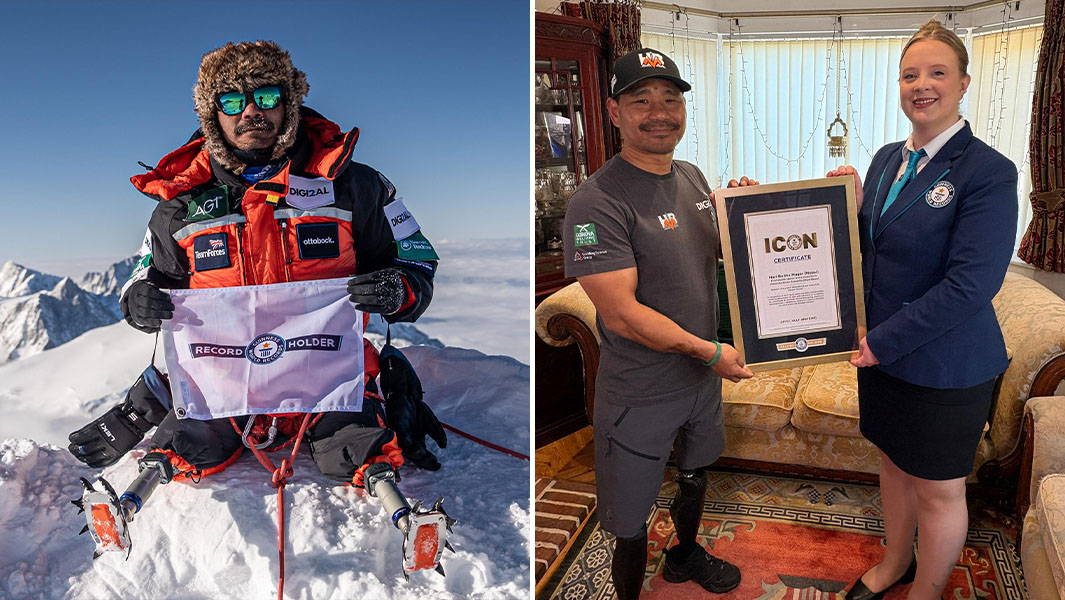
Hari Budha Magar (Nepal) is a true GWR ICON and absolute proof that nothing should ever stand in the way of your dreams.
The inspirational former Gurkha soldier suffered horrific injuries while serving with the first battalion the Royal Gurkha Rifles (1RGR) in the British Army in Afghanistan.
On 17 April 2010, he lost both of his legs above the knee, but even that couldn’t stop the determined adventurer climbing to the top of the world.
On 19 May 2023, the father-of-three became the first double above-knee amputee to climb Everest (LA3).
The LA3 in his record title refers to our impairment categories that make record breaking accessible to everyone, and that’s exactly why Hari, who now lives in the UK, took on this challenge – to inspire other people by changing perceptions around disability.
Before tackling the world’s highest mountain, the highest Hari, 46, had gone was climbing Mt. Kinabalu in Sabah, Malaysia (4,095 m) as part of his military training.
Everest is over double that at 8,484.86 m.
Hari told us: “For me this wasn’t about a record. It was about fulfilling my childhood dream to climb Everest but I also wanted to make awareness of disability. And being Nepalese, we are proud that Everest is in Nepal, we are very patriotic and proud of it and we take it as indemnity, symbol and pride.
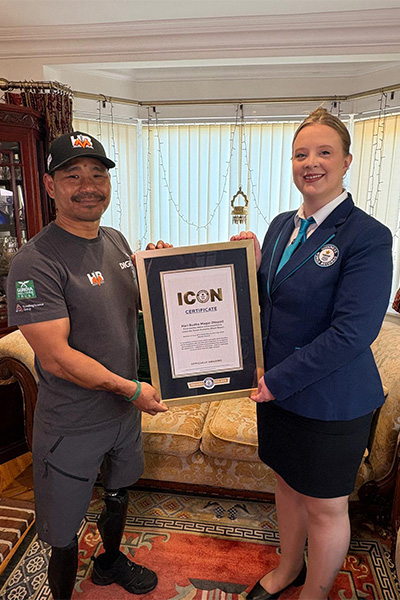
Hari with Guinness World Records Adjudicator Emma Salt
“I wanted to change perceptions around disability, not just how we perceive ourselves but how others perceive us. When I became disabled, I wasted nearly two years of my time not knowing what I can do.
“I thought my life had ended. I would be looked down on. I perceived myself as a burden on this planet because I thought I couldn’t do anything and my life was not worth living, I also thought it was a sin of my previous life, I may have done something wrong in my past life, so I’m being punished. This is how many people with disability around the world are perceived.”
Read about more inspirational athletes in our Sports and Fitness section.
Hari prepared for his epic Everest trek by climbing smaller mountains first and was the first ever double amputee to climb to over 6,000 m.
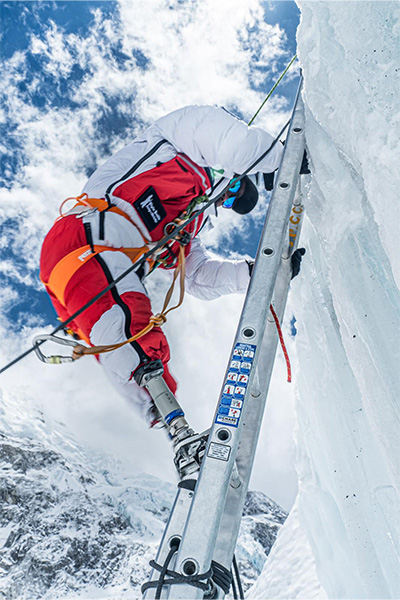
Hari climbing Everest
Among the mountains he tackled before Everest were Mont Blanc, Kilimanjaro, Chulu Far East and Himlung Himal.
His efforts were made all the more difficult by the fact that he couldn’t find any prosthetic legs designed for a double above-knee amputee to climb in ice and snow. But he got around it by designing his own.
But that wasn’t the only obstacle.
He said: “Nepal government banned double amputees and visually impaired people from climbing any mountain over 6,500 m in Nepal, so we lobbied, campaigned at United Nations in Geneva but it didn’t work, so we filed the case in Supreme Court in Nepal and won.”
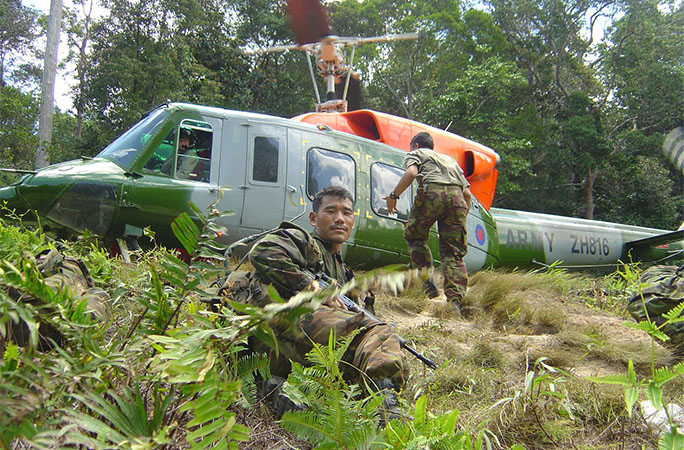
Hari while he was serving in the army
Hari also had to adapt the climb accordingly for his ability, taking everything from his prostheses to the kit he used and route he climbed.
He said fundraising was also very difficult, with people reluctant to sponsor him because they simply didn’t believe he could do it.
Proving them wrong by reaching the summit was an emotional moment for Hari.
He said: “It was an amazing feeling! I couldn’t believe myself. I hugged everyone and cried so loudly! I’m not sure how we did it. Where did we get that energy? We had to face many people say 'no', 'can’t', ‘impossibles’, ‘dangerous’.
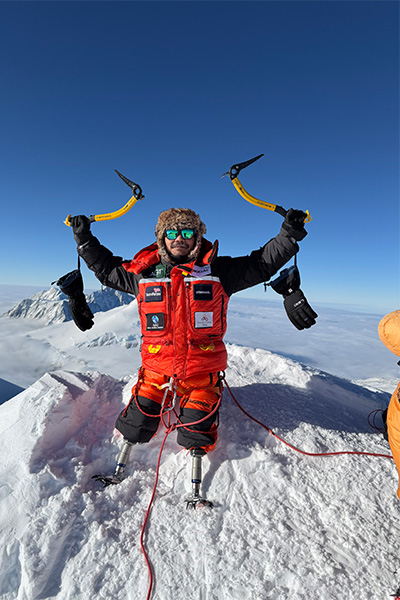
Hari on top of Vinson
“But somehow it’s done, it’s not just Everest but I climbed the Seven Summits - the tallest mountain on all seven continents and created history and made awareness of disability and inspired people around the world.
“We also gave people courage to challenge themselves and conquer their dreams but also gave hope and optimism to people who are struggling.”
Indeed, Hari is also the first double amputee to climb the Seven Summits (Mount Blanc) after also tackling Mount Black (Western Europe’s highest peak instead of the more standard Elbrus in Russia), Kilimanjaro, Denali/McKinley, Aconcagua, Puncak Jaya and Vinson.
That means he’s also the first double above-knee amputee to climb Mount Vinson and the first double above-knee amputee to climb Puncak Jaya.
He’s also been awarded an MBE and a Pride of Britain award.
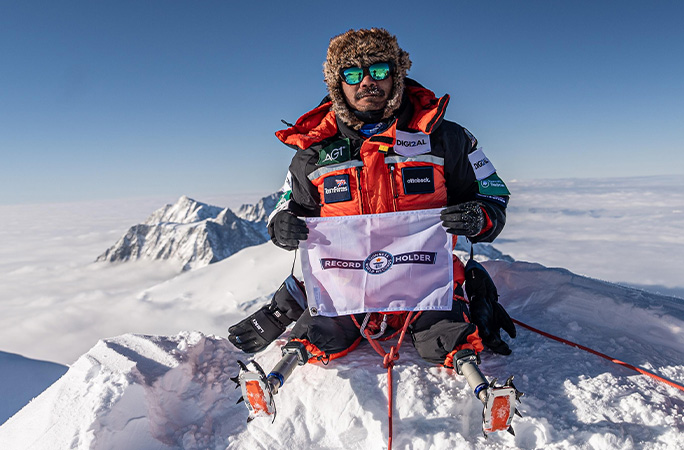
To someone who wants to climb Everest but thinks they aren’t capable of it, Hari says: “If you adapt your life according to time, situation and your ability, you can make anything possible. That’s what I did.
“I say ‘life is all about adaptation - Nothing is impossible.’ But respect the nature and adapt accordingly, nature is way more powerful than humans. If you don’t respect, it will kill you. Nature doesn’t care how strong, powerful, rich, famous you are, it will kill you.”
Determined as ever, Hari says he’d love to break more records, but for now he’s concentrating on raising awareness around disability and inspiring others.
He’s also written a book, Conquering Dreams, that will be published on 27 August, and is working on a documentary.
Hari said: “I would like everyone out there to help me to make awareness of disability around the world. People with disabilities don’t choose to be disabled.
“I was able-bodied up to the age of 31 and I became disabled when I was doing my job. It can happen to anyone in the blink of an eye. Whether you like or not, many people are becoming disabled every day.”
He added: “There are 1.3 billion people with disability living in the world. My four family members are affected by my disability, even if two members are affected by one person with a disability, it’s nearly half of the world’s population affected by disability.
“If people with disability get the right support, we can do anything and live happy, successful and meaningful lives like any other person in the world. Some parts of our body or mind might have weakness, that doesn’t mean that we can’t do anything. Nobody is perfect in this world, we all have some kind of weakness. Please help and support a person with disability, if you can. Together, we make the world a slightly better place.”