

Record-breaking works of art that have shaped our world: from da Vinci to Banksy
Grab your paints and felt-tips: Wednesday, 15 April is World Art Day! This global event is dedicated to championing artistic diversity and the myriad ways in which art can enrich our lives. First proposed at an assembly of the International Association of Art in 2012, World Art Day is now supported by UNESCO.
Why 15 April? The date was chosen to coincide with the birthday of one of history’s greatest artists: Leonardo da Vinci. An Italian Renaissance polymath, he excelled as an inventor (he’s credited with the oldest android and tank designs) engineer, architect and scientist, but it’s for his spellbinding artworks that he is best remembered today. Leonardo’s Salvator Mundi (“Saviour of the World”; c. 1499–1510) – which depicts a serene-faced Jesus Christ with his right hand raised in blessing – is currently the most expensive painting ever sold. The masterpiece was bought anonymously for $450,312,500 (£343 million) at an auction held at Christie’s New York, USA, on 15 November 2017.
Leonardo da Vinci
— Art Guide (@ArtGuide_db) March 4, 2026
Salvator Mundi, 1500 pic.twitter.com/QPLEm6K0zm
It’s not Leonardo’s most famous painting, though. That accolade belongs to the Mona Lisa (1503–17), whose beguiling smile has been entrancing audiences for half a millennium, and which has long been the most visited artwork in the Louvre museum in Paris, France. But in 1911, it made headlines for all the wrong reasons, when an audacious thief walked into the Louvre dressed as an employee, and walked out again later with the Mona Lisa rolled up under his arm. The scandal was headline news around the world. Among other suspects, another of history’s most celebrated artists – Pablo Picasso – was arrested, though quickly released.
After the painting’s recovery from Florence, Italy, in 1913, it emerged that the light-fingered thief, Vincenzo Peruggia, had wanted to “return” La Gioconda (as she’s also known) to her homeland. In the event, the theft only added to the Mona Lisa’s celebrity. For an unprecedented tour to the USA in 1962–63, it was insured for $100 million (£53.55 million) – still the highest insurance valuation for a painting. You might be surprised to hear, however, that today it is uninsured. This painting’s cultural and historical importance makes it irreplaceable; you can’t put a price on it.
Read about more record-breaking works of art in our Arts and Entertainment section.
Art is hard-wired into us, and the impulse to be creative has been a part of humanity for millennia – witness the famous cave paintings of humans, animals and intriguing abstract symbols at Lascaux in France, which date back some 20,000 years. The oldest non-figurative cave art, however, is even older: a reddish-brown stencil of a hand dated to at least 67,800 years ago was discovered alongside other Palaeolithic artworks in the Liang Metanduno cave on Muna Island in south-east Sulawesi, Indonesia. One of the fingers in the artwork seems to have been narrowed by the artist to create a more claw-like shape – the sign of an active imagination at work.
In September 2008, excavations at Hohle Fels cave in the Swabian Jura of south-western Germany uncovered a fragmented female figurine carved from mammoth ivory – the oldest sculpture and oldest figurative art. Known as the Venus of Hohle Fehls (“Hollow Rock”), this voluptuous figurine is between 35,000 and 40,000 years old and is only 6 cm (2.4 inches) tall; there’s a lumpy protrusion where the head should be, with a hole in it, suggesting that it may have been worn around the neck as an amulet or pendant. Unlike older bone or rock carvings of animals, the statue blends a recognizably human form with abstraction, making it a true art sculpture.
What do we know of the religion of Paleolithic Germany around the time they were creating written language? Why they were members of the oldest known cult, the cult of the mother goddess. The Venus of Hohle Fehls is about 40,000 years old and comes to us from Germany found in… pic.twitter.com/XU2ilK8Swj
— Archaic Lens (@ArchaicLens) February 25, 2026
Making art is its own reward. Creating an original artwork from nothing can be deeply satisfying, immense fun and works wonders for our mental well-being; it’s little wonder that art therapy can prove so effective. There are myriad ends to which artists have applied their craft, of course. Since the 1990s, the mysterious British artist known as Banksy has made his name with witty, thought-provoking street art that often takes governments, or the wealthy elite, to task. And this enigmatic figure always has a trick or two up his sleeve. In 2018, a framed version of his work Girl with Balloon (2006) sold for £1.042 m ($1.353 m). As soon as the auctioneer’s hammer fell, however, an artistic “intervention” kicked in. To the astonishment of onlookers, Girl with Balloon began to self-destruct, via a device concealed inside its ornate frame, until about half of it had been shredded and left dangling. Thereafter, the painting became Love is in the Bin (2018), a cheeky title bestowed by Banksy’s representatives. On 14 October 2021, Love is in the Bin sold for £18,582,000 ($25,327,400) at Sotheby's in London, UK, becoming the most expensive work by Banksy.
There are all sorts of ways to make art, of course, and not all of them involve using your hands… The largest painting by mouth (individual) measured 93.97 m² (1011.48 sq ft) – or around 30 times larger than a king-sized bed – and was created by Indian artist Shrishail Gasti, in Karnataka, India, as confirmed on 5 December 2017.
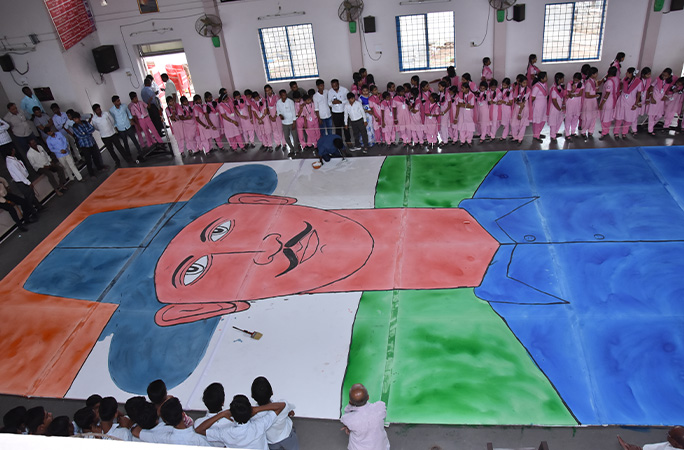
The largest painting by mouth
Shrishail’s compatriot Vaibhav Kumar Sharma produced the largest painting by foot (individual) – a 189.89-m² (2,043.95-sq-ft) depiction of a yoga meditation – which was measured in Ramgarh, Jharkhand, India, on 30 November 2023. Meanwhile, for devotees of digital dexterity, the largest fingerprint painting was a colossal 1,195.14 m² (12,864.37 sq ft) – around two-and-a-half times the size of a basketball court – and was painstakingly created by Kuang Xianpeng (China), as verified in Zhuzhou, Hunan, China, on 26 May 2018. Incorporating more than 4.8 million individual fingerprints, and two years in the making, Descendants of the Dragon portrays six Chinese dragons and six ancient Chinese arts: music, mathematics, calligraphy, archery, charioteering and rites.
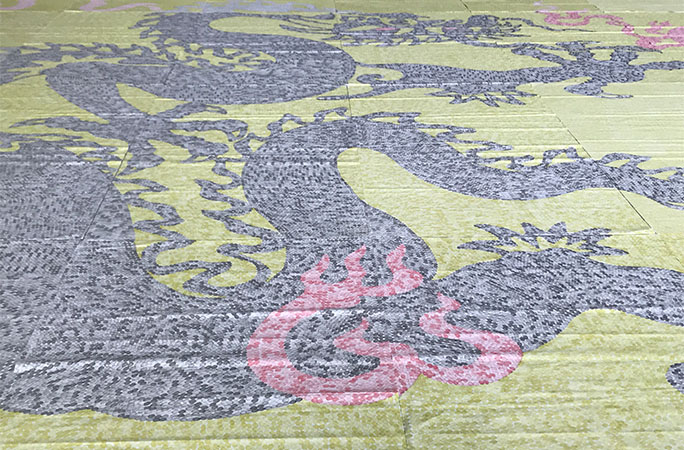
The largest fingerprint painting
And while we’re at it, who says there’s only one way to draw? The largest freehand drawing is an expansive 4.86 km (3.02 mi) in diameter and comprises 1,000 individual circles. Its creator, Jim Denevan (USA), made the outsized artwork in the Black Rock Desert, Nevada, USA, in May 2009 in seven days, by etching the sand with a rake and using chains dragged behind a vehicle.
Jim Denevan (born 1961) is an American chef and artist who creates temporary land art. He works with natural materials to create massive scale drawings in sand, ice, and soil. His sculptures are not placed in the landscape, rather, the landscape is the means of their creation. pic.twitter.com/VH0sgLsiP8
— Oksana Ivanik Art (@ivanik_oksana) August 1, 2018
All of which just goes to show that the only limit on art is our own imagination. From paints, ink and collage to clay, sand or computer screens, all’s fair in art. So grab that paintbrush – or rake – and embrace your inner artist on 15 April!
Header image: Photo by Daniel von Appen on Unsplash