


Grow big or grow home: insider tips from record-breaking giant pumpkin pros
As the days draw longer and temperatures start to rise with the arrival of spring in the northern hemisphere, many gardeners will be contemplating which fruit and vegetables to try their hand at growing this year.
For competitive horticulturalists hoping to produce a world-record specimen, this process comes with many more variables to consider than merely which crops you find particularly attractive or tasty.
Of course, this isn’t to downplay gardeners that are content to enjoy the experience of nurturing plants, spending time outdoors and hopefully ending up with some delicious organic goodies come harvest time. But as with any scenario where a world record is on the line, it requires an extra level of commitment and planning, usually bolstered by a wealth of experience gleaned from many years of trial and error.
When it comes to the world of superlative fruit and vegetables, one reigns supreme over all others: giant pumpkins. With an almost fairytale-like quality, these supersized squashes eventually dwarf the humans that cultivated them from a tiny seed, by the end attaining the equivalent size of a small car.
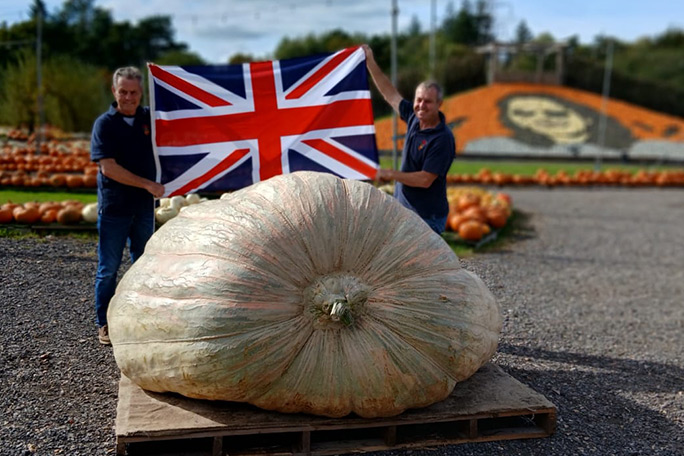
The current titles for both the heaviest pumpkin and the largest pumpkin by circumference were claimed by a single monster specimen, nicknamed “Muggle”, that was harvested in the UK in 2025.
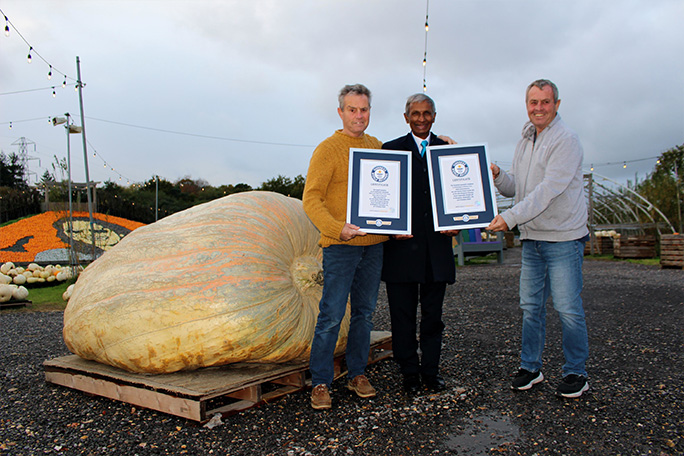
After half a century of growing pumpkins together and winning many local and national prizes, twin brothers Ian and Stuart Paton (both UK), who were already well respected in the pumpkin-growing community, finally bagged their debut world title.
When their Atlantic Giant was assessed on 6 October 2015, it tipped the scales at 1,278.8 kg (2,819 lb 4 oz) and measured 649.8 cm (255.8 in; 21 ft 3.8 in) around. Muggle’s superlative stats were ratified by representatives of the global competitive horticultural body, the Great Pumpkin Commonwealth.
Prior to the Patons, American horticulture instructor Travis Gienger wore the pumpkin-g crown for two years. His gargantuan gourd (which he christened “Michael Jordan” owing to its basketball-like shape in its early weeks of growth) was measured at the Safeway World Championship Pumpkin Weigh-Off in California, USA, registering a whopping weight of 2,749 lb (1,246.9 kg) on 9 October 2023.
The following month, thanks to the deft carving skills of sculptor Eric Jones (USA), Michael Jordan was transformed into the heaviest jack o’lantern, given a facelift with a series of military motifs in honour of Veterans Day.

With spring in the air, for anyone harbouring ambitions to grow the next record-breaking pumpkin, GWR asked Ian Paton and Travis Gienger for their top tips on where to begin and the steps that beginners can take to help your gourd attain its full potential.
First off – and possibly the most crucial element of the whole process – is deciding which seeds to plant. In the world of competitive gardening, whatever the species, obtaining seeds from specimens with a proven track record of producing XL fruit immediately puts you at a major advantage, so it’s well worth taking your time and doing your homework at this stage.
Thankfully, the horticultural community is surprisingly generous when it comes to seed sharing, as Ian told us: “Seeds can often be obtained with great genetics for free online, which I would do for the first few years. Later on, once you’ve gained a bit more experience, you could look at seeds from past record breakers that you’ll likely need to pay for.”
Travis concurred: “There are plenty of growers out there who will give you seeds for basically the price of postage. If it’s your first time, try to find seeds with genetics descended from large pumpkins. Most growers are pretty forthcoming with this information. Joining an online forum like the Facebook group “Garden of Giants” is a great place to start and there will always be people willing to help.”
The great part about growing giant pumpkins nowadays is that information is readily available. A first-year grower with the energy, time and willingness to learn can oftentimes do better than a veteran. Just keep your goals in check and don’t go too overboard with how many plants you grow – Travis Gienger
Once you’ve obtained your seeds, the next big question is: when is the best time to sow them, and of course in what conditions?
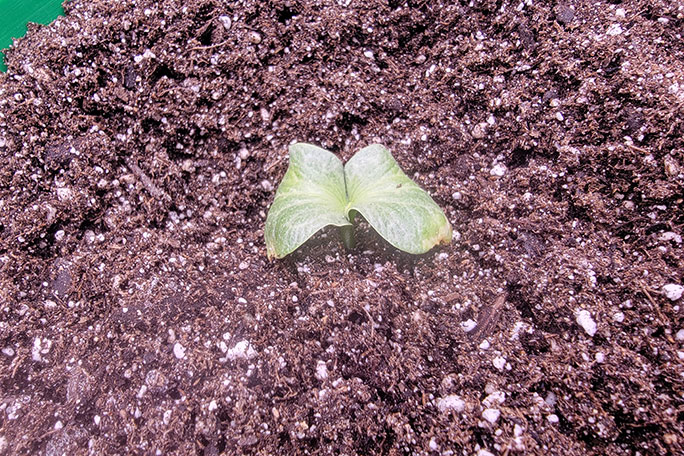
For Travis, he has a very specific date that he gets the ball rolling: “I start my seeds on 10 April indoors. I then let them grow indoors for about two weeks before transferring them outside to a heated enclosure. I live in a pretty cold climate so protecting the young plants is a must. Not only is the cold not great for a young plant but simple things like wind, critters, storms and even intense sun can harm a young seedling.”
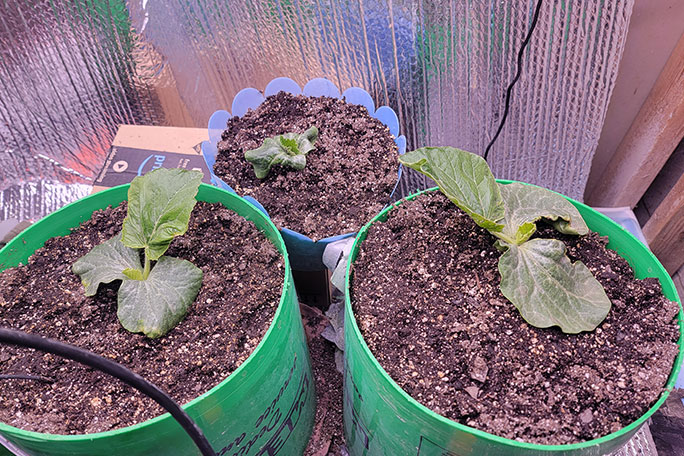
From Ian’s perspective, it depends on if you’re planning on growing the pumpkin indoors for the entirety or intending to move them outside once they’ve got started. (For reference, the Patons have long grown their giant pumpkins – including their world-record specimen from last year – in a polytunnel for the whole season, so this method clearly gets great results. “If you intend to grow inside, you can sow seeds at the end of March, otherwise sow at the end of April or beginning of May,” he advised.
So what can you do to give your seeds and later seedlings the best possible chance to thrive? Ian’s recommendations include: “When sowing seeds, it’s best to sow them in a good-quality potting compost and put them somewhere warm like an airing cupboard until they germinate. After that, they can go onto a windowsill. Always add in extra so that you can pick the strongest for planting out.
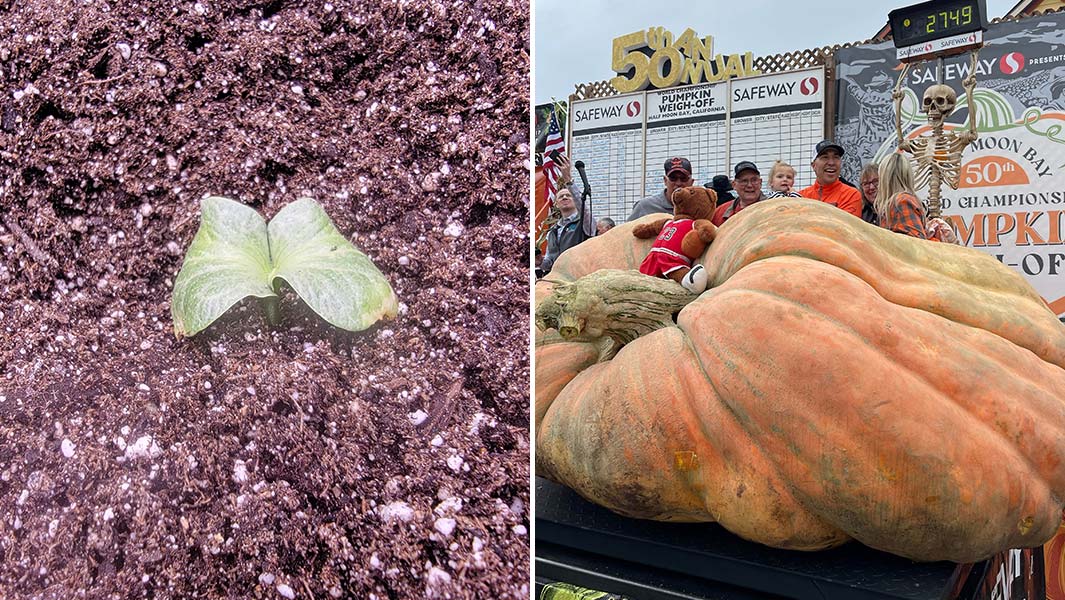
“Plant out as soon as you see the first true leaf. We plant with the first true leaf pointing the opposite direction of the way you want the plants to run.”
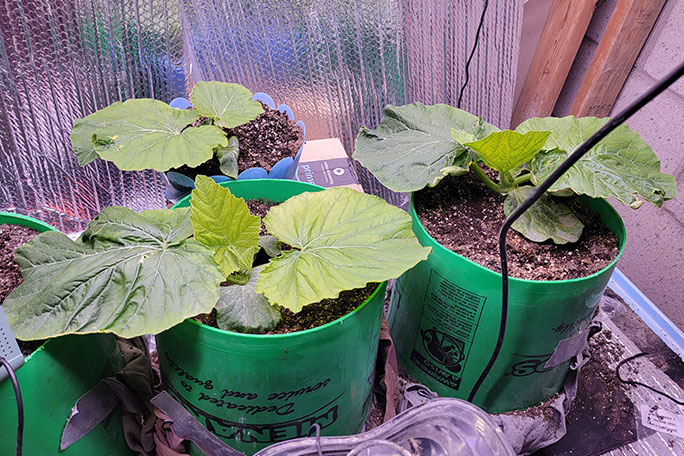
Travis follows a similar process with his young plants. “I start indoors around 85°F [29°C], humid and with good lighting. I use a high-quality potting soil, with not too much fertility. Not too wet, not too dry, just semi moist. A fluorescent light that is close to the plants is cheap and works effectively; otherwise a good LED grow light can work wonders.
“The bigger the pot, the better to start in. A lot of people will use a small cup and the roots expand so quickly. A good way to tell if your plant is happy is that it shouldn’t be stretching for light. If you want to give it anything early, start with a little fish/seaweed or seaweed at half the rate and slightly work up. Biologicals are playing a huge role nowadays too. Things like azosprilium, mycorrhiza and Bacillus species are all helping unlock the goodies in the soil.”
Once you’ve (hopefully) got a number of seeds that have successfully germinated, how do you know which seedlings are the strongest candidates to take forward?
Travis explained his approach: “I am a little different in that I often start two and those are my plants that turn into hopefully record pumpkins. A lot of growers will plant multiple and select the best ones, but if I am paying $800 for a seed sometimes, I am planting it! To choose the best one, I look for things like vigour, growth, colour, leaves etc. I don’t usually let them go too long.
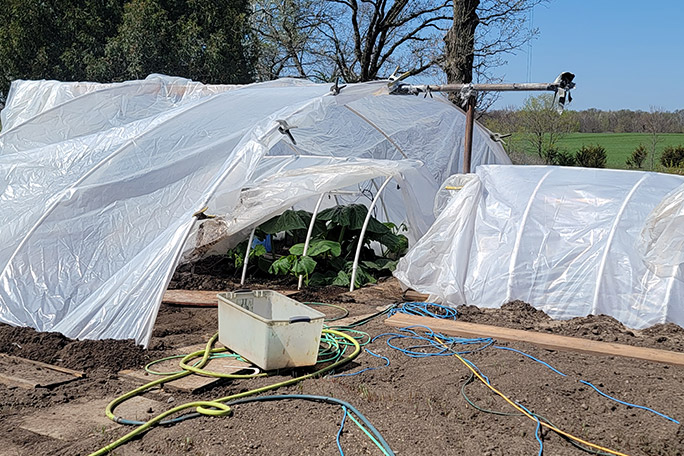
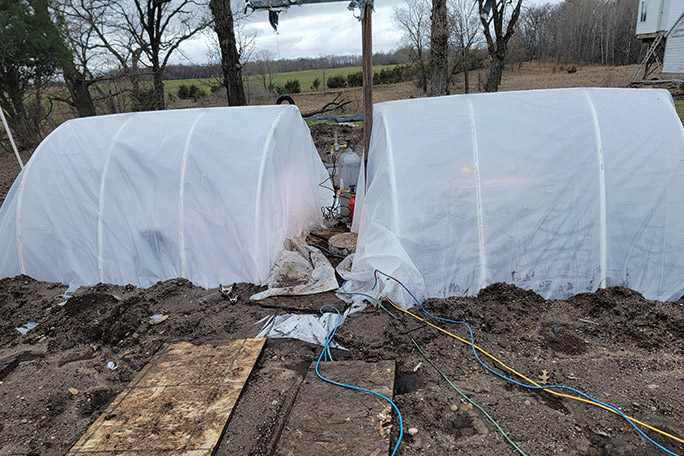
“Once I transplant outside, I use soil heating cables, heaters, grow lights and they go into a small hoop house. I try to keep the conditions fairly similar and, if they outgrow the small hoop house quickly, which they do, I then build a larger structure. When the weather looks favourable (i.e., nights in the mid 50s, days in the 70s), I may let them roam on their own outdoors.”
Even when you’ve done everything in your power to give your pumpkin plants the best start and conditions in which to flourish, there will inevitably be setbacks. It’s all part and parcel of gardening, whether you’re an amateur or a veteran grower.
For Ian, the biggest problems he’s encountered with giant pumpkins are “aphids can be a problem in the summer and downy mildew in the autumn growing outside. The biggest problem will be windy days as pumpkins have very big, soft leaves."
After 50 years growing pumpkins, you learn to live with many ups and downs but once you have the bug it’s difficult to stop – Ian Paton
Travis offers one tip that has helped protect his pumpkin vines over the years. “For me, getting a plant established is the crucial part. We want to protect them from winds, storms, hail and intense sun, which can fry the young tips. I will often position a small chair over the end of a vine that may shade it slightly, while a piece of netting can help protect the vine from being eaten by critters.”
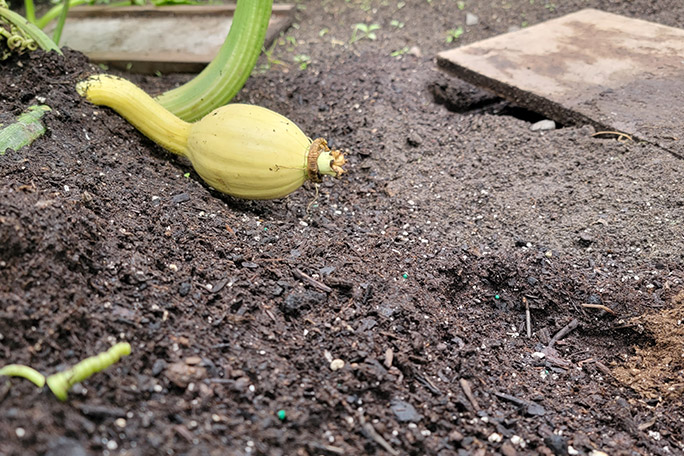
Often the final piece of the puzzle is choosing a single fruit on the vine to be “The One” you are going to take forward, though – defying conventional wisdom – Travis believes it doesn’t hurt to also keep a backup: “I feel like keeping two pumpkins on a plant doesn’t hurt – we’re just scared to prove that theory but it’s coming, trust me!
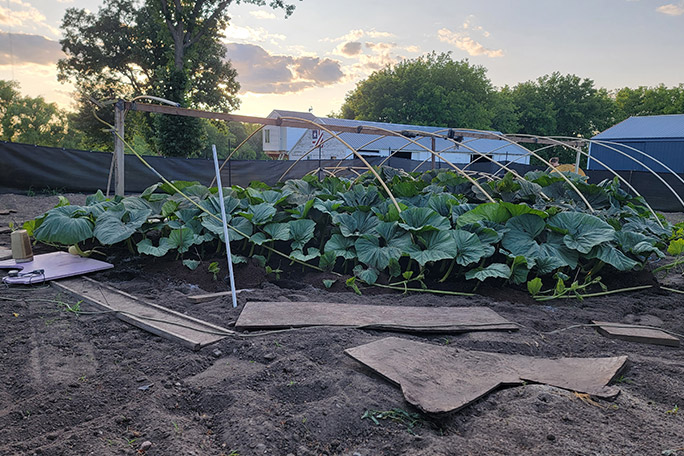
“The idea regardless is to focus a fairly large plant around the pumpkin. You’re trying to direct all the sugar water to the pumpkin by having a vast branching structure almost like a tree where that energy is all going to a fruit. Once your plants fill the allotted space, you can trim them back and the growth will all go towards the pumpkin.
“In terms of the signs, I am looking for things like shape, vine positioning, stem length and potential problems that may arise. If anything looks damaged or of concern I may opt for one farther down.”
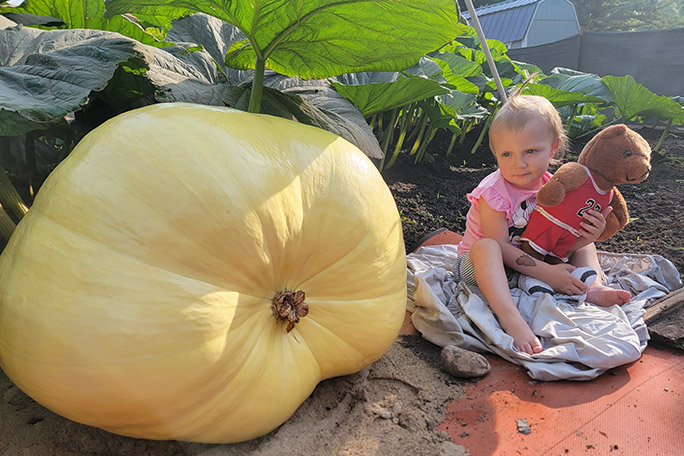
Ian’s approach to pumpkin selection is more straightforward: “We are looking to pollinate a pumpkin anywhere after 10 ft [3 m] out on the main vine. We pollinate the first two pumpkins and pick the best-looking one. It’s important to put a bend in the main vine to stop the shoulders of the pumpkins pushing themselves of the plant.”
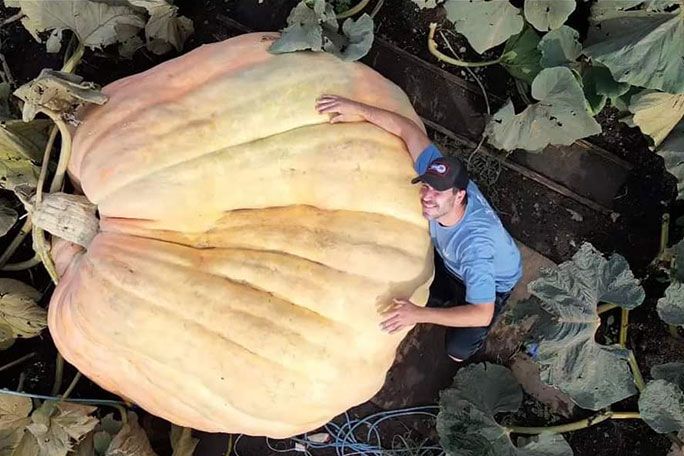
Sometimes, even when going for a world record, it can be important to remember that unless you’re enjoying the process, the journey is going to be much tougher – as both our experts agree.
“This is a super-fun hobby and it’s important to never lose sight of that,” Travis told GWR. “Things are going to happen, problems will arise, some years you might not even have a pumpkin. Through it all it is important to keep a positive attitude and be hopeful.”
And for those who might not quite be in the position to take on giant pumpkins just now, Ian concludes with this suggestion: “Not everyone will have the land or money to grow giant pumpkins, but field pumpkins are much smaller plants and prefer to be planted outside. It makes them perfectly suited to be grown by children.”