


Jeannette Piccard: The first woman in the stratosphere
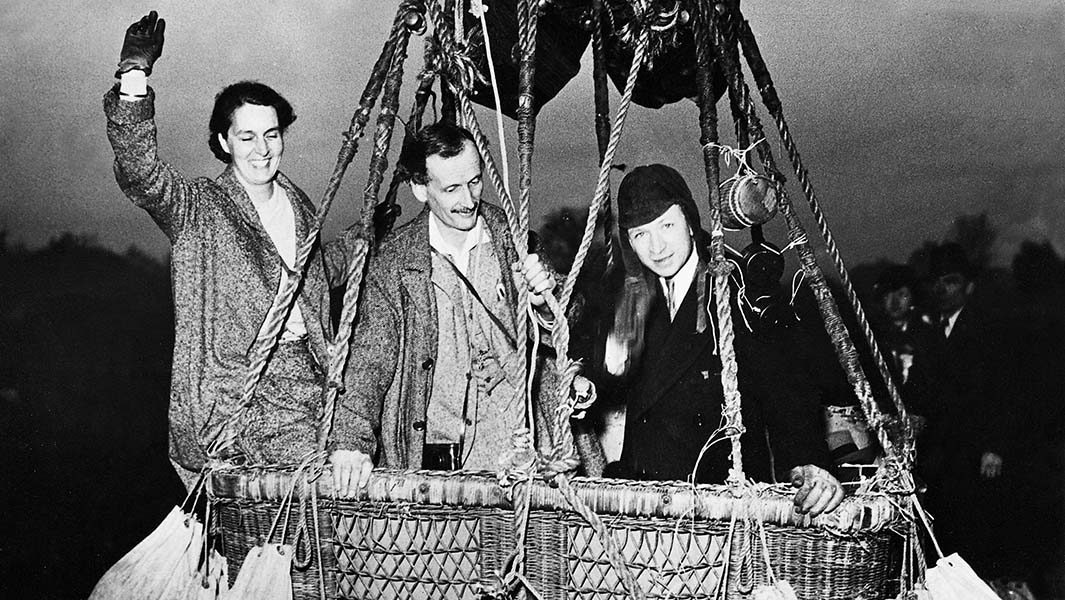
Flying in a free balloon is very different to travel by aeroplane, helicopter or even glider. In a balloon there is no engine noise, no rush of air over wings and airfoils – the wind blows and you move with it. To a balloonist on a calm day, the air seems perfectly silent and still while the ground slides past below.
At around 3 a.m. on 14 June 1934, Jeannette Ridlon Piccard was taking a moment to enjoy this strange silence. Her balloon was floating over suburban Detroit, Michigan – the lights of Motor City's factories visible over her shoulder. A gentle breeze was carrying her to the north east, parallel to the border between Canada and the USA, and everything was going as planned.
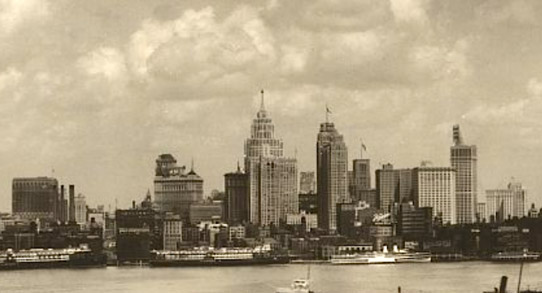
The Detroit skyline in 1929. Jeannette Piccard had to quickly drop ballast to avoid this cluster of skyscrapers. (Wikimedia Commons)
She was jolted from her reverie by a voice – "Hello up there!" – calling from below. She leaned over and shouted down a greeting, once again surprised and amused by how well sound travelled from the ground to her slow-moving basket. They spoke briefly – her in a balloon, him in a car driving along the darkened streets below – and as she drifted out of earshot, she heard her conversation partner telling someone, "there’s a balloon up there and there’s a girl in it all alone!"
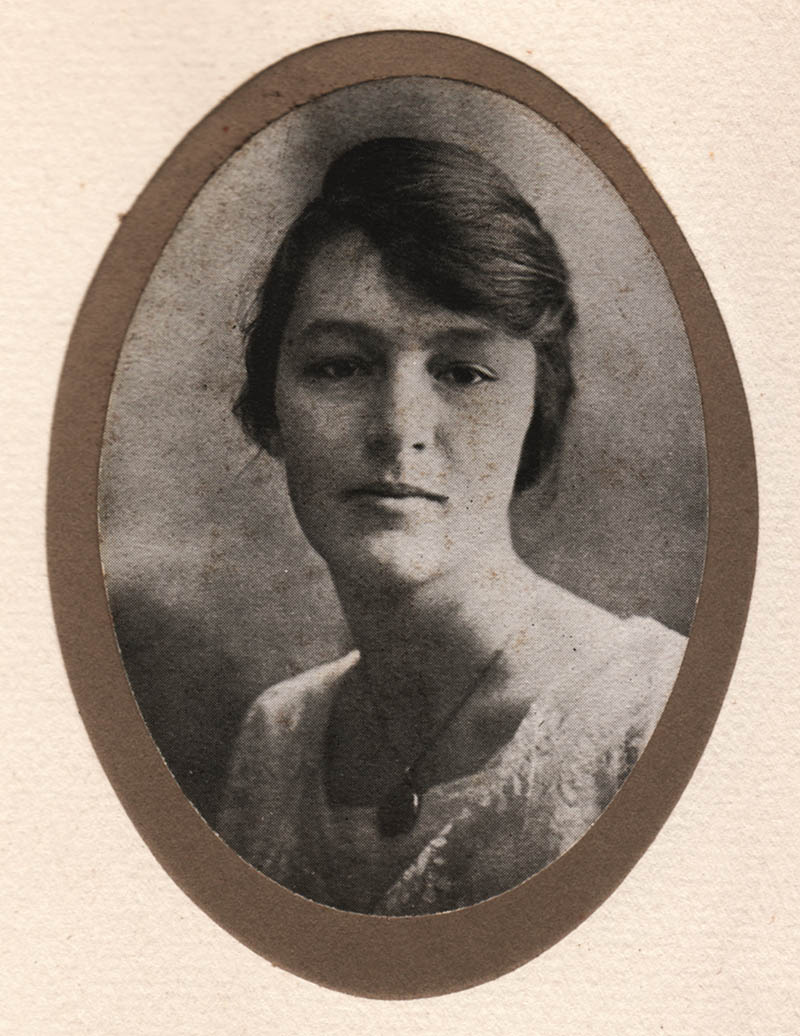
Jeannette Ridlon as a young woman in 1914. Courtesy of The Shipley School, Jeannette's alma mater.
Jeannette was tickled by the idea of the shock he would have if he saw her. His damsel in distress was a 39-year-old mother-of-three, a trained chemist whose life had taken her from Chicago, to Switzerland and now back to the Midwest. She was wearing men's tweed trousers and a heavy overcoat and had a large hunting knife clipped to her belt, ready to cut open ballast bags or slash at tangled rigging.
Troubles and responsibilities
For Jeannette, this night was a actually rare moment of calm. Despite the dangers and difficulties of flying this machine, it was the first time in months that she'd gotten to experience uninterrupted quiet. Her three young sons were at summer camp, her frail and elderly parents were at home and her family's financial struggles could, for the moment at least, be forgotten.
The chain of events that had led to this night-time solo flight were set in motion in January 1932. Her husband, the Swiss-born scientist Jean Felix Piccard, got the news that his employers would be letting him go. Like many other families during the Great Depression, the Piccards had to set out in search of work.
They got a lucky break in the summer, when Jeannette's brother in-law, the physicist Auguste Piccard, smashed his own world record for the highest altitude reached by humans. He flew a balloon called FNRS to an altitude of 16,201 m (53,150 ft) and in the process became an unlikely global celebrity.
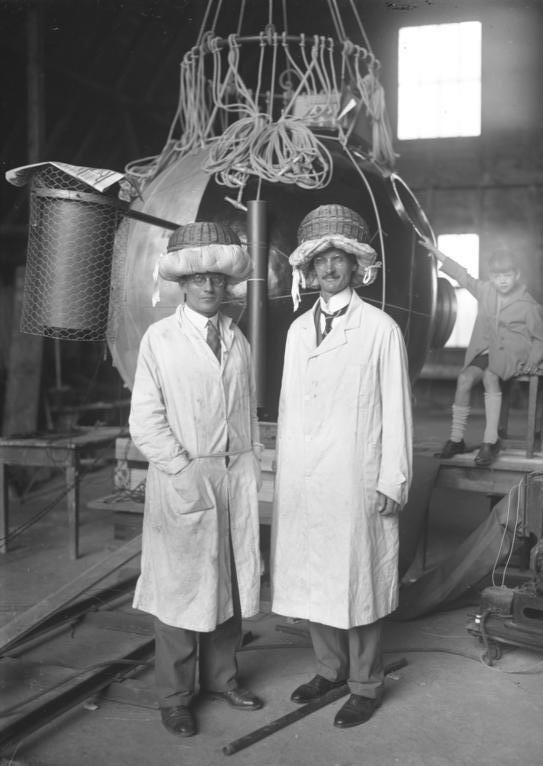
Auguste Piccard (right) and his assistant Paul Kipfer, posed in front of the revolutionary pressurized gondola of FNRS. The cushion-stuffed fruit baskets were for safety, obviously.
When he arrived in the US for a sold-out lecture tour, Auguste hired his brother to act as an interpreter. This brought Jean into contact with various organizations eager to repeat Auguste's feat on American soil, reclaiming the record that had previously been held by US Army balloonist Hawthorne Gray.
A group of industrialists and promoters pitched the idea of a stratospheric flight to coincide with the 1933 Chicago World's Fair, and Auguste put forward his brother as pilot and scientific observer.
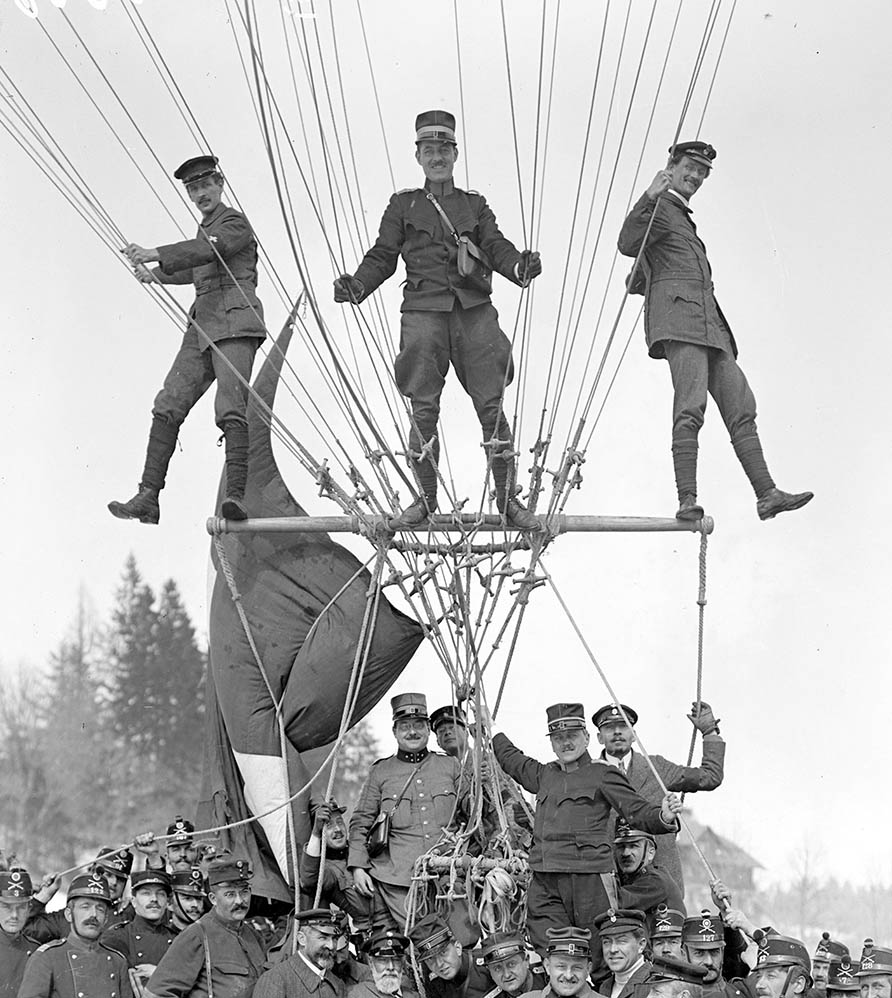
The Piccard brothers in the rigging of an observation balloon (Jean on the left, Auguste on the right), during their service with the Swiss Army in 1914. (Wikimedia Commons/Swiss Federal Archives)
The proposal was accepted, but the planning for the flight – which was expected to simultaneously serve as a publicity stunt, technology demonstration, record attempt and serious scientific endeavour – soon got bogged down in legal disputes and the Piccards had been sidelined by the summer of 1933.
Bizarrely, after many months of arguments and two failed flights by a replacement crew, in the autumn of 1933 the arcane fine-print of the contracts meant that ownership of the equipment defaulted to Jean and Jeannette. Two unemployed scientists, living in a rented one-room apartment in New Jersey, found themselves the legal owners of the Century of Progress, a lightly-used experimental stratospheric balloon and its state-of-the-art pressurized gondola.
This was the equivalent of someone today being gifted a spacecraft.
Preparing for the flight
The frustrating experience of working with so many outside organizations, each with their own requirements and priorities, left Jean and Jeannette determined to do as much as they could themselves.
Jeannette immediately put herself forward to fly the balloon. She'd been engrossed in the stratosphere project for more than a year by this point, and had absorbed a detailed – if theoretical – understanding of the demands of lighter-than-air flight. Getting a bit of practical instruction didn't sound that hard, and Auguste's stories from his flights made it sound exciting.
The difficulty was that the few official routes to getting a pilot's license were strictly off-limits to women. She could not train with the Army, nor with the Navy, and despite her repeated entreaties, the Goodyear Tire & Rubber Company (makers of balloons and airships) was unwilling to get involved.
A sympathetic manager at Goodyear, however, was able to suggest someone who might help – a friend of his called Edward Hill. This Detroit native was a highly skilled balloonist who had won the prestigious Gordon Bennett Balloon Race in 1927. He was also always on the lookout for opportunities to go flying, which had mostly dried up since the roaring twenties.
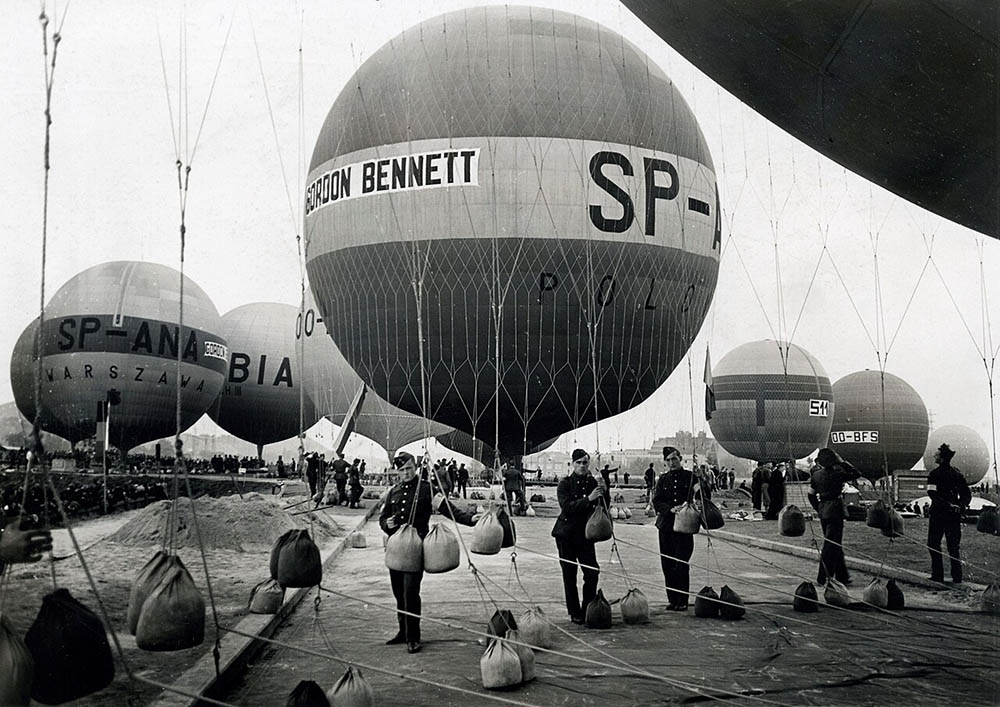
Soldiers hold down Ed Hill's balloon at the start of the 1927 Gordon Bennett Cup. The balloons pictured here are the same size and design as Hill's personal balloon, Patches. Courtesy Wikimedia Commons/Georges Champroux.
Jeannette found him working at the Metalclad Airship Corporation in Michigan, and occasionally taking people up in a small balloon that he had given the cute though not confidence-inspiring name of Patches. He agreed to train Jeannette for $217 (about $15,000 today, relative to wages), and they started making training flights in May 1934.
Earning her license
This catches us back up to where we started, on 14 June 1934. After landing on the outskirts of Detroit at around 7 a.m., and collecting signatures for her logbook, Jeannette took off again, drifting out over Lake St Clair in the dawn light. The winds now carried her south east, into Ontario. At around 9.30 a.m., she brought Patches down for a gentle landing near Leamington, on the north shore of Lake Erie.
With this pair of solo flights completed, Jeannette had now met all the requirements for an FAI Balloon Pilots License – the first ever issued to a woman in America. The news of her successful flights made front-page news across the country – "Jeannette Piccard Qualifies as First Woman Aeronaut".
Waiting for their moment
We'll skip forward now to the evening of 22 October 1934 – passing over an additional few months of financial struggles and logistical wrangling. For the last few weeks, the Piccards have been living at the Dearborn Inn, a hotel built three years earlier to serve pilots coming and going from Ford Airport (today the location of the Ford Motor Company's test track). Each morning they sat down with the day's weather forecast, hoping for the perfect atmospheric conditions for their flight.
On the evening of the 22nd, however, the weather forecast was perfect and the Piccards were determined to get into the air. As Jean and Jeanette supervised the inflation of the envelope, Ed Hill arrived with 300 volunteer ground crew – recruited by his industry contacts from local factories and flying clubs.
At dawn, Jean and Jeannette got ready to climb through the narrow hatch of the Century of Progress, which was swaying in the gentle breeze under the massive balloon. Their two oldest sons – 10-year-old Paul and eight-year-old Donald – pushed through the crowds to present Jeannette with a bouquet of flowers as she climbed into the gondola.
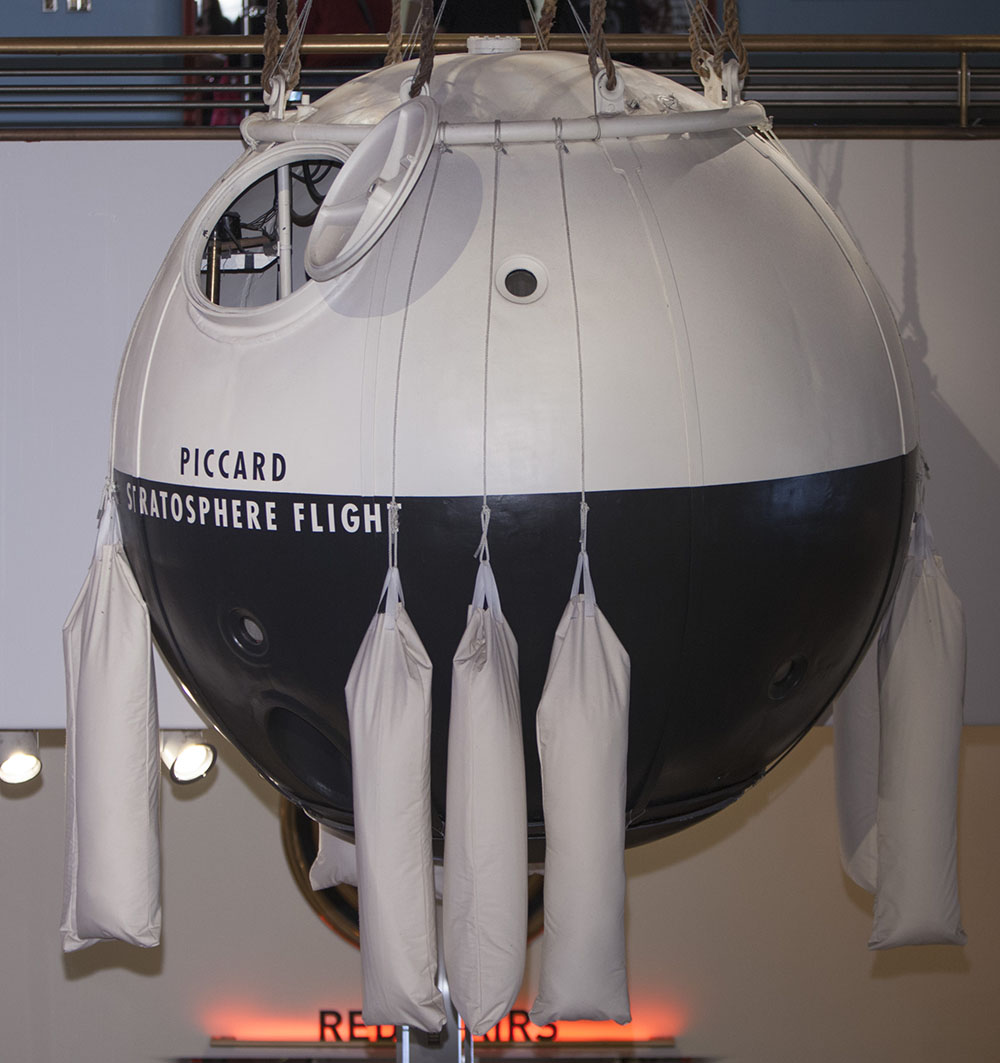
The tiny cramped gondola of the Century of Progress, today on display at the Griffin Museum of Science and Industry in Chicago, which supported the Piccards during their preparations. Image courtesy of the Griffin Museum of Science and Industry.
At 6.51 a.m. on 23 October 1934, Jeannette leaned out of the hatch and shouted "Let's go!" and the ground crew cut away the last of the ballast. As the balloon climbed, Jeannette saw first the cheering ground crew and then, beyond them, a sea of 45,000 upturned faces. A huge crowd had gathered, including Henry Ford himself, to watch them take off.
The last sound Jeannette remembered hearing from the ground were her sons shouting "goodbye mother!".
Into the clouds
The forecast had predicted clear skies, but the Piccards soon found themselves engulfed in cloud so thick that they couldn't see the balloon above them. Jeannette had spent many hours studying maps and learning landmarks, navigating by compass and dead-reckoning, but there was nothing she could now do but wait. The balloon's location, heading and speed were all a complete unknown. If the forecast was also wrong about the strength of the wind, they could be out over the ocean in as little as three hours.
Then the Century of Progress broke through top of the cloud layer, and the Piccards were suddenly looking out over a "limitless expanse of rolling cloud" under a strikingly deep-blue sky. Speaking about it later, Jeannette mentioned how – despite having heard descriptions from Auguste Piccard – the beauty of this view was still unexpectedly mesmerizing.
Jeannette was snapped back to the task at hand by the realization that at some point during the climb the valve-release rope – which controlled the flaps that allowed her to vent lifting gas from the balloon – had gone slack. She looked through the viewing ports in the top of the cabin and saw that the rope was tangled around the load ring (the mounting point for balloon's rigging).
A daredevil in-flight repair
This was a big problem. The exact same thing had happened to her brother-in-law during his first flight in 1931. Without the ability to vent hydrogen, Auguste and his co-pilot Paul Kipfer had been forced to simply wait until the gas seeped out on its own. They spent a freezing cold night drifting over central Europe, reduced to licking condensation off the walls of the cabin because they'd run out of drinking water. When they eventually came down, it wasn't on the plains of Germany or France, as planned, but rather on a glacier in the Austrian alps. Auguste had to make a pair of improvised skis from wooden slats in the balloon's rigging and trek down the mountain in search of help.
If Jeannette could not work the rope loose, it was possible they would drift out over the Atlantic Ocean, where a survivable landing was unlikely.
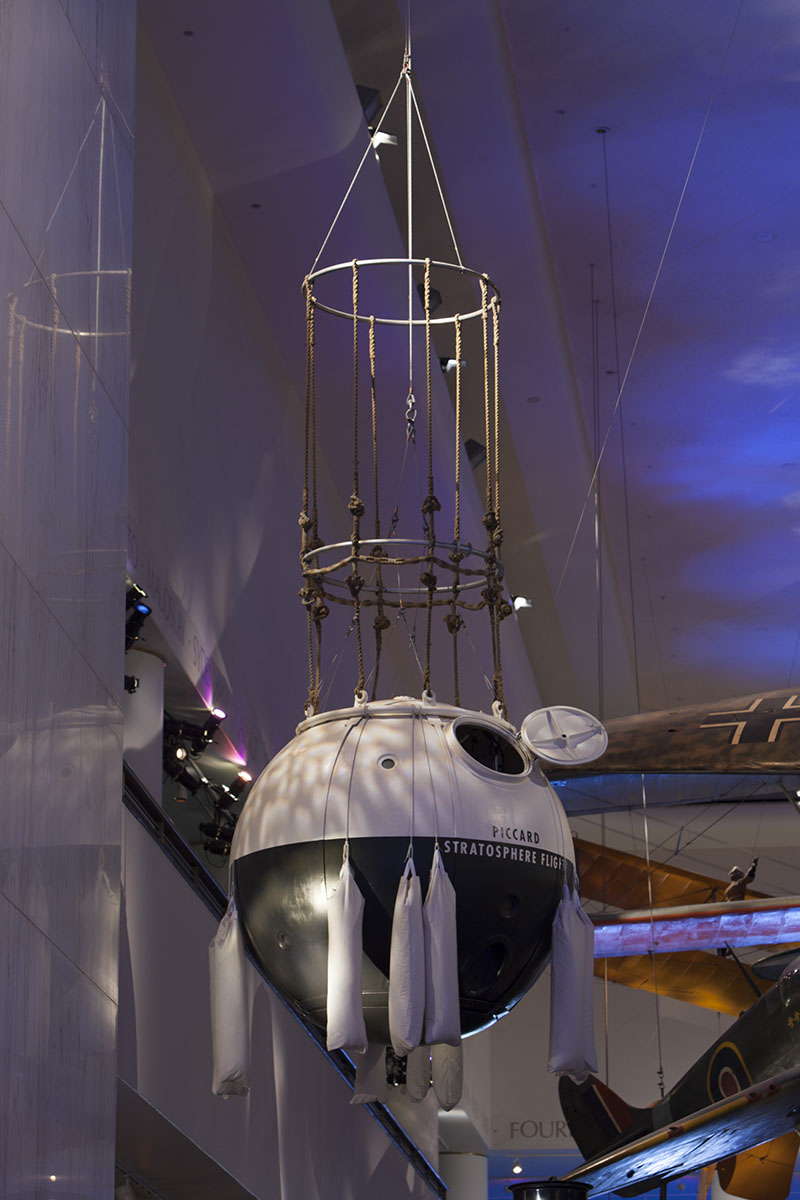
The Century of Progress gondola, showing the balloon's rigging. The main load ring is the first metal hoop above the cabin. Image courtesy of the Griffin Museum of Science and Industry.
While Jean worked to set up the various experiments, Jeannette pulled on one of their parachutes (not an easy task in a cabin not much bigger than a phone-box) and climbed up the metal shelves to the hatch. Once the hatch was open, she would only have a few minutes to free the rope before the air became too thin to breathe.
Jeannette pulled herself up through the rigging until she was standing on the top shelf with only her feet and ankles inside the cabin. This was still not quite enough, however, so she had to step up and balance on the frame of the hatch opening, standing on tip-toes to reach the load ring. This precarious task was made all the more nerve-wracking by the fact that some of the lead shot from the ballast bags had been spilled into the hatch. Her feet kept slipping "like stepping on roller bearings" while she was suspended thousands of feet above the Earth.
Eventually the rope came loose, and Jeannette was able to climb back inside and seal the hatch again. She never mentioned this harrowing experience in her post-landing interviews, recording it only in her unpublished memoirs. She and Jean were probably worried about saying anything that would potentially put off future sponsors, as it was the PR risk of "putting a mother in danger" that had deterred many of the organizations they'd approached before.
The highest woman in the world
Around an hour into the flight, the Century of Progress climbed past 50,000 ft (15,240 m), making Jeannette indisputably the first woman to reach the stratosphere. It eventually topped out at 57,579 feet (17,550 m), short of the overall highest altitude record – which had been raised to 19,000 m (62,335 ft) by the crew of the Soviet balloon USSR-1 in Sep 1933 – but high enough to earn Jeannette the record for the highest altitude reached by a woman.
We were sorely tempted to drop all lead from the Milliken apparatus, shoot our last sand bags and try to make an altitude record. But [...] we concluded that it would not be wise to risk tumbling through clouds at low altitudes and cracking on the ground before we could tell where we were.
– Jeannette Ridlon Piccard
There was no celebration of this milestone on board the balloon, however. Both Jean and Jeannette were silently engrossed in their work – her monitoring instruments and keeping an eye on the balloon, him taking notes and configuring experimental equipment. For more than two hours, the only sounds were the ticks of the "cloud chamber" used to record high-energy cosmic radiation and the occasional scratches and rustles of Fleur-de-Lys, the Piccards' pet turtle, which they had brought along in a box as a mascot.
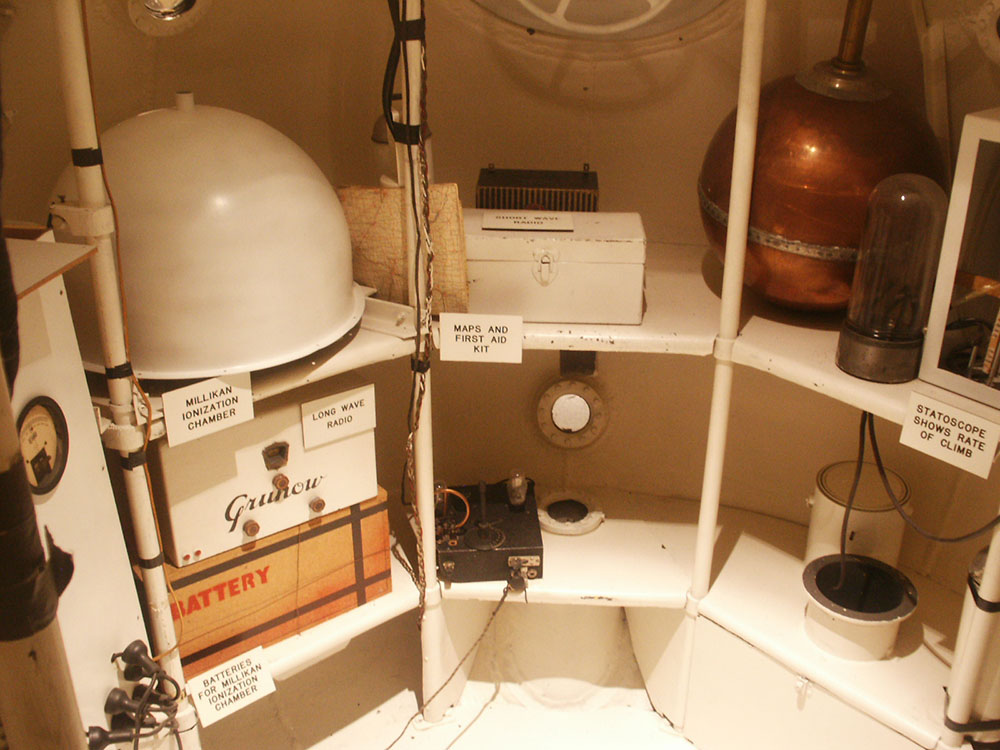
The cramped interior of the Century of Progress (which would have had been packed with consumables and other equipment during the flight). Image courtesy of the Griffin Museum of Science and Industry.
Shortly before 11 a.m., Jean broke the silence to ask whether Jeannette thought they should start to descend. They discussed the problem for about half an hour, each weighing the desire to collect as much scientific data as possible against the risk of travelling too far east. The terrain was still shrouded by a dense layer of cloud, making it impossible to gauge their speed or location. Based on what they knew about typical wind speeds, it was unlikely they were in any danger yet, but they finally decided to err on the side of caution and start venting gas.
Coming in for landing
The descent took almost three hours, but the Century of Progress eventually broke through the low clouds, giving the couple their first view of the Earth since they cleared the trees around Ford Airport more than seven hours earlier. Jeannette gazed out over a "charming country of partially wooded rolling hills" with absolutely no idea where they were. Her and Jean exchanged guesses as she wrestled to balance ballast and lifting gas – Ohio? Ontario? New Jersey?
The final descent was the most challenging one Jeannette had faced so far as a pilot. The cloud cover extended all the way down to around 2,000 ft (600 m), which gave her very little room for manoeuvre. If she dropped too much ballast, they'd be back up in the clouds, flying blind, but if she vented too much gas they risked striking the trees. The sight of the countryside rushing past below them was a shock after hours of hanging seemingly motionless above the clouds.
As they got closer to the ground, Jeannette realized they were on a collision course with a cluster of farm buildings, and dropped the last two ballast bags to gain some height. When this wasn't enough, a 53-pound lead-acid battery was heaved overboard (with a parachute attached). That only slowed their descent enough to clear the farmhouse, however, and was not enough to allow the selection of a better landing spot.
The Century of Progress descended into a thicket of trees on the outskirts of a village that turned out to be Cadiz, Ohio. It came to a halt with a great tearing of fabric and snapping of branches, leaving the gondola briefly hanging from a tree before it fell the last few metres.
"Wore No Hat"
Aside from a sprained ankle for Jean, they were unharmed and their experimental equipment was all intact. Jean declared the mission an overwhelming success and their backers were glowing in their praise, but all Jeannette could talk about at first was how guilty she felt about the landing – "I DID A POOR JOB, SAYS MRS. PICCARD", ran one headline.
After she'd taken a moment to steady her nerves, however, her outlook improved. She said, "My, what a marvelous experience. It was the thrill of my life!" and enthused about the things she'd seen. The reporters, predictably, asked her about what they'd had to eat and commented on her outfit.
"It wasn't very cold in the gondola when we were up there, but for a while I was glad I had on my light sweater" The sweater was a gray turtle-neck, put on over yellow sports shirt and black and white knickers. Mrs. Piccard, who is a licensed balloon pilot, wore no hat. As she cut the snarled ropes with a hunting knife, she went on...
– Associated Press wire story, 24 October 1934.
The Piccards suddenly went from itinerant, self-employed lecturers to front-page news all over the United States and beyond. Jeannette was hailed as a hero and her family dubbed "The Flying Piccards" by the press. Jean was offered a permanent position teaching aeronautical engineering at the University of Minnesota, ending the family's nomadic wanderings and allowing them to put down roots for the first time in years.
Jeannette's legacy
Although it wasn't formally recognized by the FAI, Jeannette held the women's altitude record until she was 68 years old. In those three intervening decades she'd earned her doctorate, mentored a generation of young scientists at the University of Minnesota and helped design a new generation of weather balloons and experimental equipment.
Her record was finally broken by Valentina Tereshkova in the Vostok 6 spacecraft on 16 June 1963, about six months after Jean's death. Newspaper reporters found Jeannette at home in Minneapolis, looking after her granddaughter Betsy. She told them "I welcome the Russian spacewoman into the world of opening outer space and congratulate her on being the first woman to reach an altitude higher than my record".
Her retirement did not last long, however. Within a year, one of Jean's old students, NASA Director Robert Gilruth – who had always regarded Jeannette as "at least half the brains of that family, technical as well as otherwise" – recruited her to work as a consultant at NASA. She would work there for the rest of the 1960s, before returning to what had been her original career plan, all the way back in 1914, and starting yet another act in her extraordinary life as one of the first ordained episcopal priests in America.
For more stories about pioneer inventors, take a look at our Science and Technology section.
Header image, showing Jean and Jeannette after their record-breaking flight, courtesy of Scherl/Süddeutsche Zeitung Photo/Alamy. I'd like to extend my thanks to Dr Sheryl K. Hill, whose 2009 PhD thesis on Jeannette Ridlon Piccard was an invaluable resource when researching this story.