


Indonesian python makes GWR hissstory as the longest measured wild snake
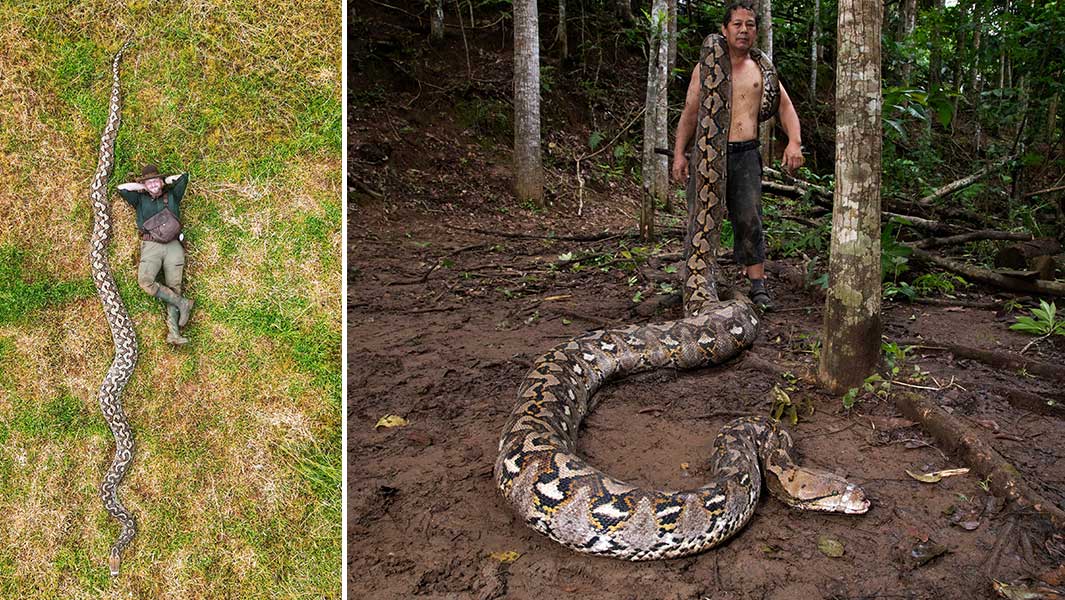
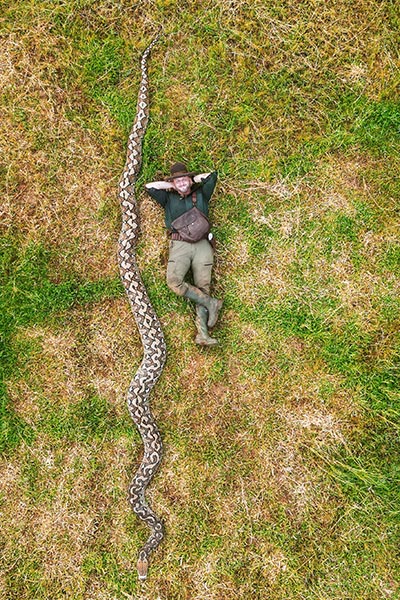
A giant female reticulated python (Malayopython reticulatus) discovered in the Maros region of Sulawesi, Indonesia, in late 2025 is believed to be the longest wild snake to be formally measured, with evidence seen by GWR confirming a length of 7.22 m (23 ft 8 in) from head to tail tip on 18 January.
This means that if placed across a standard FIFA goal, this prodigious python would occupy essentially the entire width from post to post. Alternatively, it is around the length of six-and-a-half shopping carts/trolleys in a row.
Under anaesthesia, when snakes’ bodies fully relax, she could be at least 10% longer – so in reality her true length is likely nearer 7.9 m (26 ft). But owing to the inherent risks of anaesthetic, GWR believes that animals should only ever be “put under” for safety reasons or necessary medical procedures, so this has not been put to the test.
The superlative serpent, who is now in the care of local conservationist Budi Purwanto, was assessed by Diaz Nugraha – a wildlife guide, rescuer and licensed snake handler from Kalimantan, Borneo, along with Radu Frentiu – an explorer and natural-history photographer who has resided in Bali for two decades. (A mutual associate of Frentiu’s and GWR’s – George Beccaloni, Director of the Wallace Correspondence Project – helped to relay details of the discovery.)
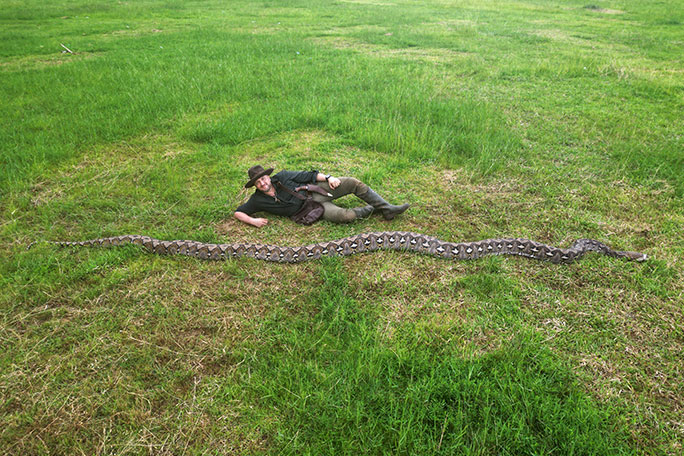
Nugraha and Frentiu arranged a trip to Sulawesi as soon as they heard rumours of this supersized snake, keen to see it with their own eyes and to make sure it was properly documented. They also hoped that shining a spotlight on this phenomenal specimen could help protect both her and others like her in the future.
Every coil of muscle is a powerhouse on that snake and it seemed to work individually. So it’s the power of such a snake that silently impresses you the most, along with its ability to expand when swallowing enormous prey, right up to the size of a cow, which is virtually impossible for most people to comprehend - Radu Frentiu, explorer and nature photographer
As well as being measured with a surveyor’s tape, the python was also weighed (while placed in a big canvas sack) at 96.5 kg (213 lb), which is akin to a full-grown giant panda! This was done on scales that are usually reserved for weighing bags of rice.
It’s worth noting that she had not recently eaten a big meal, after which she would doubtlessly have surpassed the 100-kg (220-lb) mark.
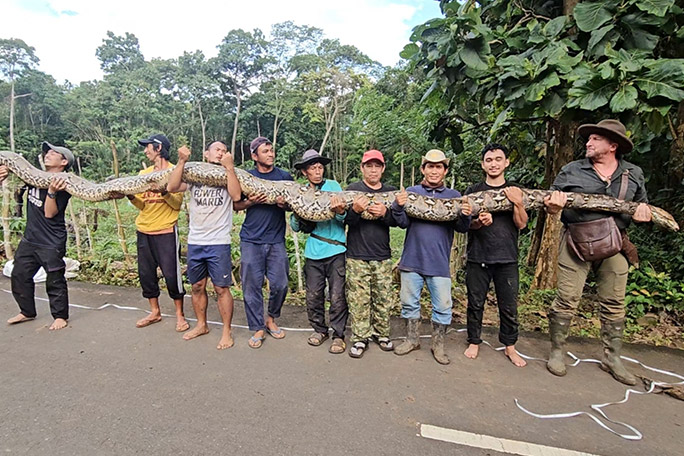
The remarkable reptile has been named “Ibu Baron” (which translates as “The Baroness”). She joins a number of other serpents that Purwanto has rescued in Sulawesi in recent years as he has developed something of a snake sanctuary.
Ibu Baron almost certainly owes her life to Purwanto, who acted quickly when news of her discovery emerged in December 2025 to acquire her from those that found her, ensuring that she came to no harm. He has done the same for several other snakes, and now keeps them in their own spacious enclosures on his estate in Maros County, ensuring the safety of both the animals and residents in his local community.
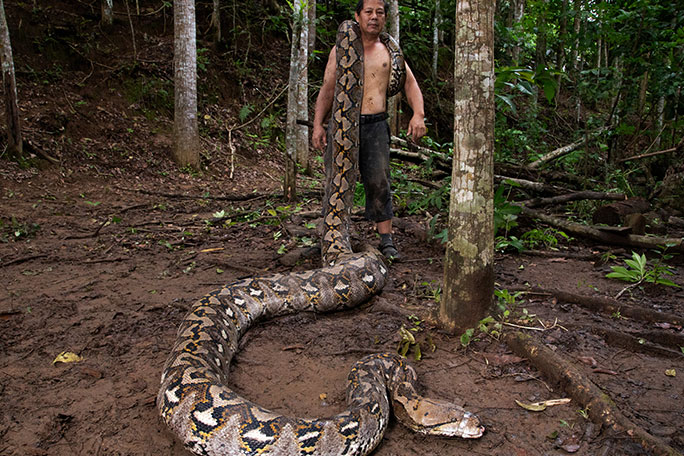
Ibu Baron with local Maros County snake conservationist Budi Purwanto
In this part of the world, there has long been conflict between people and snakes, particularly larger specimens such as Ibu Baron. They are – with fair reason – seen as a serious threat to livestock, pets and even humans (particularly children), with several people claimed by pythons in recent years, and many more domestic animals like dogs.
While none of the python family are venomous – the largest venomous snakes are king cobras (Ophiophagus hannah) of India and south-east Asia which can reach up to 4 m (13 ft) long – they're still lethal owing to their powerful, muscular bodies that are capable of coiling around a victim and squeezing until they are asphyxiated.
As a result, when reticulated pythons do come into the vicinity of an inhabited area, they tend to be exterminated immediately, and more generally they are also hunted as a source of bushmeat.
Bornean wildlife rescuer and snake expert Nugraha told GWR said that this human-snake friction has been exacerbated in recent times: “Appearances of these giant snakes are increasing because their habitats are reducing and availability of the snake’s natural food [such as wild pigs and wild anoa cattle] is decreasing likely as the result of poaching, meaning pythons are coming into contact with people more often than in the past.”
Iconic species like the reticulated python are also highly sought within the illegal exotic pet trade, so this is another threat faced by these record-setting reptiles.
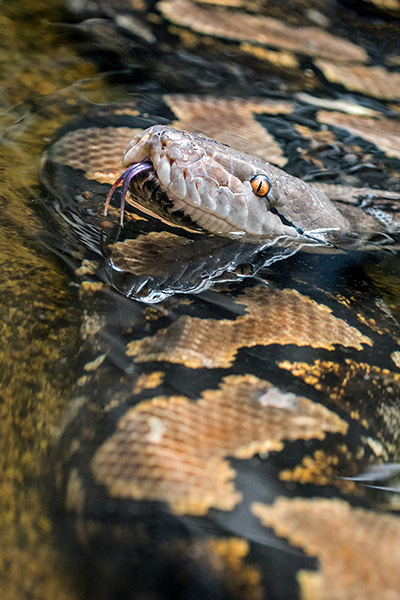
This general example of a reticulated python shows how they are naturally at home in semi-aquatic habitats. Unsplash / David Clode
Reticulated pythons are on average the longest species of snake, typically reaching between 3 and 6 m (9 ft 10 in–19 ft 2 in), though giants greater than 6 m have been documented from time to time. The largest individuals for the most part tend to be females.
In terms of weight, another colossal constrictor is thought to surpass them on balance. Females of the more bulky-bodied green anaconda (Eunectes murinus and E. akayima) of South and Central America average 3–5 m (9 ft 10 in–16 ft 4 in) long and typically weigh between 30 and 70 kg (65–155 lb). But extra-large individuals after a substantial meal or during pregnancy might tip the scales at up to 300 kg (660 lb)! As such, GWR recognizes them as the heaviest snake species overall.
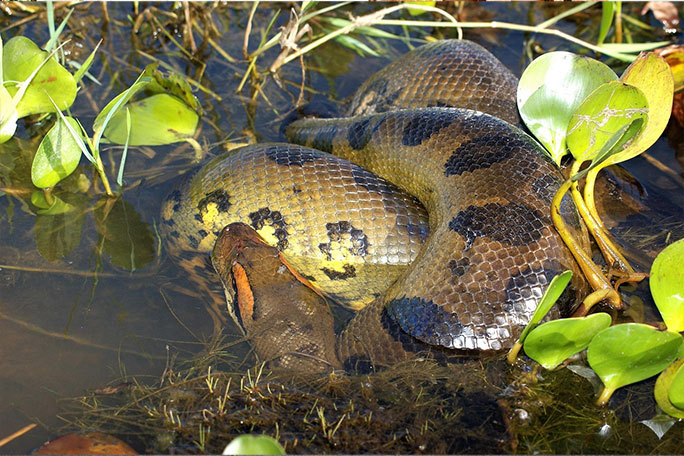
Green anacondas of the Americas also reach incredible sizes, and are generally more hefty in bodyweight than reticulated pythons. Pixabay / Denis Doukhan
The longest scientifically measured wild reticulated python in recent years is thought to be a 6.95-m (22-ft 10-in) female found in East Kalimantan, Borneo, in August 1999. She came to light after devouring a recently released sun bear that was fitted with a tracking device. This specimen was discussed in a paper published in the Raffles Bulletin of Zoology in 2005.
Over the decades and centuries, there have been historical reports of even longer wild “retics” but a key distinction is that documentary evidence of their measurements are scarce to non-existent.
Furthermore, for the reasons already discussed, in the vast majority of cases, they sadly often do not survive very long after discovery, either being killed or mysteriously disappearing, making reported figures tricky to retroactively corroborate.
One widely cited specimen from the chronicles is a reticulated python that was hunted in Sulawesi (then known as Celebes) in 1912 that was claimed to be 10 m (32 ft 10 in) long. This would have made the snake the same length as a US school bus today!
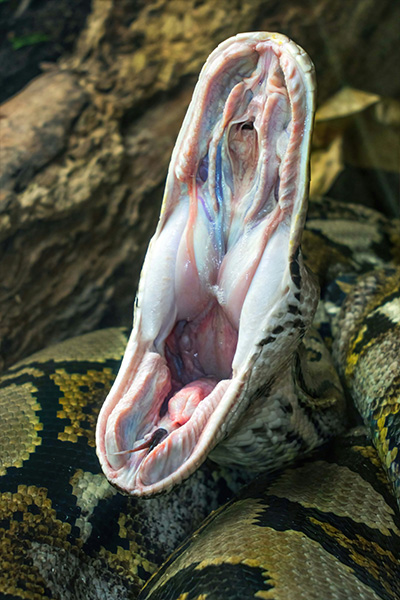
This general example of a reticulated python yawning shows just how far their jaws can stretch apart. Unsplash / David Clode
A couple of historical reptile reference books, such as MWF Tweedie’s The Snakes of Malaya (1954), allude to extraordinary pythons exceeding 8 m (26 ft 3 in), but these rely on anecdotal historic accounts and again do not have the first-hand evidence of the measuring process as we have for Ibu Baron.
More recently in 2016, there was a huge retic python found on a building site on the island of Penang, Malaysia, reported to be between 7.5 and 7.9 m (24 ft 7 in–26 ft). While video of the snake did feature in the news, a formal measurement does not appear to have been conducted (or at least not recorded) and it sadly died just a couple of days later.
With more than a decade’s experience giving wildlife tours and capturing/relocating snakes in Indonesian Borneo, we asked Nugraha if he believes it’s possible there are bigger snakes than Ibu Baron out there: “I think so, yes. How big? It is quite realistic to expect snakes of 9 m [29 ft 6 in] or even larger exist somewhere, quite possibly again in Indonesia, if not [anacondas] in the Amazon Basin.”
For Nugraha, Frentiu and Parwanto, they are hoping that the rescue and documentation of Ibu Baron can raise awareness about the threats faced by giant snakes in Indonesia and inspire more effective conservation efforts.
Speaking to GWR, Frentiu said: “Our hope is for pythons and other giant snakes to no longer be seen as vermin, but rather as a symbol of the islands and necessary animals to the ecosystem. They can be a local wildlife treasure to generate tourism, encouraging ever-more popular herpetological safari trips (known as ‘herping’). All these things could bring revenue to local people, create awareness, serve conservation and boost local pride.”
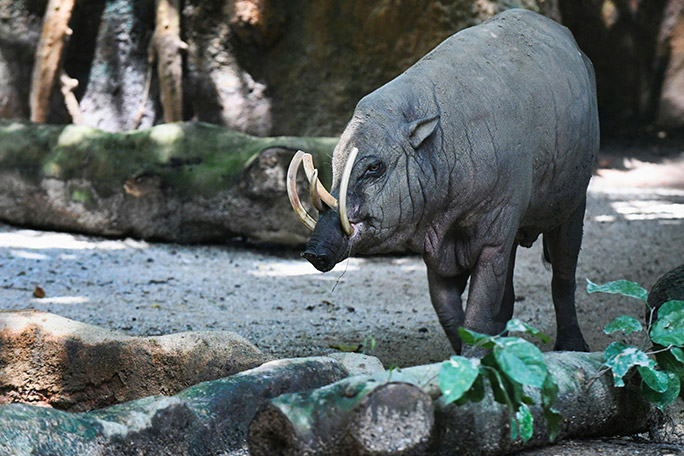
Babirusa wild pigs are traditional prey of reticulated pythons in Sulawesi, though as pig populations have declined, encounters between pythons and people have increased. Pexels / Richard Ho Low Hong
Nugraha firmly believes that more needs to be done in terms of legal policy to protect his country’s native reptiles: “My opinion is more towards stricter safeguarding, accompanied by strong laws for preserving the forest which is the habitat of the snake, as well as a ban on killing snakes in protected areas."
There are methods that can be applied to reduce contact between humans, their livestock and snakes, as well as better maintain the natural food chain and ecosystem so that snakes will come less to villages looking for prey - Diaz Nugraha, wildlife guide, conservationist and snake handler
The longest snake in captivity ever was a reticulated python on a similar scale to Ibu Baron. Medusa stretched 7.67 m (25 ft 2 in) as confirmed in Kansas City, Missouri, USA, on 12 October 2011.

The superlative slitherer was a much-loved member of a haunted-house exhibit that was overseen by Full Moon Productions (USA).

The record holder prior to Medusa was Fluffy – a resident at Columbus Zoo and Aquarium in Ohio, USA – who was confirmed to be at least 7.3 m (24 ft) long on 30 September 2009.
However any animal in human care has numerous advantages over their wild counterparts when it comes to growing to epic proportions, given that they receive regular meals and veterinary care and face no natural threats or survival challenges.
Going back to prehistoric times, there were serpents that grew to even more mindboggling proportions, perhaps as long as 15 m (49 ft), which is the equivalent of nearly two double-decker buses parked end to end.
The longest snake species ever include Titanoboa cerrejonensis, a type of boa dating back 58–60 million years known from the fossils of 28 specimens found in La Guajira, Colombia. It would have measured approximately 1 m (3 ft 2 in) across at the thickest portion of its body, and weighed roughly 1,135 kg (2,500 lb).
Competition to Titanoboa has recently emerged though. In April 2024, details were published of Vasuki indicus, a fossil species of madtsoiid snake known from 27 vertebrae unearthed in the Indian state of Gujarat during 2005. This species is estimated to have measured 10.9–15.2 m (35 ft 9 in–49 ft 10 in) long. It lived 47 million years ago, during the Mid-Eocene Epoch.
Discover more amazing creatures that made it into the record books in our dedicated Animals section.