
Can you really eat a slice of Queen Victoria's 200-year-old wedding cake?
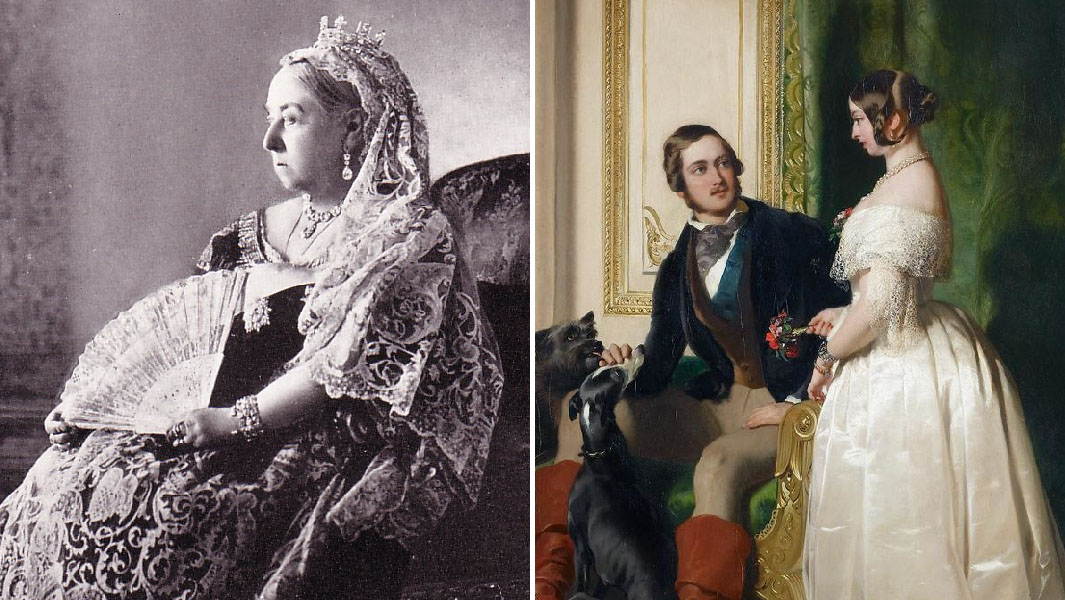
Queen Victoria paved the way for modern weddings.
It is no secret that her dress began a longstanding tradition of brides wearing white when walking down the aisle, but not everyone knows that other elements of her wedding day also lived on long after the ceremony.
Such is the case of the royal wedding cake, which takes the crown as the oldest wedding cake in history.
Commissioned for the wedding breakfast of Queen Victoria and Prince Albert of Saxe-Coburg and Gotha, the record-breaking fruit cake dates back to 10 February 1840.
The nuptials took place at the Chapel Royal of St James' Palace, London, where an enamoured Alexandrina Victoria, surrounded by bridesmaids and dressed in the satin-and-lace white gown that would forever change bridal fashion, exchanged vows with her 'dearest Albert' in front of many guests; later, the queen would describe it as 'the happiest day of her life'.
The cake chosen for the wedding breakfast was a show-stopping plum cake created by the expert hands of Mr John Mauditt, the Queen's personal confectioner.
The three-metre-wide (10 ft) recipe ambitiously elevated the idea of a traditional fruit cake, a Victorian Era fan-favourite for important events, flawlessly incorporating modern elements with tradition. Despite the trendy French elements displayed on the outside, it was packed with yummy ingredients such as candied fruits, liquor and vanilla cream, remaining a beloved British recipe on the inside.
The result was a three-tiered masterpiece covered in thick white icing.
It weighed a massive 300 pounds (136 kg) and included extraordinarily pricey ingredients such as butter cream, vanilla, cherries and candied fruit, plus plenty of high-quality liquor.
Despite the French flair in the external decorations, the theme also stayed unmistakably rooted in British history.
As appropriate for the wedding of the Queen of England, the delicate sugar sculptures portrayed “Britannia, the royal pair in Roman costume, and one of Victoria’s ubiquitous canines, to suggest fidelity.”
However, Mr Mauditt's eye-catching masterpiece wasn’t necessarily meant to be mouthwatering... or even eaten at all!
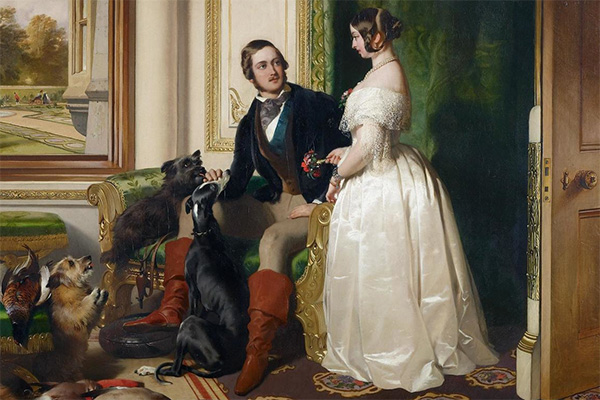
Portrait "Windsor Castle in modern times; Queen Victoria, Prince Albert and Victoria, Princess Royal" by Edwin Landseer / Wikimedia Commons
Despite the bride and groom's genuine enthusiasm, a royal wedding remained first and foremost a public affair.
The day, thoroughly devised to shine on an international stage, held immense political resonance. It reinforced the image of Queen Victoria's kingdom as a wealthy, unified and powerful force, delivering a clear message to foreign countries in an era of massive industrial changes and modernisation.
It is not a coincidence that it pinpointed a crucial moment in history, kicking off trends that would long survive the happy couple.
Queen Victoria herself was, in many ways, a trendsetter ante litteram.
While some elements have now become a thing of the past (the fruit cake's rise in popularity, for example), other traditions pioneered by the royal couple are still absolute must-haves for modern brides-to-be, with the queen's white gown being perhaps the most striking example of how the day rewrote the rules of modern marriages.
From start to finish, every detail chosen for the St James' Palace ceremony stood out as much more than the simple union of two young people in love: it was a public matter, a grand, lavish spectacle meant to be witnessed and remembered.
Every part of it, newlyweds included, played a political role.
As such, the three-tiered cake was created to satisfy the public eye before the couple’s taste.
Displayed publicly, Queen Victoria's plum cake reasonably attracted plenty of onlookers.
It is reported that massive crowds lined up to take a sneak peek at the extravagant culinary creation, or read about it through detailed illustrations and newspaper articles: in a time when most fruit cakes were flat and single-layered, the three-story cake became a statement and the blueprint for wedding cakes well after the Victorian Era.
The head-turning cost of the ingredients, the massive sugar sculpture of Britannia blessing the pair, and the gigantic size all painted a sweet but unmistakable picture, sending a message of prosperity to the entire nation and (perhaps most importantly) to the neighbouring European countries.
It is said that cutting a cake during weddings became popular after Queen Victoria and Prince Albert's reception.
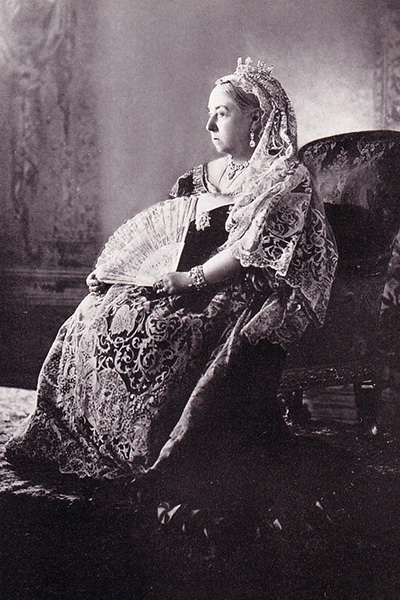
An official photograph of Queen Victoria, taken for her Diamond Jubilee in 1897 / Wikimedia Commons
But the cake's usefulness didn't end after the day itself.
Fruit cakes are remarkably long-lasting, and many rectangular slices were wrapped in paper bearing the Queen's signature, placed in elegant engraved boxes and handed out as souvenirs. The boxes were then distributed among guests and dignitaries as a memento of the sumptuous ceremony.
Almost 200 years later, some of those cuts still exist today.
These resilient plum cake portions weathered many ordeals and survived industrial revolutions, the Belle Époque and two world wars, outliving both the bride and groom, were displayed for the first time at Windsor Castle in 2007.
Featured in a larger exhibition on royal marriages that opened on 27 April 2007, the two pieces were 167 years, two months and 17 days old at the time.
Fragments of the oldest wedding cake ever were even sold at auction in recent years, most notably in 2016 and 2023, attracting stellar prices and collectors from all over the world.
A piece of Queen Victoria's cake was sold in 2023, having survived in a perfectly preserved state for a remarkable 182 years.
The royal artefact, defined as a "great piece of history," was auctioned at Devon's Bearnes, Hampton and Littlewood auctioneers for £700 ($941.65 today). It racked up almost double the initial estimated price.
All parts of the cake are stored in the original wrapping, featuring the Queen's signature and royal cypher.
The dessert still comes with its celebratory box, adorned with beautiful engravings of a crown and a message that reads "The Queen's Bridal Cake, Buckingham Palace, Feb 10, 1840" on the lid.
Despite the impressively well-preserved state, what remains of the cake isn't exactly Great British Bake Off material.
Nonetheless, the auction house emphasises that the cake should not be eaten.
It's easy to guess that the dessert isn't exactly edible anymore (and likely poisonous, at this point), but you never know when someone might fancy a bite of royal cake... even 200 years past the 'best before' date!
On her wedding day and for the rest of her life, the Queen was utterly in love with her husband.
In her diaries, she famously praised the sweet character, kindness and looks of her husband, and wrote comments such as "How can I ever be thankful enough to have such a husband". Prince Albert was Queen Victoria's first cousin and remained by her side as a trusted royal advisor and Prince Consort.
Throughout a happy union that lasted 20 years, the pair had nine children (despite Victoria's dislike for newborns and pregnancies) and continued to rule together until Albert's illness and death in 1861.
The loss threw the Queen into a state of deep mourning from which she would never fully recover: widowhood weighed heavily on the queen's mental health, and she isolated herself and wore black for the rest of her life.
A woman of extraordinary influence, Queen Victoria ascended to the throne of England at just 18 years old and became the longest-serving head of a Christian church, as well as the previous record holder for the title of longest reigning queen.
She handed over the title to another famous British monarch in September 2022, when Queen Elizabeth II passed away aged 96 and snatched her great-great-great-grandmother's record after 70 years and 214 days of uninterrupted reign.
Remarkably, a teenage boy also broke a bizarre record for stealing the Queen's underwear.
Queen Victoria died in 1901, at the age of 81, after reigning for an unprecedented 63 years and 216 days.
Did you enjoy the sweet story of the oldest wedding cake? Then these record-breaking food stories might be your cup of tea!