


The wild world of worm charming – and the 10-year-old who took the title as Champion
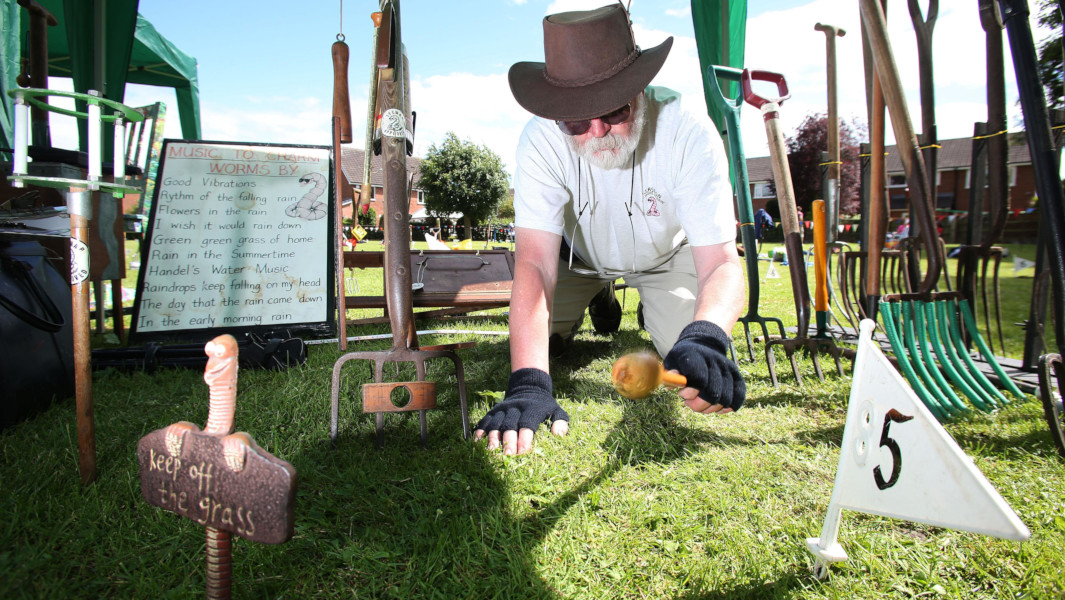
Let’s say that the grass is lush and green, and the ground is damp and fertile – in 30 minutes, how many worms could you catch?
One? Five?
How about 567?
Well, that’s what it would require to take the record from Sophie Smith (UK), who claimed the title for the most worms charmed at the 2009 World Worm Charming Championships in Willaston, England at the impressive age of 10 years old.
Despite its mythical-sounding name, worm charming – sometimes known as worm grunting, fiddling, or rooping – is a surprisingly old skill, used by fishermen to lure live worms out of the ground to use as bait.
The general method is to create vibrations atop damp soil, spurring the worms to shoot out of holes and into the unsuspecting clutches of their new handlers. Scientific research revealed that charming replicates the sound of the worm’s natural predator, the mole, causing them to “run” out of the soil at surprisingly quick speeds.
Traditional techniques in the USA involved using two wooden sticks, one plunged into the soil, and one scraped against the side of the other, to create short bursts of sound that prompt the worms out of the grass – though in the UK, worm charmers tend to twist a metal gardening fork to replicate the same effect.
Afterwards, the worms are either used as bait – or, they're returned back to the ground.
Nevertheless, in recent memory, the UK has turned this curious profession into a life of its own – adding a competitive (and quirky!) twist to the skillset with the World Worm Charming Championships.
As the record holder for the longest-running worm charming competition, Willaston Willaston County Primary School has been hosting the event since 5 July 1980, gradually turning the tradition into the spectacle it is today.
Their first-ever winner was a local farmer’s son, Tom Shufflebotham (UK), who charmed a record of 511 worms out of the ground (within a 3 m², 9.84 sq ft plot) in the allotted 30 minutes. Yet as the competition expanded, and new rules were added – notably, don’t hurt the worms – this festival has turned into a delightful display of local culture.
And nowadays, the methods used for worm charming are as wild and wacky as the event itself.
Participants, many dressed in their worm-iest attire, bring contraptions made from household goods like trashcan lids, bongo drums, and skateboards to knock against the earth. Some take the musical approach – performing on xylophones, electric guitars, and ukuleles – while others stick to the tried-and-true approach of a good mallet, garden fork, or wooden poles.
After the 30 minutes are up, participants scoop their finds into a cup and bring them to the judging table to be accounted for – and later, all the worms are returned to the field, where they writhe back into the dirt.
Worm charming’s popularity even inspired other annual events across the country, such as the The Blackawton International Festival of Wormcharming in Devon, UK, and the Falmouth Worm Charming Championships in Cornwall, UK. At the latter event, last year’s featured participants used contraptions such as snorkelling flippers, a double bass, and a roomba with a worm attached to the top, to attract the slimy pink creatures.
Read more stories like this in our dedicated Hobbies and Skills section!
So what method is best at charming worms? Well, most professionals say that the conditions must be perfect first – damp, not dry, soil allows the worms to move around, and a quiet spot also prevents them from getting disoriented by lots of loud sounds.
Otherwise, it’s up to you! Sophie’s record-setting technique was the classic gardening fork, which she wriggled and hit with a stick to make the proper vibrations. She also said that she was helped by the warm and humid weather, which made the worms pop right out of the ground.
That said, most championship gatherings now offer points for creativity – so who knows, maybe you have something in your home right now that would be the perfect tool for befriending these charming worms.
Header image: Lynne Cameron/PA Images/Alamy