


The Kentucky Meat Shower and the surprising history of fleshy rain in America
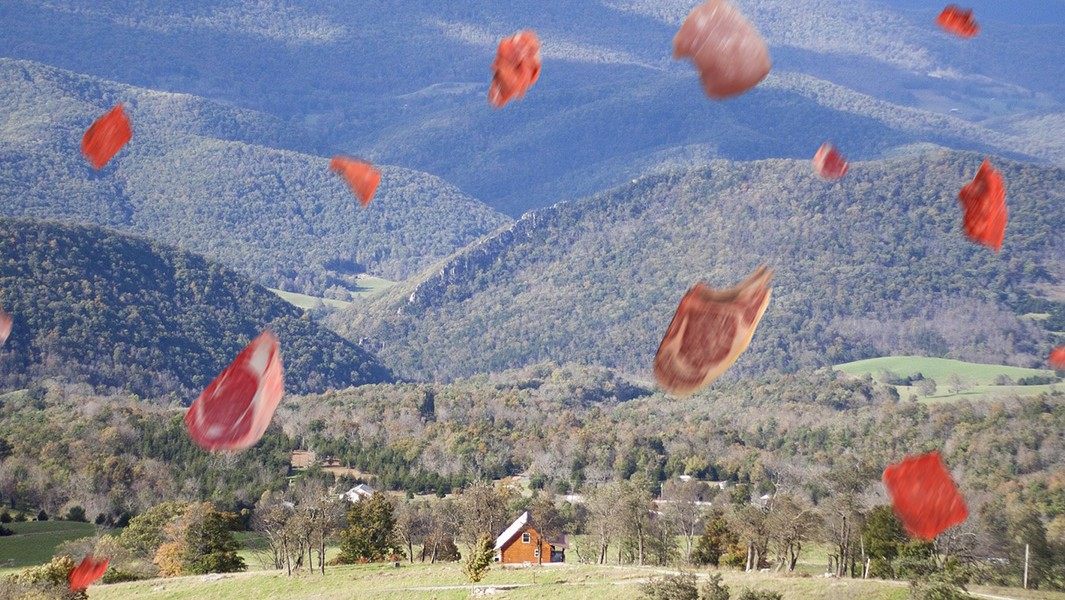
Connoisseurs of strange tales and historical oddities have probably already heard of the Kentucky Meat Shower. This bizarre incident appeared in Charles Fort's first great compendium of anomalous phenomena, The Book of the Damned (1919), and has been a mainstay of "Believe it or Not?"-style collections ever since.
However, I'm not going to assume that you – dear reader – spend as much time with dusty tomes as I do. So here's a quick overview of the facts:
On the morning of Friday, 3 March 1876, some time between 11 a.m. and noon, a shower of what seemed to be raw meat fell from the sky and landed on a farm in Bath County, Kentucky, USA. Bath County is located in the Appalachian Mountains, in what is now the Daniel Boone National Forest. This bizarre event was witnessed by Rebecca Crouch and her 11-year-old grandson Allen (who excitedly called out "Why, grandma, it's snowing!" before presumably realizing he was very, very wrong, poor lad).
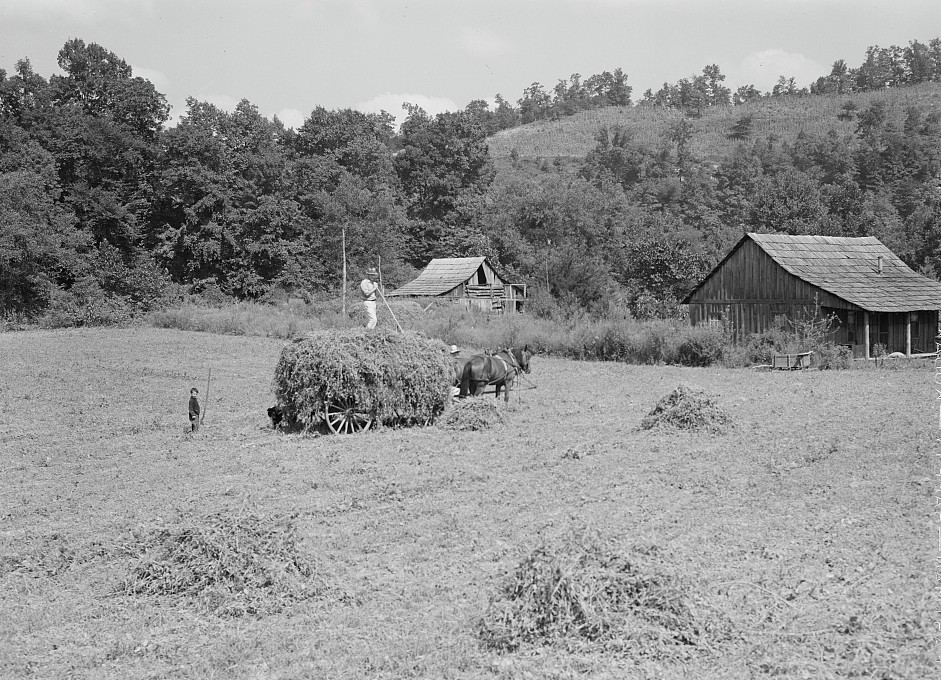
A farmer gathering hay on an Appalachian farmstead likely similar to that of the Crouch family. This picture was taken in eastern Kentucky in 1935. As an aside – all contemporary reports give the name of the primary witness simply as "Mrs Allen Crouch", I found her first name by digging through late-19th-century census records for Bath County.
Sadie Robinson, a young schoolteacher boarding with the family at the time, was working inside the house when the rain of meat took place. She didn't see it fall but ran out to look at the mess when she heard the commotion. Rebecca's husband Allen returned home shortly after and also saw the meat hanging off tree branches and fenceposts.
The meat was scattered across a large area – estimated by witnesses to be around two acres (one or two football fields) – encompassing the Crouch's farmstead, some of their outbuildings and sections of the neighbouring fields. Rebecca Crouch described the material deposited on her farm as follows:
The largest piece that I saw was as long as my hand, and about half an inch wide. It looked gristly, as if it had been torn from the throat of some animal. Another piece that I saw was half round in shape and about the size of a half dollar.
The overall volume of these scattered pieces of meat was estimated at between "half a bushel" (by Mrs Crouch) and "half a wagonload" (by a neighbour who visited the scene). Both of these estimates are a little vague, as potential record metrics go, but put the overall quantity at – very roughly – somewhere between 15 and 150 kilograms (33–330 lb).
Over the following weeks, curious neighbours, a local college professor and several journalists visited the farm. Multiple witnesses from the community were able to confirm the bizarre scattering of meat, and also to vouch for the trustworthiness of Rebecca Crouch and her family. The meat was tested (and tasted!) by some of these visitors, but no-one was able to come to a conclusion about what it was.
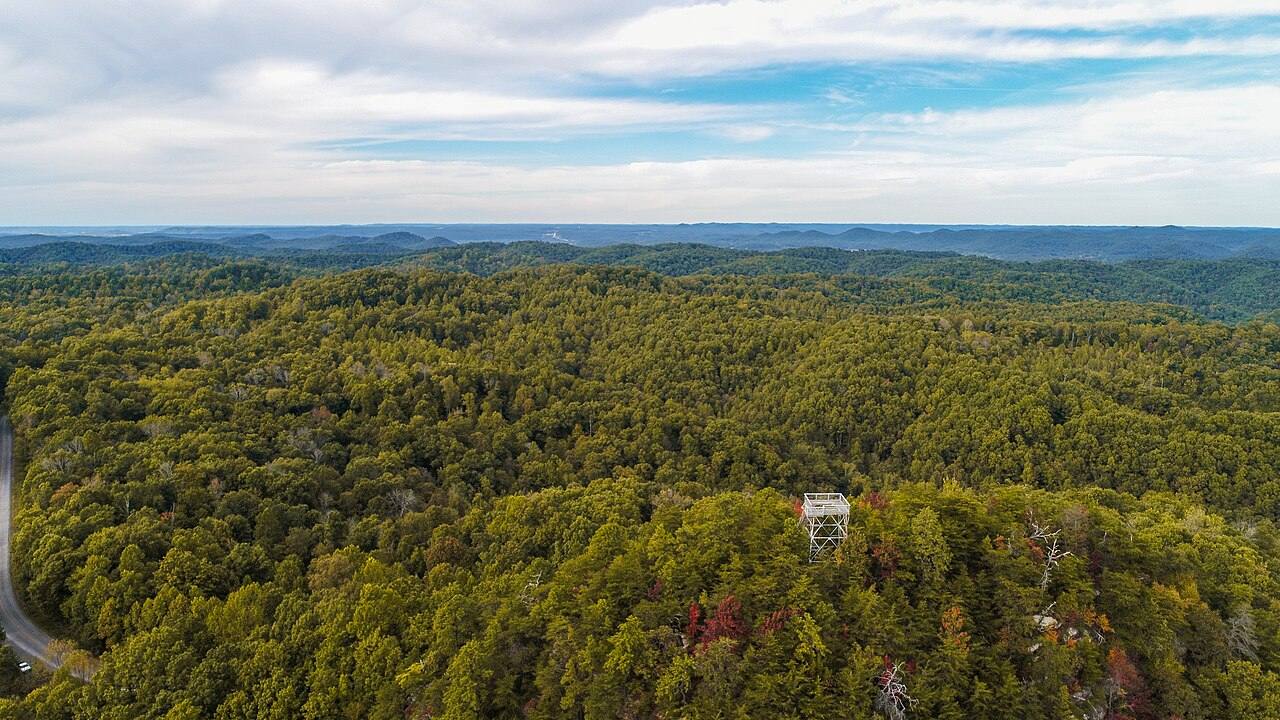
A view of the Daniel Boone National Forest, looking out across the mountains from Tater Knob (stop giggling at the back there), which is not far from the location of the Crouch farm. [US Forest Service/Public Domain/Ben Childers]
The best expert testimony comes from L C Frisbe, a butcher from nearby Mount Sterling, who encountered samples of the meat when it was still relatively "fresh". In an interview with a reporter, he said, "I have handled all kinds of meat, and I never tasted anything exactly like it before. I am not prepared to say for certain that the taste resembled that of either fish, flesh or fowl.", adding that it "looked more like mutton than anything else" and that, after tasting it, he decided against actually swallowing the stuff. (A wise decision, as the Crouch family dog, which ate some of the pieces off the ground, reportedly got very sick as a result).
A century of meat showers
I know what you're thinking. You're thinking, "this is all fascinating, but where's the record?". After all, a unique event can't be the largest or the longest because it's the only one. Guinness World Records can't have a title for meatiest rain, either, because that would be daft.
Thing is, this wasn't the only time it has rained meat in the USA. Indeed, the phrase "shower of meat" brings up more than 1,000 results in the Newspapers.com archives from the USA between 1800 and 1900. Admittedly there's a lot of duplication in those results, as well as some false positives, such as an article describing the aftermath of a deadly explosion at a sausage factory in Loganton, Pennsylvania... but the point stands. Here are a few of the more notable examples I have turned up in my research:
- On 6 August 1841, there was a downpour of what was described as "putrid flesh, or a bloody glutinous matter concreted" on the tobacco plantation of a Mr Ekillis Chandler near Lebanon, Tennessee. It fell over an area "forty to sixty yards in width" and "six or eight hundred yards in length" (approximately 55 x 732 m). The matter was described as "thinly scattered, probably a drop for every ten or fifteen feet, although irregularly dispersed". The largest pieces were an inch or two in length and composed of a mixture of muscle and fatty tissue.
- On 20 August 1851 a "shower of flesh" fell on the grounds of a US Army post in Benicia, California. The station's commander, Major Allen (who was reportedly hit by the falling meat) said the rain of "bona fide beef" lasted for two minutes and was scattered over an area "three hundred yards long and eighty wide". The cumulative volume of the fragments, which ranged from "the size of a pigeon's egg up to that of an orange", was estimated to be "perhaps not less in amount than 100 lb".
- On 18 March 1863, it briefly rained "beefsteaks and liver, or something that very much resembled those favourite articles of food" across several plots of land near the corner of D Street and 20th Street in Sacramento, California. The chickens kept by local residents apparently disposed of most of the material before any examination could be made. (Reporters noted that this was only a few days after it apparently rained frogs in nearby Stockton).
- On 1 August 1869, a "shower of meat and blood" interrupted a child's funeral in Los Nietos, Calfornia (today within the city limits of Los Angeles). This especially distressing rain of meat was splattered across an area of around two acres, and ranged from "fine articles to strips of six and eight inches in length". Particularly notable in this case was that some of the fragments were large enough to be identified, and reportedly included an eyeball and the lower half of a heart.
So going on the reported extents and volumes of material dropped, it looks like the battle for the record is a two-way contest between the Benicia Meat Shower and the Kentucky Meat Shower. The upper and lower ranges of the volume estimates have a great deal of overlap, but I'm inclined to award the title of largest meat shower to the Kentucky incident as it is by far the best documented of the two.
How could this have happened?
At this point, you're probably wondering what on Earth was going on, or, as one contemporary newspaper poetically put it, "from whence came this remarkable rain?"
A few theories were immediately put forward in the press. One of the most commonly espoused opinions, particularly among east-coast metropolitan newspapers, was that this was a rain of red algae or perhaps frog spawn misinterpreted by excitable hillbillies. This one, I think we can exclude right away – several reporters went out to the region and interviewed multiple eye witnesses, including a butcher, a doctor and, of course, many local farmers who would have known perfectly well what raw meat looked like. In all the cases I've mentioned above, people were sure that they were looking at meat and in some instances were even able to identify specific anatomical features.
The next theory is that the meat was carrion, vomited up or dropped by large flocks of high flying (and thus unseen) vultures. I don't really know anything about vultures, but I thought this one was at least worth considering as 19th century America was home to a degree of natural abundance that is unimaginable today – this was a country, you must remember, where flocks of the now-extinct passenger pigeon once massed in large enough numbers to block out the sky.
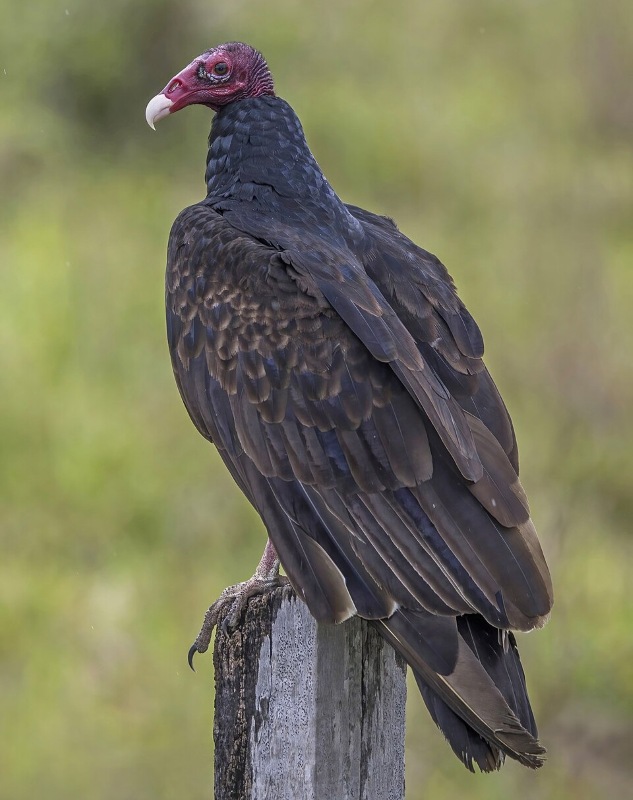
A North American turkey vulture (Cathartes aura). [Wikimedia Commons/CC BY-SA 4.0/User: Charles J Sharp]
Because I was deep down this particular research rabbit hole, I put this vulture theory to Dr Alex Bond, who is the Principal Curator and Curator in Charge of Birds at the Natural History Museum here in London. He said:
I think the bird explanation is quite far fetched to be honest. In the 19th century, the two North American species of vulture – California Condor and Turkey Vulture – had quite limited ranges and small populations. They are also quite small for vultures, and do not really carry food, and certainly not in that quantity!
Dr Bond went on to explain that California Condors, though quite large at 8-9 kg (17–20 lb), are solitary feeders that don't generally flock. Turkey Vultures, meanwhile, are much smaller at around 1.5 kg (3 lb 5 oz), and so wouldn't have been able to hold much food. They were also (and this was a detail that I found really fascinating) much less widespread in the era before the ubiquity of the automobile provided a consistent, nationwide buffet of roadkill.
The most plausible explanation therefore, is the same one that science seems to have settled on in relation to rains of fish: a small dust devil or tornado picked this meat up and threw it high into the air.
Obviously, small cuts of meat do not naturally roam the hills of Kentucky, but it seems plausible that – and I apologize for a really unpleasant mental image here – if a dust devil passed over, say, a deer carcass in an advanced state of decomposition, particularly if it had already been ripped at by scavengers, it could quite easily lift a assortment of shredded bits into the air. This would also account for the slightly unrecognizable nature of the meat.
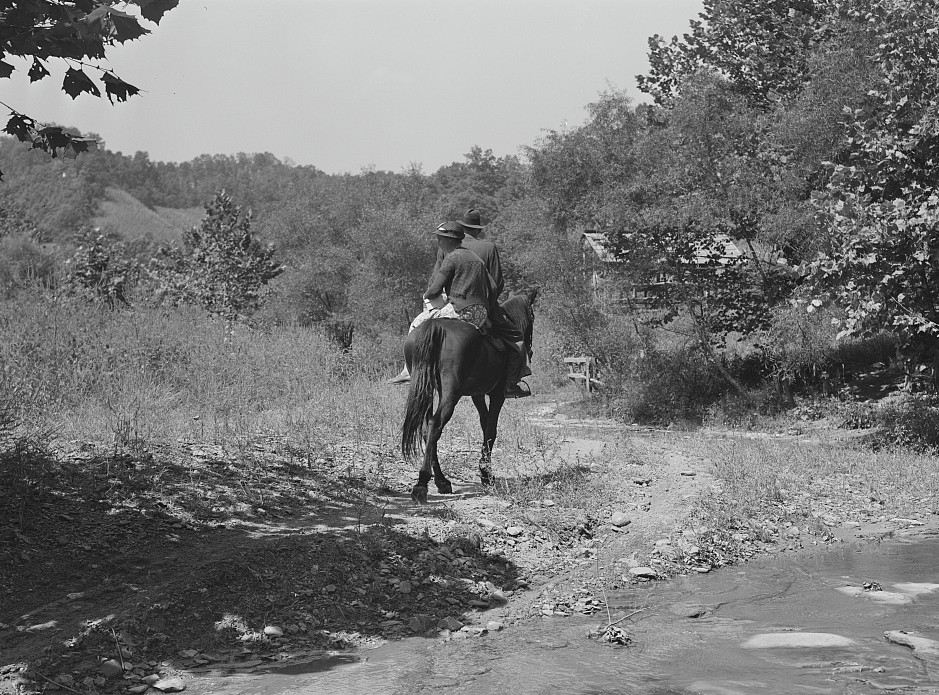
A couple on horseback travelling a dirt road near the location of the Crouch farm in eastern Kentucky. This picture, like the hay-gathering picture above, was taken by Marion Post Woolcott for the Farm Security Administration in 1935. Her striking images of rural life show how undeveloped the region still was, 60 years later.
I should mention, however, that there is one other suggestion that often gets talked about in relation to the meat shower, alongside the "vulture vomit" and "beefnado" theories. A few days after the event, there was an article in the New York Times ascribing the phenomenon to the presence of "meteoritic meat". The author suggested there might be "vast nebulae of finely comminuted meat circling steadily around the Sun", adding "if they revive the theory – now generally abandoned – that meteoric stones are fragments of an exploded planet, they we may require them to admit that the Kentucky shower consisted of fragments of the exploded inhabitants who formerly occupied the wrecked planet."
Much as I love this particular idea, and the implication that it was ever taken seriously, I've read the whole article and it is undoubtedly intended as a joke.
A thing of the past
Sadly (sadly?) we aren't likely to get a chance to test any of these theories, as the age of the meat shower is seemingly behind us. The Crouch family's experience was in fact one of the last great meat showers in America, and barring one or two vague, passing mentions, they seem to have entirely vanished by the end of the 1880s. Searches for phrases like "shower of meat" or "meat rain" from the 1890s onward bring up only incidents like the aforementioned sausage factory explosion, or the time when a New Jersey butcher drank too much and started pelting passers-by with handfuls of ground beef.
Barring some remarkable new discovery, like a preserved fragment of the fallen meat, this one's going to have to remain a mystery.
Header image: This is a view of an isolated farmstead on the West Virginia side of the Appalachian Mountains, just over the state border from the region where the events of this article took place. In case you hadn't guessed, I added the meat myself in Photoshop. [Pixabay]