


The ancient protective magic of hidden shoes
One morning in the late 1950s, Northampton Museum curator June Swann (officially, "Keeper of Boots and Shoes") noticed something strange while looking through the museum's latest acquisitions.
Northampton, a large town in the midlands of the UK, was at the heart of the British shoe-making and leatherworking trade for centuries. And because of the town's industrial history, its museum has always had a large collection of historic footwear. When someone finds a centuries-old shoe in some forgotten corner of a country house, it is often sent to the Northampton Museum's curators for dating and identification.
The detail that caught June Swann's eye that morning, wasn't some aspect of the shoes themselves. It was the fact that almost all the artefacts she was looking at that day were apparently found tucked inside chimneys.
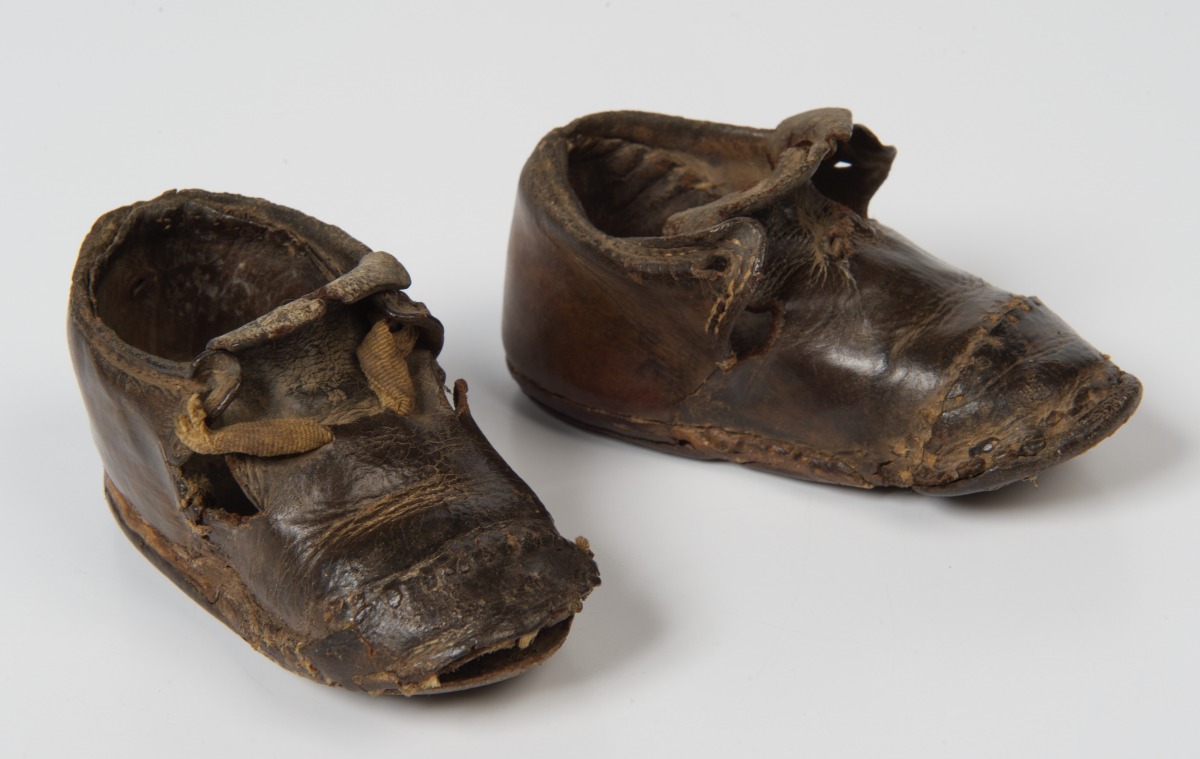
A pair of children's leather shoes, showing marks from several repairs, sole replacements and embelishments. Found behind the fireplace of a 17th century house near Guildford in 1967. [Northampton Museum and Art Gallery]
Ritual concealment
This revelation reminded June of a submission she'd seen a few years earlier, one that had puzzled her enough to stick in her memory. It was a pair of children's shoes that had been found woven into an old cottage's thatched roof. Now, a shoe under some floorboards or inside a wall, that could be written off as an odd bit of improvised insulation or the work of rats, but how did a shoe end up in a roof?
The more she looked through the museum's archives, the more of these puzzling finds turned up. And new ones kept arriving, too; throughout the 1960s, as homes across the UK were modernised with luxurious features such as central heating and indoor bathrooms, builders stumbled across caches of mummified shoes.
A particularly topical cover of Do It Yourself magazine from December 1966, part of the TP Archive collection. Picture no. 13788479 https://t.co/Oq7ty30MBh
— Mary Evans Picture Library (@Mary_Evans) December 15, 2022
I don't know how, but based on my own experience fixing 1960s British DIY in old houses, this project almost certainly involved the creative use of asbestos.
As the evidence piled up, June became convinced that these items had been hidden on purpose, though there was no logical reason for people to have done so. The only explanation she could think of was that this was some sort of magical spell.
Shoe superstitions
This isn't that odd of a leap of reasoning: people have always felt a bit strange about shoes. They, more than any other item of clothing, take the impression of their wearer. They mould themselves to our feet, and the way they wear down provides a physical record of how we walk, how we stand and how we tie our laces. An old shoe can serve as a symbolic stand-in for an individual, something profoundly personal and unique.
There are lots of known superstitions about shoes, most associated with good and bad luck. People used to throw shoes after people when they set out on long journeys, or tie shoes to wedding cars. I can personally remember being warned against the dangers of placing newly bought shoes on tables – even in their boxes! – by my Irish grandmother. Bad luck, apparently.
Furthermore, there's lots of evidence of other domestic deposits that are more obviously associated with magical practices, so it was definitely a thing people did. You can say, "I'm sure there's a mundane explanation", when you find a shoe tucked above the fireplace lintel, but it's a little harder to take that attitude when you find, say, a stoppered bottle full of teeth and hair, or the mummified heart of a bull with iron nails driven through it.
Awwwww. Everyone is posting pictures of hearts for #ValentinesDay Here's a nineteenth century bull's heart pierced with nails and ritually deposited in a Somerset farm.
I'm doing this right, yeah?
📸 Pitt Rivers Museum https://t.co/1Rk74mQi6H— James Wright (@jpwarchaeology) February 14, 2025
However, while there are lots of bits of shoe-related folklore, there are precisely zero written references to the practice of hiding shoes in buildings, which is remarkable. The oldest concealed shoe in the Northampton Museum Index of Concealed Shoes dates to 1530, and there is evidence of the practice throughout the English-speaking world, including not just the UK, but also Australia, Canada and the USA. As of September 2026, there are more than 3,000 individual entries in the Index covering a span of almost 500 years.
Five centuries, it seems, during which time people were determined to keep this whole thing a secret.
Magical spells
So what was the thinking behind stashing these shoes away? The best guess, according to folklorist and occasional GWR consultant Dr Ceri Houlbrook, is that the practice was a form of what's called apotropaic magic – that is, a spell designed to protect a household from evil spirits and dark powers.
There are folk stories from around the UK of demons and witches being tricked and trapped using shoes, and it is thought this belief is what motivated people to start hiding them in their homes. The main bit of evidence in support of this theory is the specific locations in which the shoes are often found – typically around chimneys, hearths, windows and doorframes – were all places regarded as vulnerable entry points for evil spirits.
Shoes were assumed to act as a sort of spiritual lightning conductor. Malevolent forces, whether they were witches, demons, evil spirits or faeries, would mistake the shoe for the person who had once worn it, and direct their ill intentions harmlessly into the leather.
Over time the specifics of the magical mechanism by which this practice was thought to work may have shifted, and it may have simply become one of the many little things that people routinely do "for luck", but the belief in its importance remained.
It's also entirely possible that these shoes represent a whole range of different beliefs and practices. People have always had a strange, whimsical streak – sometimes they start a funny little tradition simply because they had an impulse to do so. Sometimes other people they take up that idea and before you know it, you have a bridge creaking under the weight of hundreds of padlocks.
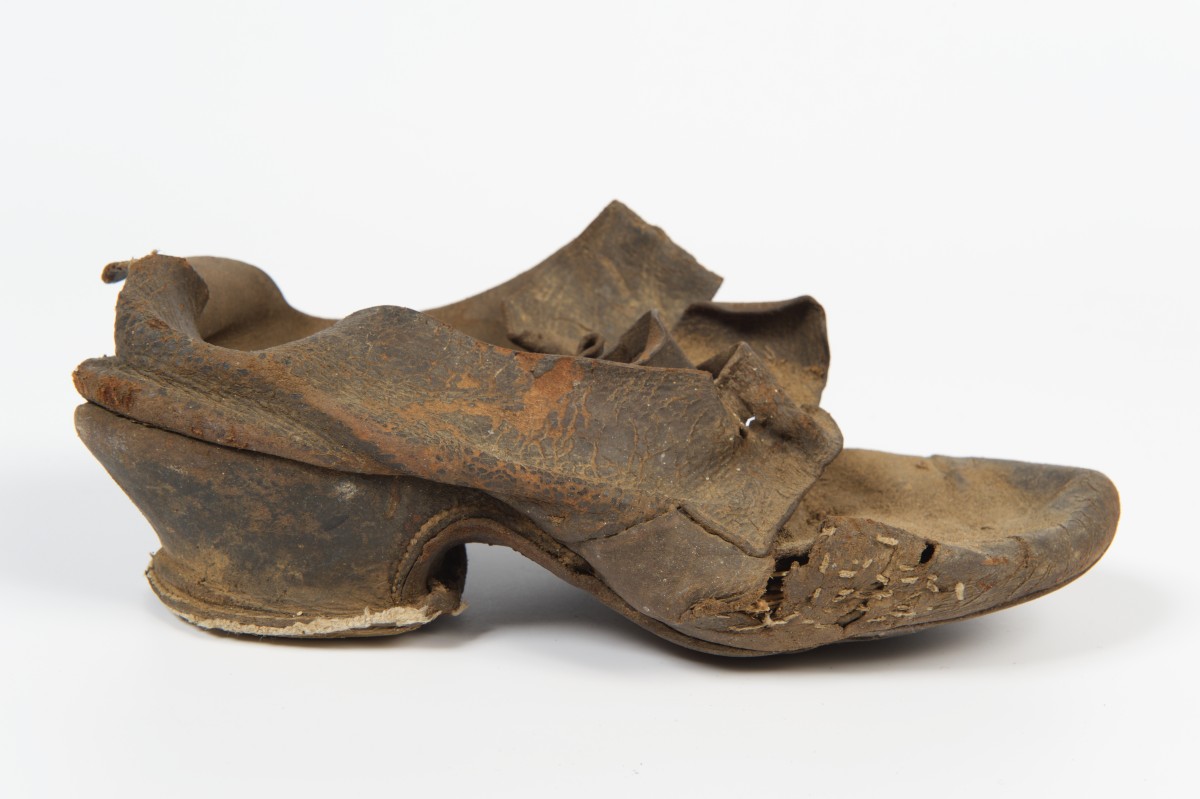
A woman's leather buckled shoe from the 1750s, complete with darned repairs and a hole in the sole. Found hidden in a flue above an oven in Lower Harlestone, Northampton. [Northampton Museum and Art Gallery]
A long history
The practice wasn't just something limited to the long-distant past. The peak of the practice seems to have been in the 18th and 19th centuries, but it was seemingly widespread well into the 20th century.
In some cases, builders have uncovered multiple generations of shoe stashes in a single house. The most concealed shoes in a single building was uncovered in Gelli Iago, a 17th-century farmhouse in the Nant Gwynant Valley, Eryri National Park (Snowdonia), in Wales. During work on the building in 2010, 58 shoes and 189 shoe fragments, dating to the second half of the 19th century, were found beneath the fireplace in the cottage's main reception room.
Furthermore, the impulses that inspired the practice are still very much with us. About half of all the concealed shoes that have been reported to the team at the Northampton Museum since the 1960s were carefully returned to their hiding places by the people who found them. In some cases, the discoverers even decided to add a shoe of their own to the stash, just in case.
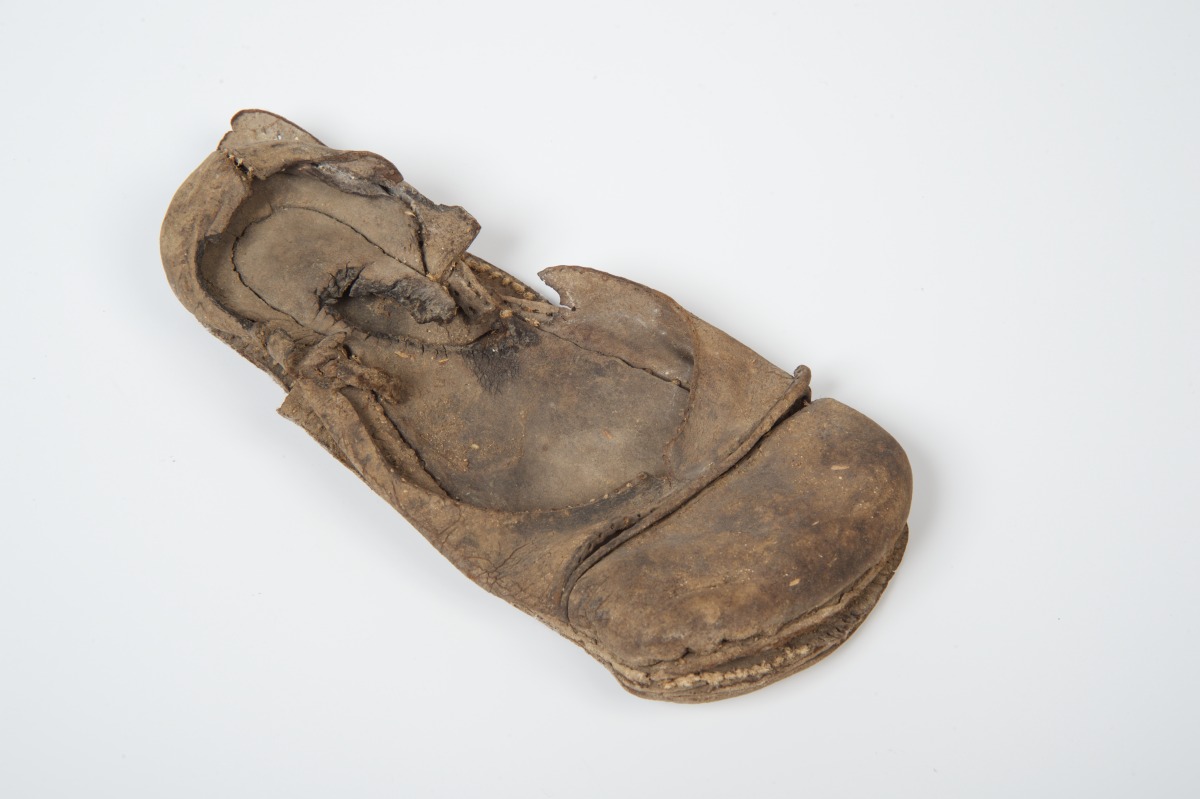
A wide-toed leather shoe, dated to around 1540, found concealed in the ceiling of the dining room of St John's College, Oxford. [Northampton Museum and Art Gallery]
New discoveries
So what should you do if you find an old shoe when you're doing some DIY? I spoke to Rebecca Shawcross, June Swann's successor at the Northampton Museum and the current overseer of the Index of Concealed Shoes (which is now fully digitized).
"We have a link on our website where people can then fill in a form and provide the specific information that we ask for. If it's known, that is, it's not always known. But if they can fit in as much as they can, that's great. Then they can send me photographs and I will deduce from those photographs information about the type and the date."
As with everything in the field of archaeology, the most important information about any find comes from its context, so resist the urge to pull the shoe out of the wall and clean it up. Photograph it in situ and try to store it as you found it.
Of course, if you're particularly worried about witches, it might be best to just leave it be.
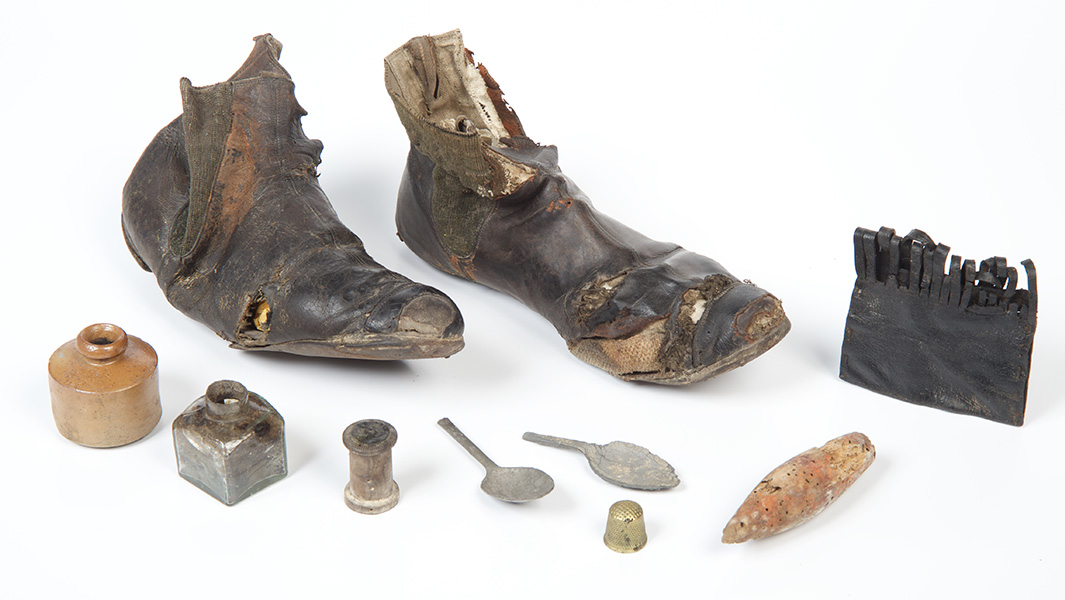
Header image: A pair of women's boots from the 1860s. Found under the floor in the servants' quarters of a house in Brackley, Northamptonshire. They are shown with the other items in the cache: a leather purse, two broken tea-spoons, glass ink bottle, stone bottle, cotton reel, and a child's 'tippit'. [Northampton Museum and Art Gallery]