


Supernatural superlatives: Spooky season at Guinness World Records
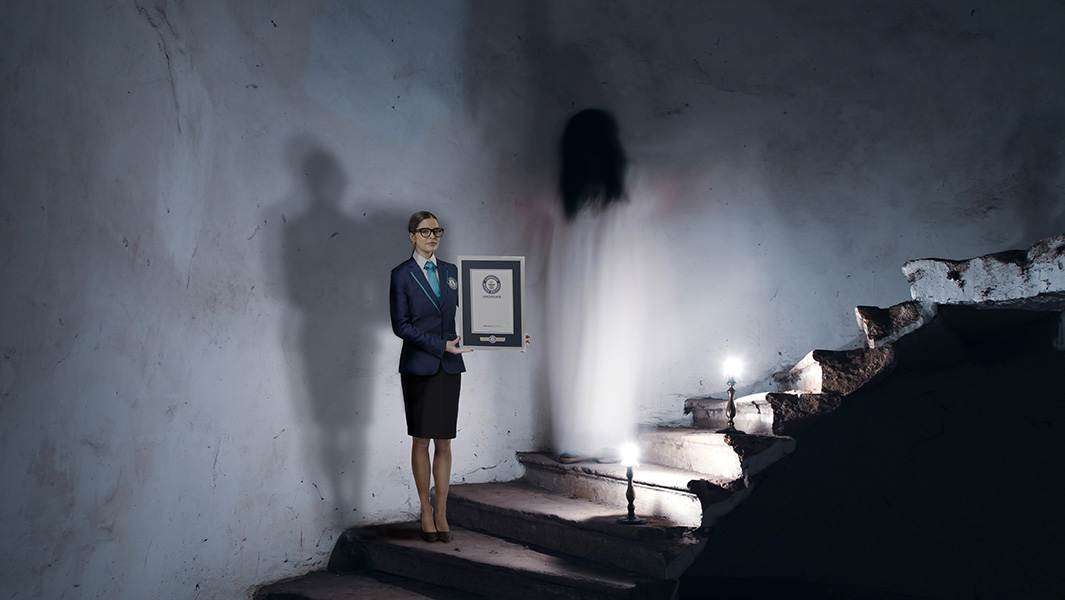
Spooky season is always a bit of a tricky time for us at Guinness World Records. We like to get into the Halloween spirit as much as anyone, but it's not easy to cover subjects like ghosts, monsters and aliens when your stock-in-trade is very much the tangibly real, measurable and repeatable.
You need a sense of mystery for this stuff, and mystery is just not something we do. After all, if you're in the business of asking the person applying for largest collection of teapots to photograph and catalogue every single item in their house-filling collection, it looks bad if you then take the person claiming to have achieved the most ghosts witnessed at their word.
That said, our job, at least here in the editorial team, is to use record breaking as a window on the world – a lens that gives us a unique angle on the things that people are interested in. And all of this stuff does definitely fall into the category of "things people are interested in". The earliest depiction of a ghost is more than 2,500 years old (for more on that, see our article here).
Large-scale public surveys in the UK and the USA typically put about 40% of the population into the broad category of ghost-believers, and the cautiously ghost-curious typically make up about another 30%. Monsters, magic and other similar mysterious phenomena boast smaller, but still significant numbers of believers.
GWR and the Supernatural
Of course, none of this is new, and it's not by any means a new thing for GWR to cover these topics. The first appearance of the supernatural in the pages of Guinness World Records came in the 18th edition (published in October 1971).
For context, the 1970s were a time of generally high background spookiness here in the UK. In addition to the blockbuster horror movies – such as The Exorcist – that were crossing the pond, there was also a home-grown horror renaissance, characterized by influential TV shows like The Stone Tape.
To give an idea of how horror-mad the 1970s was in the UK, this is an actual public safety video made to be shown in primary schools. Like, to children.
The entry in question drew on the work of the influential paranormal researcher Peter Underwood, who was then the president of the Ghost Club. Underwood's magnum opus, the Gazetteer of British Ghosts, had been published earlier that year. This book was an attempt to compile a detailed census of the reported hauntings and spectres of the British Isles, organized into a great encyclopedia-like tome.
I feel like this quixotic attempt to impose scholarly rigor on something famously impossible to pin down puts Underwood into the same category as our own founding editors, Ross and Norris McWhirter. Indeed, though I've not been able to find any proof of this, I suspect they knew each other. Norris and Peter were members of several of the same London clubs and societies, and the very short gap between the publication of the Gazetteer and the 18th edition of GWR (only a few months), makes me think that Norris might have gotten his data from Peter directly.
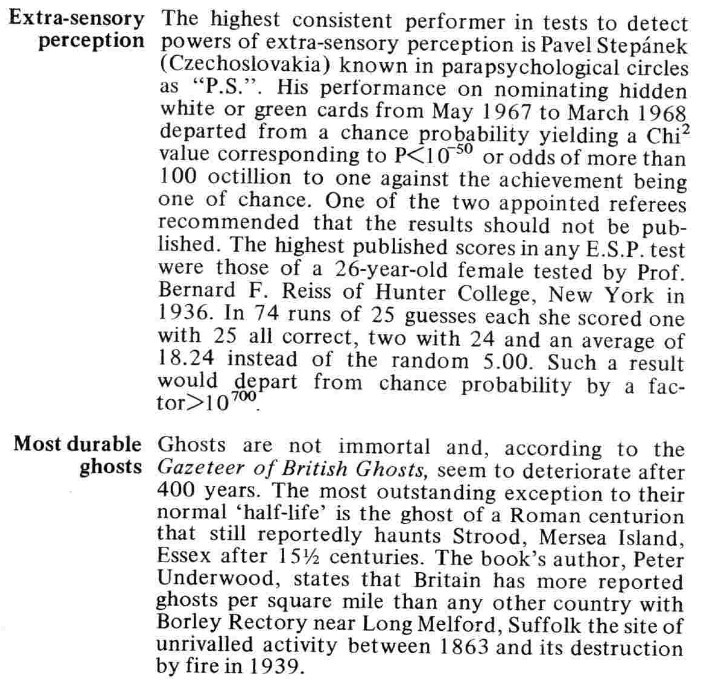
Ghosts per square mile! It's always important to have a quantitative metric.
This particular record remained on the books for decades, and even changed hands a few times, though it's not clear exactly how that particular application process worked. That lonely centurion, who had been haunting the holiday cottages of the Essex coast for centuries, apparently lost his record to a group of Roman soldiers from York in the late 1980s. We have to assume one of them paused in their haunting to add "ooOOoo we're actually from an earlier phase of Roman military occupation ooOOoo".
Eventually all the Roman spirits were outdone by a late-bronze-age horseman, specifically identified as being from around 700 BCE (again, not clear how this date was determined). The wonderfully dry text of Guinness World Records 1990 adds that the ghost "frequents the B3081 near Sixpenny Handley, Dorset". [quick note for non-UK readers, the B3081 is a minor public road, and "Sixpenny Handley" is, against all logic and good sense, the name of a town.]
This was the last appearance of this record in the book. I suspect that as GWR's processes became more standardized and less idiosyncratic, it became a tough one for the editorial team to defend.
The plan for this year
So what do we do in spooky season? We can't just take these supernatural stories as objective truth, and dish out the records accordingly, and it feels like a cop-out to follow the example of the 1998 edition and simply stick question marks after all the titles.
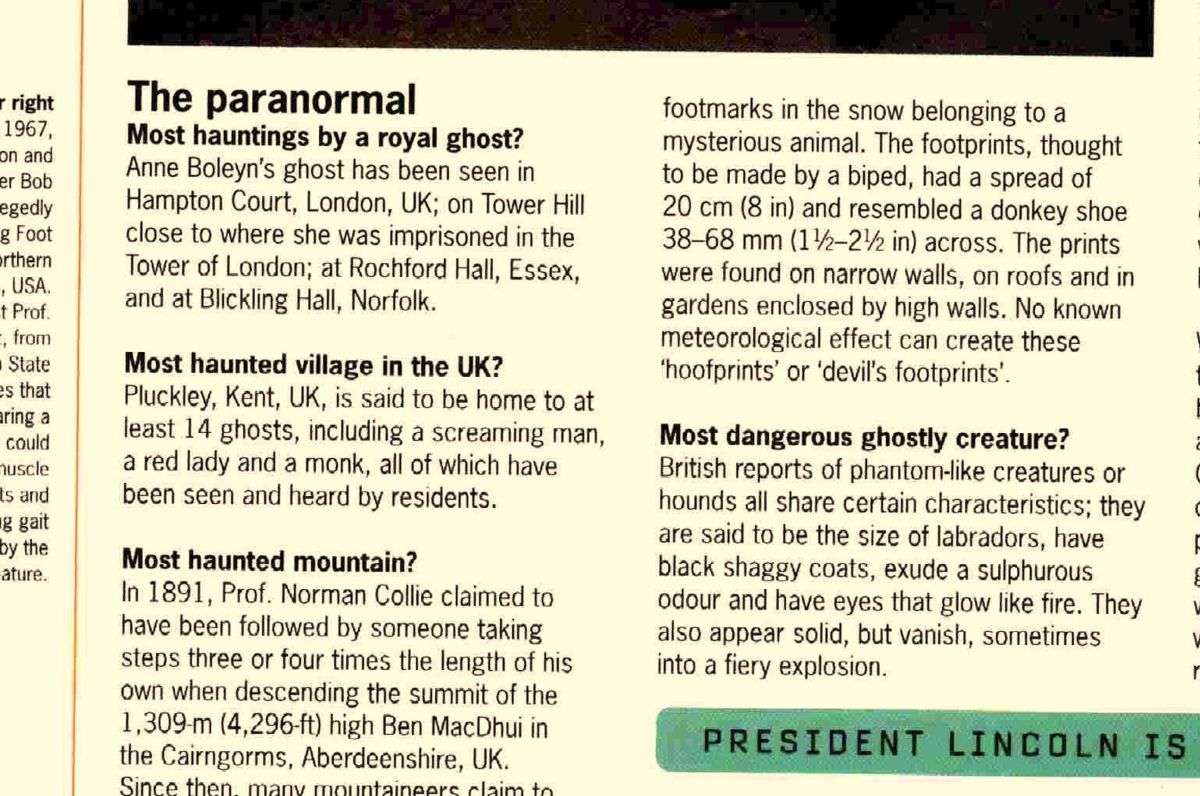
I've encountered some pretty sulphurous labradors in my time.
The answer, we've decided, is to take a slightly side-on look at these subjects, focusing on the human and cultural elements that underpin so many of these stories. Like the truth, the superlatives and significant firsts are out there, we just have to wade through more than the usual number of dubious claims to find them.
Over the next few weeks, as the darkness closes in and more and more things become pumpkin scented and flavoured, check back in with GWR for a series of record-breaking features on everything from vampires and ghosts to magic shoes and rains of mysterious meat.
Header image: Melinda Nagy/Shutterstock. I would like to reassure the reader that adjudicator Joanne Brent was not harmed or possessed in the making of this article.