


NASA's Perseverance rover breaks the record for longest road trip on Mars
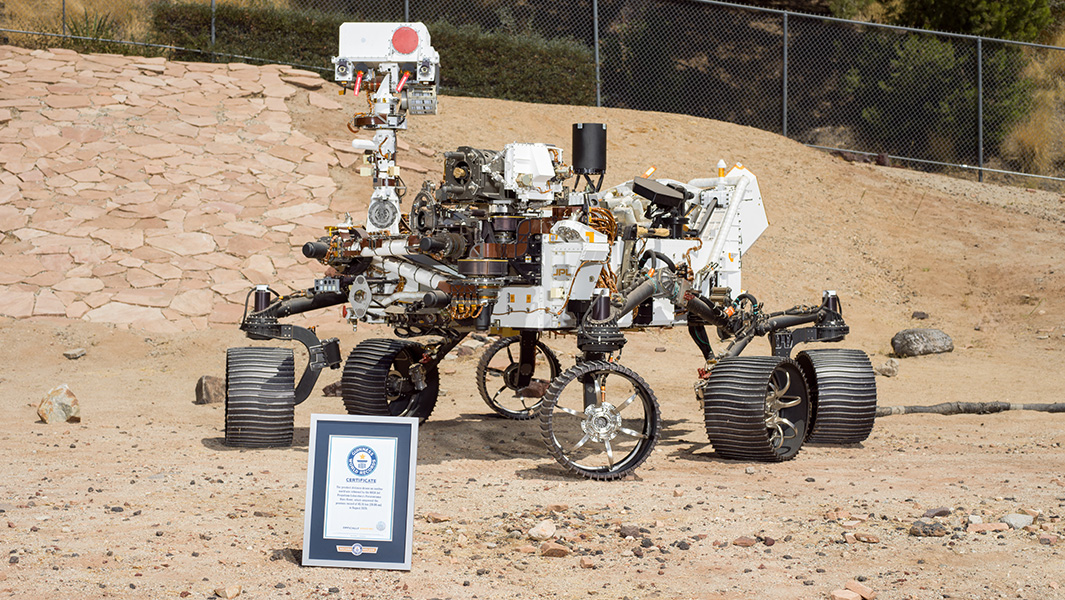
On Sunday 11 October 2026, NASA's Perseverance Mars rover carried out a 91.31-m (299-ft 6-in) drive from the "Lac de Charmes" on the rim of the Jezero Crater, towards a region of ancient eroded rocks named "Idubi". As it went, the six-wheeled vehicle's odometer ticked from 45.13 km (28.04 mi) to 45.22 km (28.09 mi), surpassing the Opportunity rover's historic record for the greatest distance travelled on another world.
To celebrate this out-of-this-world achievement, we're going to take a quick look at the history of this record and explain how the team at NASA's Jet Propulsion Laboratory (JPL) in California, USA, equipped Perseverance to break this record in less than half the time it took the previous holder.
The history of the record
The first planetary rover was the Soviet Union's Lunokhod-1 ("moonwalker 1"). This wheeled robot touched down in the Mare Imbrium on the Moon's near side on 17 November 1970 (about nine months before Apollo 15, the first NASA mission to make use of the Lunar Rover Vehicle).
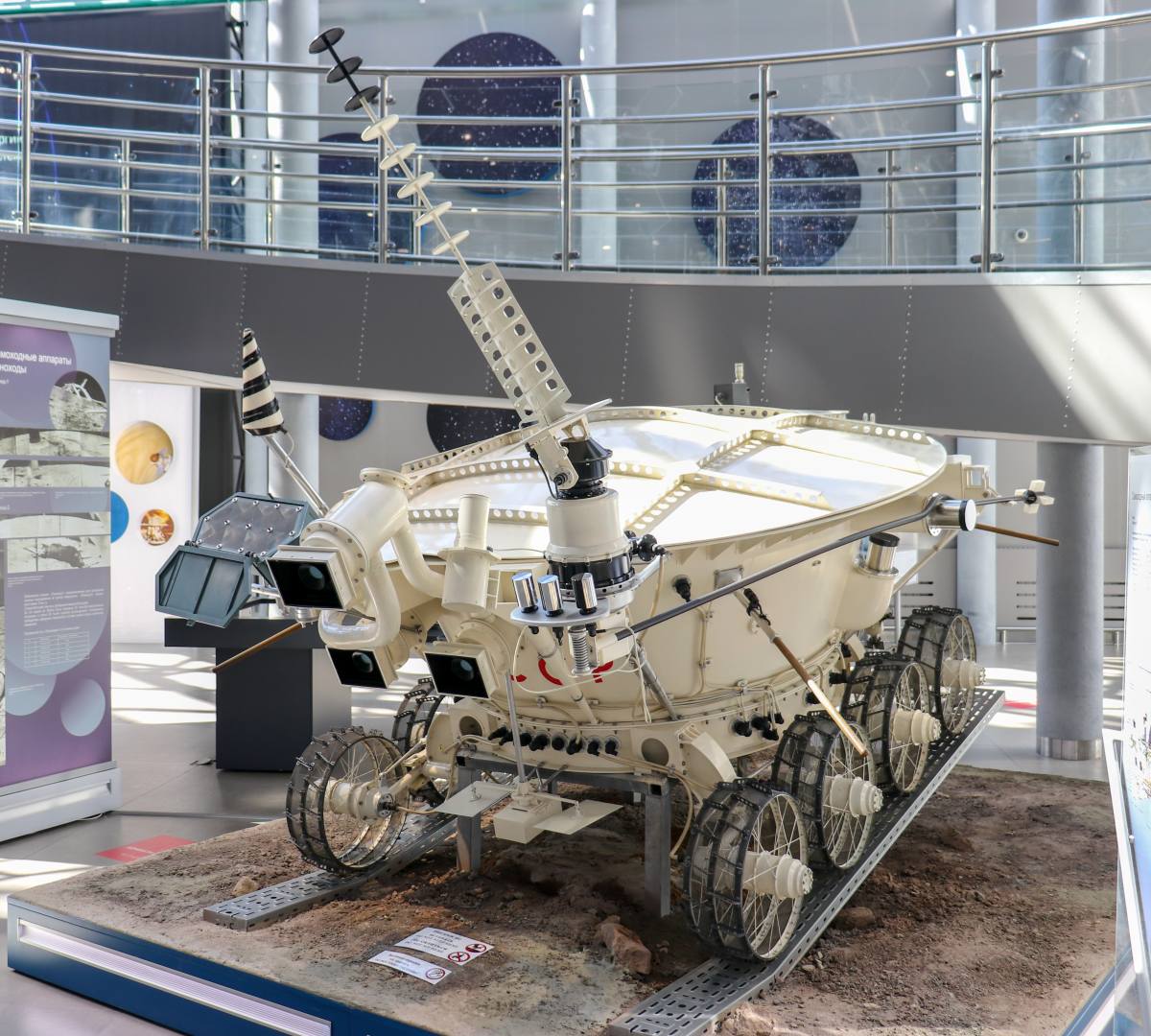
A replica of Lunokhkod, located at the Tsiolkovsky State Museum of the History of Cosmonautics in Kaluga, Russia. It is shown in its initial deployment configuration – once active, the "lid" hinged up to reveal its solar panels. [CC BY 4.0/Wikimedia Commons/User:Stolbovsky]
Lunokhod-1 looks somewhat crude when compared to Perseverance, but it was state-of-the-art for the time. Soviet mission control could only use six basic movement commands (forward short, forward long, turn 20° left, turn 20° right, reverse, and halt). Because of these limited instructions, the rover was designed to be partially autonomous, using its own sensor data to interrupt actions that might lead to it getting stuck or damaged.
Lunokhod-1 drove a total distance of 10.54 km (6.54 miles) between its landing on 17 November 1970 and its final shutdown command on 14 September the following year. That mark was bettered in 1973 by its sibling, Lunokhod-2, which covered 37 km (23 miles) over the course of about four months. Its record for greatest distance travelled on another world would stand for more than 40 years.
Spirit and Opportunity
The next milestone in the history of this record came with the 2004 launch of NASA's twin Mars Exploration Rovers, MER-A and MER-B. These identical solar-powered robots, each around the size of a golf cart, would come to be known as Spirit and Opportunity.
Each was designed to land, drive off its protective base-station and then spend three months trundling around the local area, testing samples and taking pictures. The rovers were expected to cover a distance of no more than 1 km (0.62 mi) before shutting down.
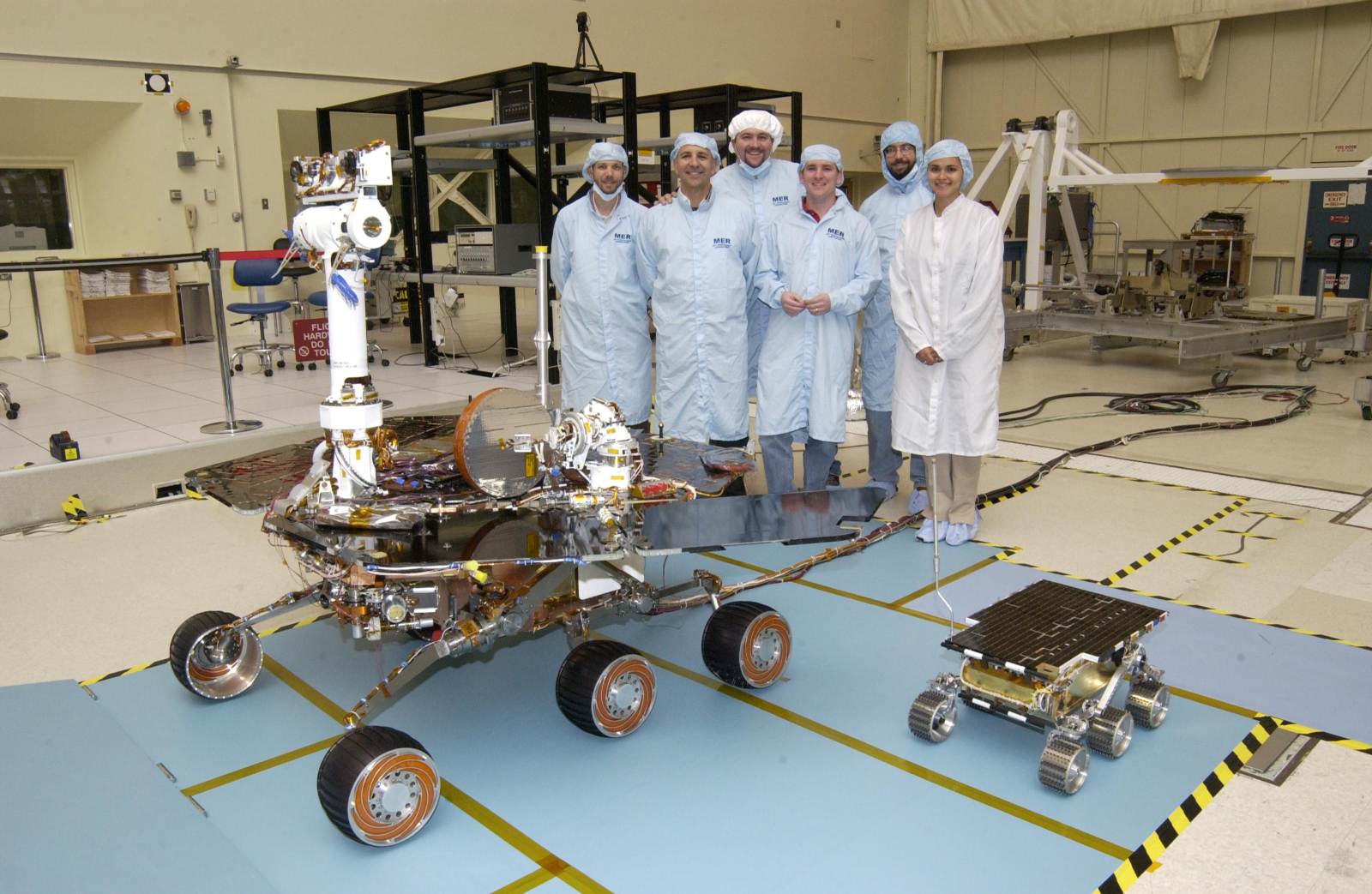
Mars Exploration Rover B (Opportunity), pictured at the Jet Propulsion Laboratory in Pasadena, California, alongside members of the Mars exploration programme team. The small rover to the right is the backup Sojourner rover (which was part of the 1997 Mars Pathfinder mission). [NASA/JPL-Caltech]
This is famously not what happened. The end-of-mission date came and went without either rover showing signs of running out of steam. They were both instructed to leave their planned area of operations (the Gusev Crater for Spirit, the Eagle Crater for Opportunity) and set off on journeys of exploration.
Over the next five years, the two rovers travelled many times further than they were ever expected to go. They set Martian land-speed records with straight-line drives that reached a blistering 3.7 cm/sec (0.13 km/h, or 0.08 mph) and recorded evidence that transformed our understanding of Mars's ancient history.
Spirit became bogged down in soft sand in May 2009, and lost power as the dust built up on its solar panels in March 2010, but Opportunity (by now affectionately known as "Oppy") kept going for another eight years. It broke Lunokhod-2's record on 27 July 2014 and would eventually cover 45.16 km (28.06 mi) over the course of its 14-year mission, which remains the longest time survived on Mars by a spacecraft.
The rover operators at the Jet Propulsion Laboratory had to finally say goodbye to Opportunity in 2018. A planet-wide dust storm blotted out the sun and cut power to the old rover's solar panels as it was exploring the Endeavour Crater, and it didn't have battery capacity enough to outlast the storm.
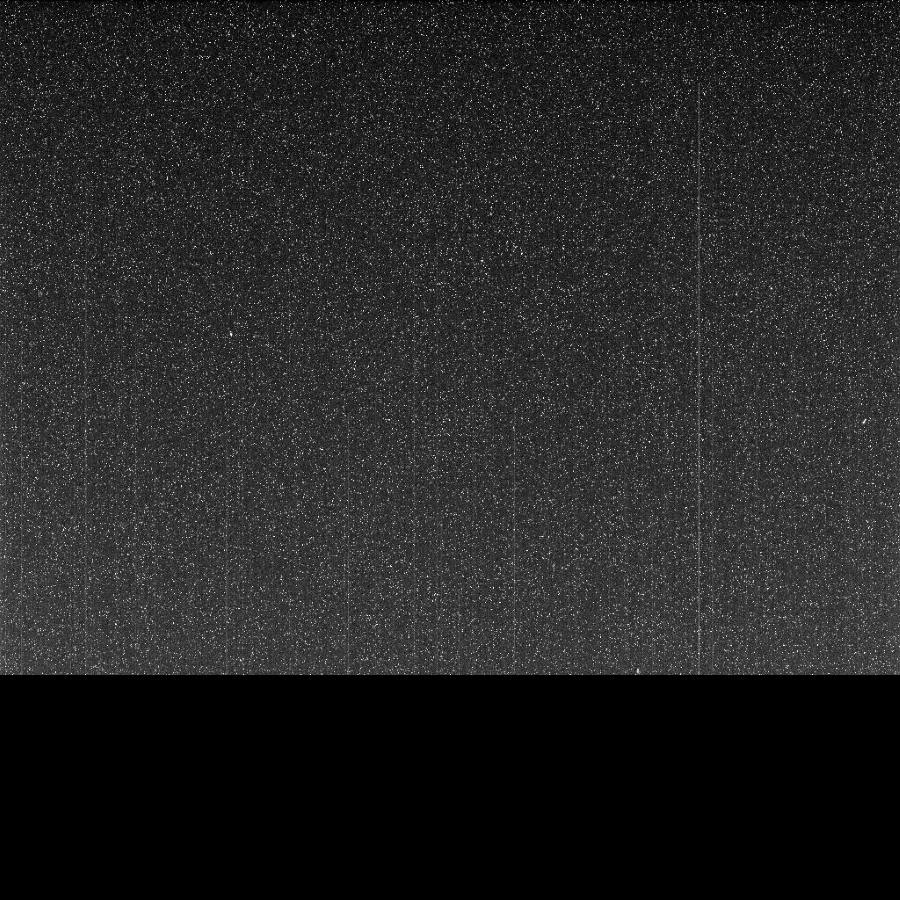
Opportunity's last message to Earth. It was looking up at the sky in the middle of the Martian day, but the picture shows only darkness and digital noise as the opaque dust cloud rolls overhead. The rover lost power before the last section of the picture could be transmitted. The accompanying telemetry was famously interpreted by journalist Jacob Margolis as "My battery is low and it's getting dark". [NASA/JPL-Caltech/Cornell/ASU]
Bringing things up to date
That's how the record stood until this morning. Opportunity's successor, the massive 900-kg Curiosity rover, has been active on Mars since August 2012, but it has, to date, driven "only" 38 km (23.6 miles). This is because Curiosity was designed for in-depth investigations within a comparatively small area. It uses its drills, lasers and powerful scientific instrumentation to gather as much information as possible about the complex geology and potential former life of its home in the Gale Crater, where science objectives are clustered close together.
Its huge size (Curiosity is about as big as a Volkswagen Golf) and limited self-driving capability mean it was never expected to go on long road trips, and its mission plan doesn't require them.
Curiosity has almost matched Opportunity's longevity record, however, and is showing no signs of slowing down. It gets its power from a device called a Radioisotope Thermoelectric Generator (RTG), which converts the heat emitted by a block of radioactive plutonium into electricity, meaning that it's not bothered by dust storms. It might not get there quickly, but it will probably match Opportunity's distance record eventually.
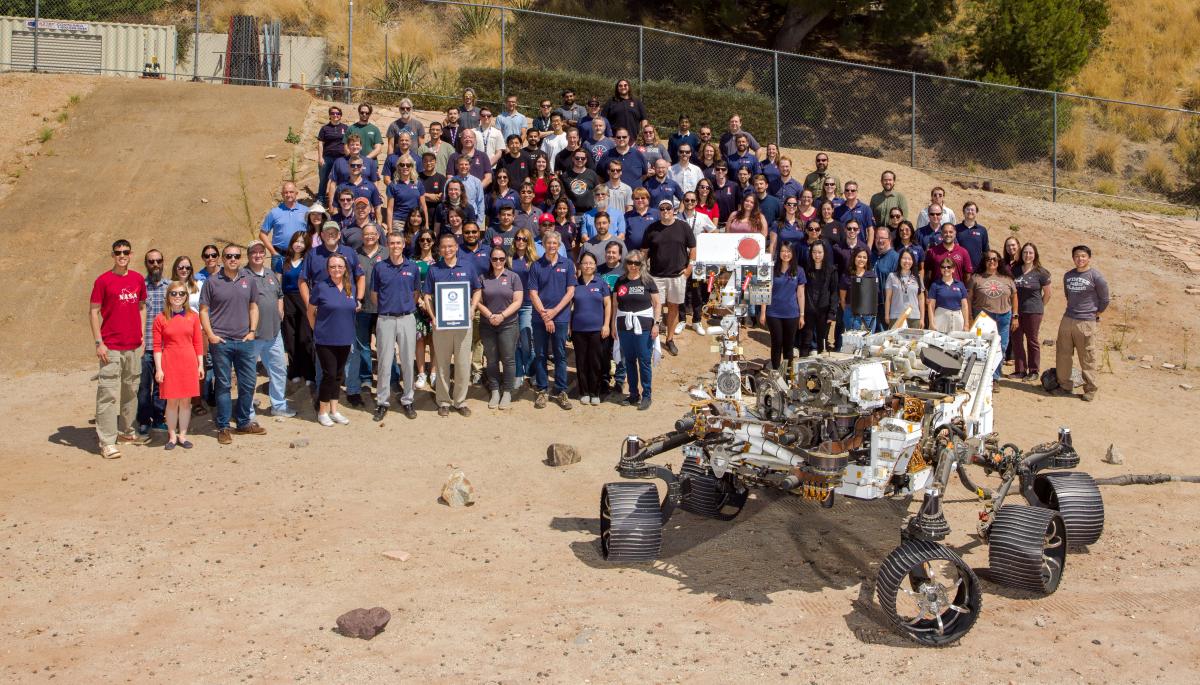
The record-breaking Perseverance Rover team pose with their GWR certificate behind OPTIMISM, which is Perseverance's Earth-bound engineering duplicate. They are standing in the Mars Yard – a testing facility at JPL. [NASA/JPL-Caltech]
Perseverance, though even bigger than Curiosity (at 1,026.4 kg, or 2,262.8 lb, it's the largest planetary rover ever launched), has a few important upgrades that allow it to travel further than its older sibling.
The problem of navigation
So how has Perseverance managed to break Opportunity's record in such a short time? You'd think perhaps it's faster or more powerful, but no, Perseverance's top speed is the same as Opportunity's and its drivetrain is more or less identical to Curiosity's (it has slightly larger, chunkier wheels as Curiosity's have taken more of a beating than expected). Instead, the difference is in the rover's brains.
Because signals take such a long time to get to Mars, it's not possible to operate the rovers in real time (you can't have a joystick and a video feed, like a drone on Earth). The two planets are, on average, about 225 million kilometers apart, meaning that an instruction sent by radio takes 13 minutes to reach Mars, and any response takes another 13 minutes to get back.
As a result, the process of driving a Mars rover has traditionally been a slow and painstaking one. While broad plans of where to go can be made by plotting routes on satellite maps, the day-to-day instructions have to be much more detailed.
With Curiosity, for example, the latest navigation camera pictures are used to plan a route that weaves past the obstacles in the rover's field of view (and there are lots of obstacles, from jagged rocks, to steep-sided craters, to patches of soft, wind-blown sand). The rover then drives that route, stops and takes more pictures so the process can begin again. The route planning can either be done manually by the operators at JPL (as had to be done for every drive with Spirit and Opportunity) or very slowly by the rover's onboard computers.
The problem is that computing power is very limited (space-rated processors have to be simple and rugged to survive being bombarded with solar radiation) and so Curiosity can't drive and think about where it's driving at the same time. It has to drive to the edge of its field of view, stop, take pictures and then analyze those pictures before it can set off again.
This keeps the multi-billion-dollar hardware safe, but it means that the rover can't go anywhere fast – or even the Mars rover version of "fast" (about 140 metres per hour).
Thinking and Driving
Perseverance has an additional on-board computer – called the Vision Compute Element – dedicated to autonomous navigation. This computer can run while the rover is driving, allowing it to spot distant obstacles as they appear and amend its drive plans on the fly. Like self-driving cars on Earth, it uses AI image recognition to identify obstacles and plan its route. The whole system is called AutoNav.
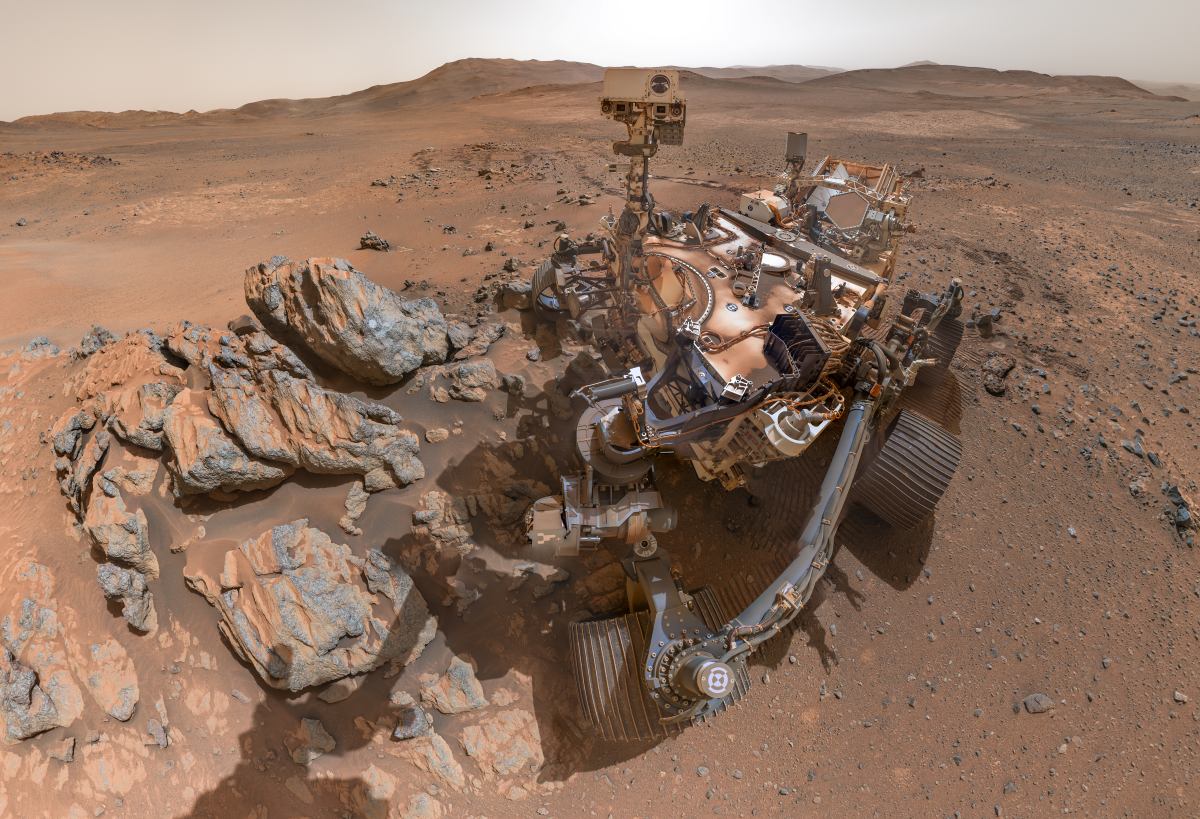
The most recent selfie taken by Perseverance on 11 March 2026. If you compare this with the picture of OPTIMISM above, you can see see how the rover has gotten covered in a thick layer of fine Martian dust. [NASA/JPL-Caltech/Kevin M. Gill]
Thanks to these innovations, Perseverance can cover distances of up to 411.7 m (1,350.7 feet) in a single drive. By comparison, Curiosity typically moves only around 30–50 metres at a time.
Additionally, Perseverance is still being actively maintained and updated by the team at JPL. One particularly clever new feature was added in February, when the spare computing hardware originally used to handle communications with the Ingenuity helicopter was repurposed to help Perseverance orient itself without human help.
Called Mars Global Localisation, it works like this. First, the rover takes a 360 picture with its mast camera. These pictures are then sent to the Ingenuity base-station computer, which identifies landmarks on the horizon and references them against satellite maps. By triangulating these landmarks, Perseverance can now automatically pinpoint its position on Mars to within around 25 cm.
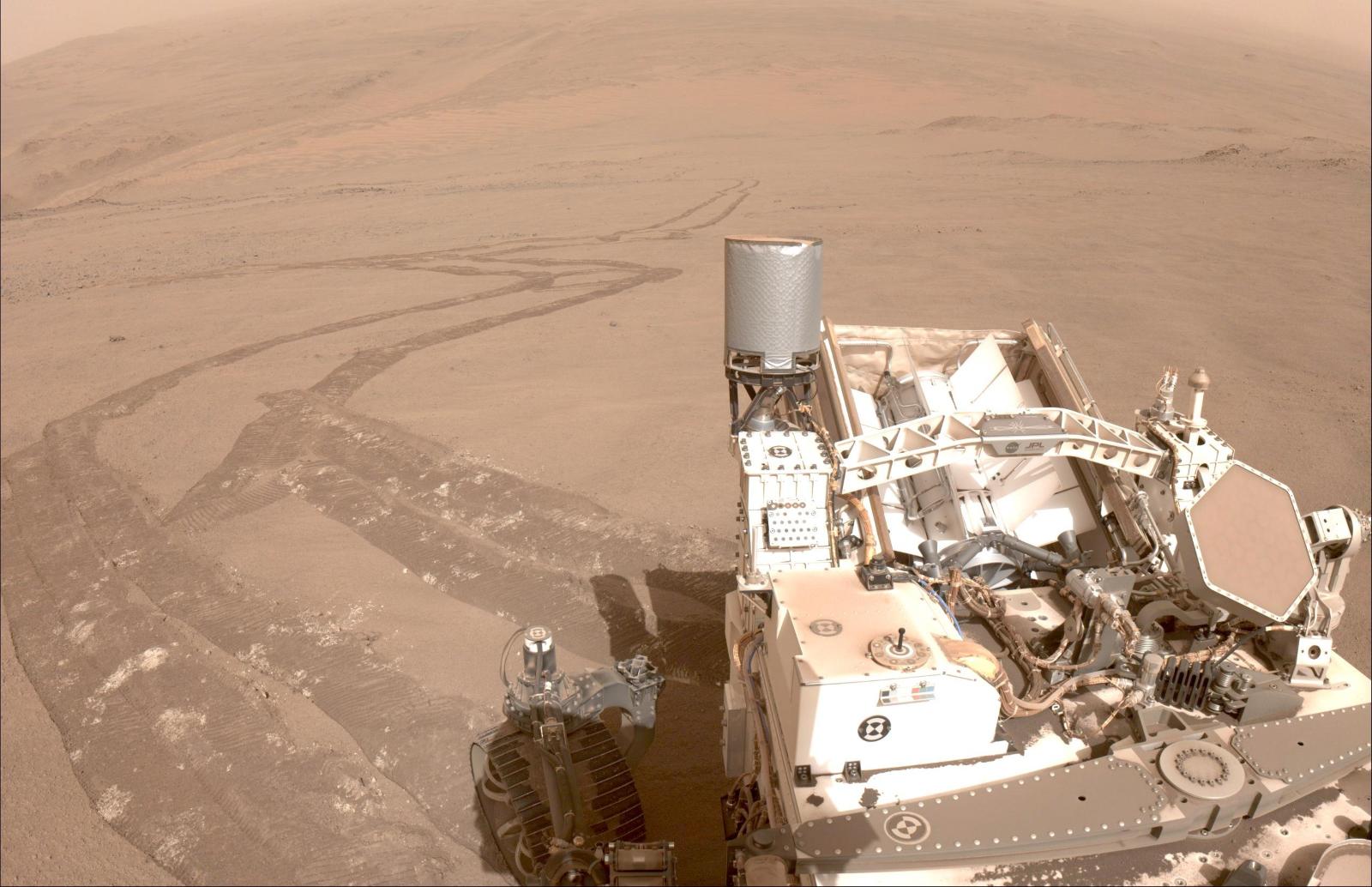
Perseverance looks back at its tracks during the long climb up the rim of the of the Jezero Crater. [NASA/JPL-Caltech]
The Future
The team at JPL have grand plans for Perseverance. The rover's long lifespan and long-range cruising capability are well suited to its scientific objectives in the Jezero Crater. The rover's motors, which were conservatively rated for 20 km (12.4 mi) of driving, are now expected to cover at least 100 km (62 mi) over their lifespan. This brings a huge range of potential sampling sites within reach, allowing JPL to make the most of their robotic investigator in the 4-billion-year-old strata of this region of Mars.
"The team is excited to continue exploring, building on the legacy of NASA’s trailblazing Mars missions," said Curiosity and Perseverance rover project manager Steve Lee. "As we continue playing our part in advancing the nation's space exploration goals, Perseverance’s distance record will grow each sol (Martian day) in our mission to investigate the Red Planet and search for signs of past life."
For more science & technology stories from GWR, click here.
Header image: Perseverance's Earth-bound twin, OPTIMISM, poses with its GWR certificate at the JPL campus in Pasadena, California, USA. [NASA/JPL-Caltech]