


It's Raining Fish! Anomalous preciptation and falling fish in Louisiana
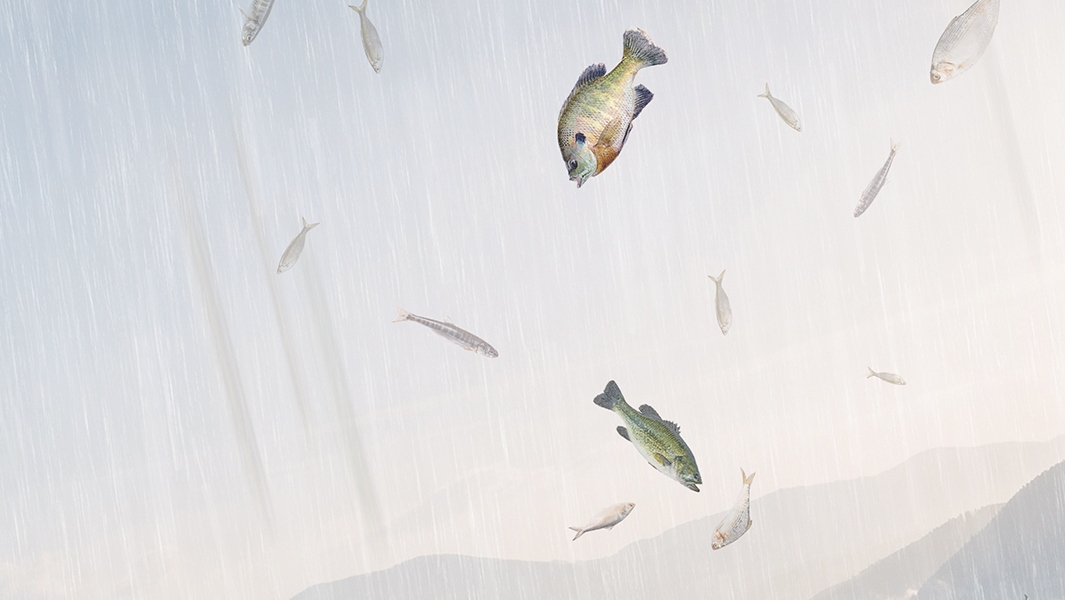
Dr Alexander Dimitrievich Bajkov was a fascinating man. Over the course of his eventful life he had been a champion cross-country skier, an artillery officer in the trenches of World War I and, eventually, one of America's foremost experts on freshwater fish. His adventures had taken him from St Petersburg, to Prague, to Manitoba and then all over the United States. He spoke seven languages fluently, was a gifted musician and had the sort of self-confidence required to style out a nose-width moustache and a side-parting well into the 1950s.
Article from 23 Feb 1946 The Dayton Herald (Dayton, Ohio)
...Yikes
On the morning of 23 October 1947, Bajkov's wandering lifestyle had landed him in a booth at a diner in Marksville, Louisiana – a small town about 120 km upriver from Baton Rouge. He was eating breakfast with his wife Virginia, and getting ready for another day of fieldwork in the nearby Spring Bayou Wildlife Reserve.
Breakfast interrupted
Shortly before 8 a.m., Dr Bajkov's breakfast was interrupted by a waitress who came over to inform him that fish were raining from the sky.
I think it's fair to say that this would be enough for anyone to abandon their Café du Monde and biscuits, and that goes double for a bona fide fish scientist. Dr Bajkov and his wife (who, like many academics' wives from this era, did double duty as a research assistant) rushed outside to examine the falling fish.
Main Street, which had just two weeks earlier hosted the Avoyelles Parish Fair (opened by Miss Bernadine Dupont, local beauty queen, riding atop a giant fish-shaped parade float) was now splattered with real fish. The creatures covered the street around the town's courthouse in an area approximately 1,000 feet long and 80 feet wide (304 x 24 m).

The Avoyelles Parish Courthouse with the shops and cafes of Main Street in the background. Imagine this view (taken as part of a US Historic Buildings survey in 1981) but with older cars and more dead fish. (Public Domain/US National Parks Service)
Bajkov spoke to the director of the local bank, James Barham, whose yard was full of fish, as well as Barham's neighbours Elizabeth Joffrion and Eddie Gremillion, who reported the same thing. Furthermore, two local shopkeepers, Emanuel Blanchard and J M Brouillette, testified that they had been struck by the falling fish as they walked down Main Street.
(I admit I included these details mostly for an excuse to include this fine selection of authentic Louisiana Cajun names.)
The Bajkovs collected up as many of the fish as they could find, noting that they were distributed at a density of around one fish per square yard. He recorded that they were all freshwater fish native to local waterways, including "large-mouth black bass (Micropterus salmoides), goggle-eye (Chaenobryttus coronarius), two species of sunfish (Lepomis), several species of minnows and hickory shad (Pomolobus medtocris)." The largest fish he found was a large-mouth black bass that measured 9 1/2 inches (24.1 cm) in length.
He described them as absolutely fresh and fit for human consumption (presumably provided one had a permissive interpretation of the five-second food-on-the-floor rule).
Rains of fish, other things
The important thing to stress about this bizarre story was that Dr Bajkov was not particularly surprised or at all mystified by this event. He immediately realized that he and his colleagues at the Fish and Wildlife Service had been gifted a unique opportunity to study a well-known but previously unexplained phenomenon in detail.
According to GWR's meteorology consultant, Professor Randall Cerveny, showers of fish are the most common type of anomalous rain (i.e. things falling from the sky that aren't water or water ice), with hundreds of documented cases throughout history. (Other odd types of rain discovered by Dr Cerveny in written records include falls of frogs, beans, worms, toads, spiders, rice, snails, crayfish, seeds, sand-eels, snakes, coins, clams, beetles and, er, "mysterious jelly".)
The oldest known reference comes from the Deipnosophists – a selection of historical accounts collected by the classical Greek writer Athenaeus of Naucratis in the 2nd century CE. In the chapter "De Pluvius Piscium" ("On Rains of Fish") he asserts "it has very often rained fishes" before going on to list numerous examples from now-lost ancient texts.
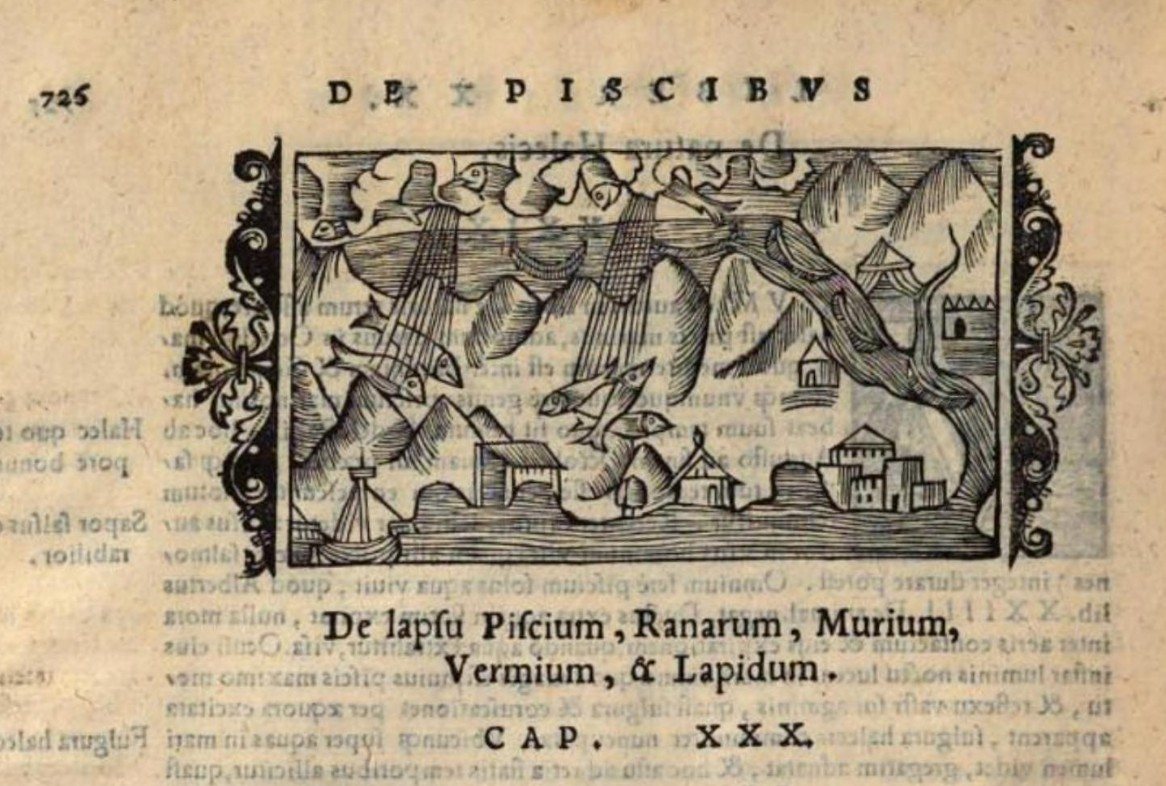
An illustration showing a rain of fish from Olaus Magnus' Historia de Gentibus Septentrionalibus ("A History of the Northern Peoples") published in 1555. I can tell you, having thumbed through more than 700 pages of this book, this is one of the less weird woodcuts.
In his 1946 review of the subject, "Rains of Fishes – Myth or Fact?", ichthyologist E W Gudger comes down very much on the side of "fact", having counted 78 well-documented rains of fishes throughout history. This isn't a phenomenon of the distant, unreliable past either, they continue to occur around the world on a fairly regular basis.
Unfortunately, it's not easy to find these stories anymore because the world's AI slop factories have latched on to the concept and publish the same doctored images so often that the real stories get drowned out. The most recent actual case I'm aware of took place in Lajamanu, a tiny outback town in Australia's Northern Territory, in February 2023.
What causes these events?
The reason I've chosen to focus on the Marksville Fish Shower is that the scientific community was uniquely well placed to study it in real time. Not only was Dr Bajkov present at the scene, but he and his colleagues from the Fish and Wildlife Service had been conducting fieldwork in the nearby bayous for several days beforehand.
For context, the town of Marksville sits in a geographical setting that is pretty typical for a central Louisiana town. It's positioned on a patch of elevated ground that puts it about 10 metres above the surrounding wetlands and rivers (practically a mountain for this part of the world). It is located between two substantial wetland areas – the Spring Bayou to the east and the Grand Cote Wildlife Refuge to the west. The Red River runs around 8 km to the north, and the broad slow-flowing waters of the Atchafalaya River are just 30 km away to the south-east.
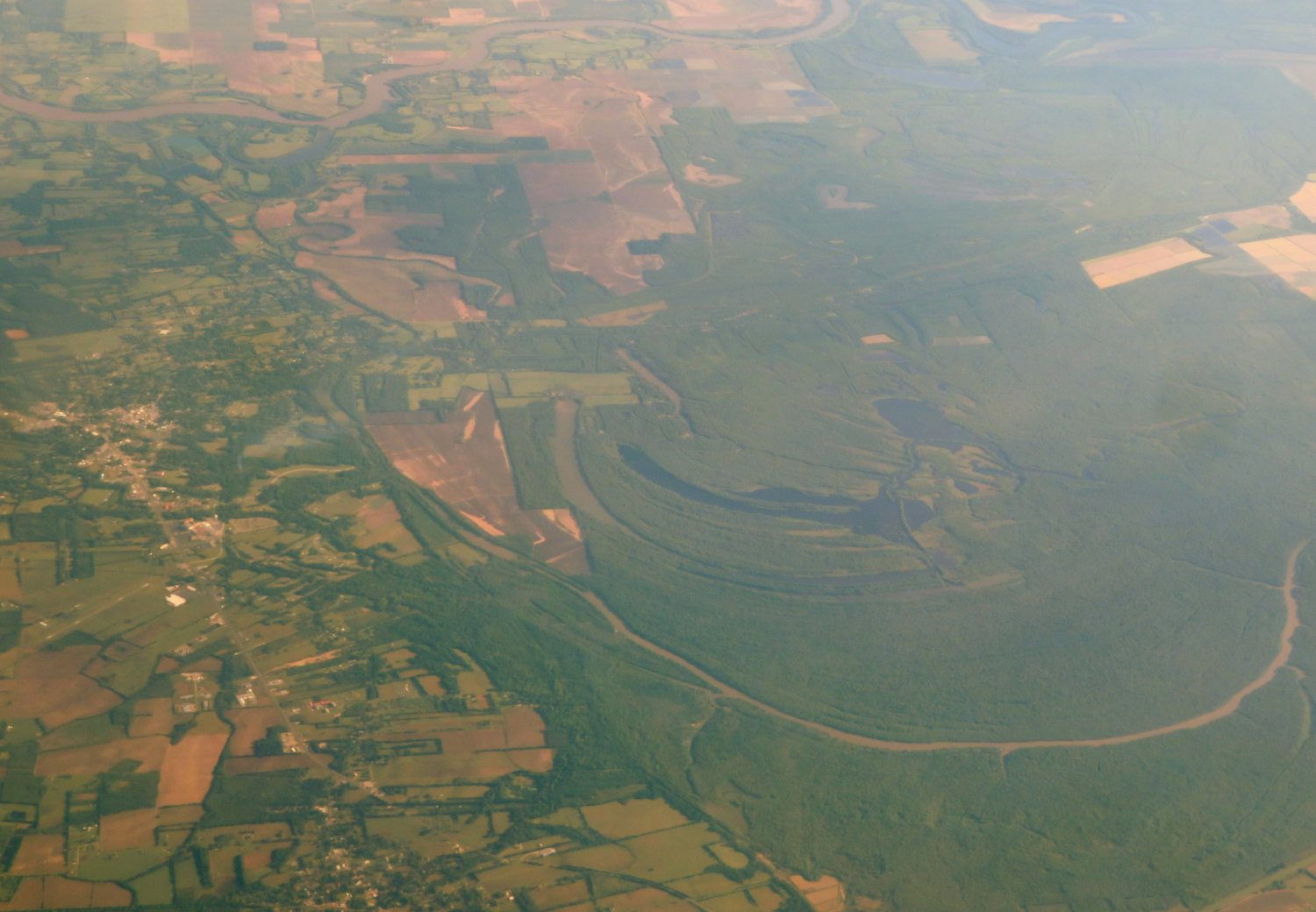
A picture of Spring Bayou State Wildlife Management Area, taken from the air in 2021. Marksville is visible in the far left of the image, the Red River at the top. (Wikimedia Commons/CC BY-SA 2.0/User:Ken Lund)
The region does not lack for fish, is what I'm saying. There's a reason why the local high school's parade float was a giant fish.
You might find more stories you like in our Science and Technology section.
While the official weather report from 23 October 1947 makes no mention of storms or tornadoes, Dr Bajkov and his colleague Dr James Gowanloch had observed numerous waterspouts and dust devils (small tornado-like events) when they were out in the Bayou the previous day.
The explanation put forward by Dr Bajkov was that this shower of fish was the result of a waterspout sucking up many small fish from the warm shallow waters of the surrounding lakes. These fish were launched several hundred metres into the air, high enough that when they came down it was somewhere far enough away from the waterspout that no-one had seen it happen. As he said in his 1949 scientific report on the event, "Many people have never seen tornadoes, but they do not doubt them, and they accept the fact that wind can lift and carry heavy objects. Why can't fish be lifted with water and carried by the whirlwind?"
Header image: This illustration was composited together by the designer of Guinness World Records 2028 for our "Tales of the Unexplained" feature. [Shutterstock]