
How far can you wang your welly? Enough to beat this 30-year-old record?
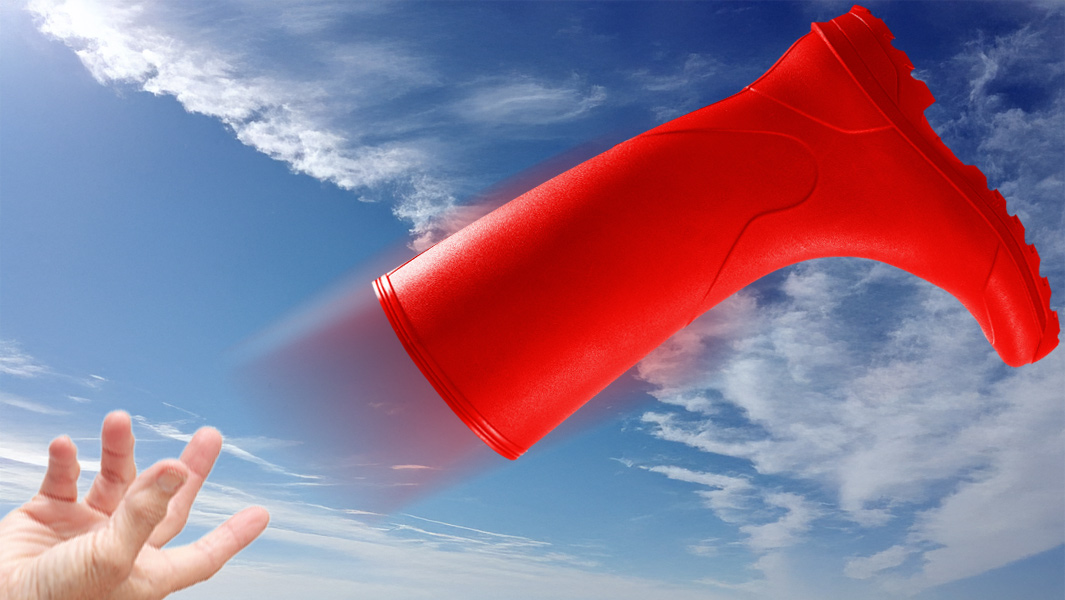
On 12 October 1996, in Hämeenlinna, Finland, Teppo Luoma picked up a Wellington boot and did something nobody has managed to do ever since: he threw it – or, technically, wanged it – an incredible 63.98 m (209 ft 9 in). Three decades later, his fantastic feat of flying footwear remains the all-time Guinness World Records title for the farthest distance to throw a Wellington boot/gumboot.
For anyone unfamiliar with welly wanging, the principle requires very little explanation. Take one Wellington boot. Throw it. Measure where it lands. Try to make it go farther next time.
The origins of this "sport" are less straightforward. Throwing a gumboot – aka Wellington boot or welly, as it's known in the UK – appears to have emerged in England’s West Country during the 1970s before becoming a familiar challenge at village fêtes, galas and fundraisers across the UK. Upperthong, near Holmfirth in West Yorkshire, has since established itself as the sport’s spiritual home, and hosts the World Welly Wanging Championships.
Upperthong also has the better origin story. Local legend has it that the “sport” began after one farmer accidentally spilt beer into another farmer’s boot in a pub. The soggy-footed victim gave chase, then removed the offending welly and wanged it at his escaping opponent. Villagers supposedly began re-enacting the incident, and competitive welly-wanging was born.
It may not have quite the same kudos as the Olympic movement, but with a founding story like this, it’s a sport that deserves global attention. And look at just how far the record-breaking welly has been thrown in competition: it's about the same length as 15 family cars, or six London double-deckers parked end to end, or two kissing blue whales, or the wingspan of a jumbo jet.

Adobe Stock: I-picture/Aline/nicolasprimola
So, never underestimate the sporting prowess of a welly: the ubiquitous boot makes an appearance in a number of record-breaking challenges, such as the largest Wellington boot race and the fastest marathon wearing Wellingtons, in both male and female categories.
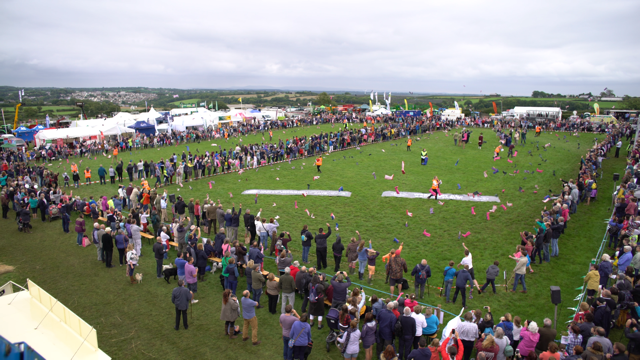
But it's throwing them that really caught the public's imagination. In 1978, Guinness World Records recognized its first world-best throw: Tony Rodgers achieved 52.73 m (173 ft) in Wiltshire with a size-8 Dunlop Challenger. The sport has since travelled far beyond the British fête circuit, with organized welly-wanging in countries including Finland and New Zealand. Today, Guinness World Records also recognizes welly wanging en masse, with a category for the most people throwing Wellington boots simultaneously, as seen below:
Those boots are made for wanging: the rules
There’s no single universal welly-wanging rulebook. Some contests demand a standing throw; others permit a run-up. In parts of Somerset, the welly has even been filled with water, while elsewhere competitors have been made to stand in a bin to stop them sneaking extra momentum!
At Upperthong, the standard projectile is a green size-9 Dunlop welly, unmodified and definitely not polished with anything designed to make it more aerodynamic. A run-up of up to 42 steps is allowed, and the boot must land inside the designated throwing area – known as “the Thong”. Wind assistance is positively encouraged, although competitors have only one minute to wait for a helpful gust. Artificial wind is forbidden.
As for technique, this is up to the wanger. Throws can be one-handed, two-handed, backwards and between-the-legs. All have been tried, with wildly varying combinations of distance, dignity and danger!
Read about more fun records like this in our Hobbies and Skills section
Welly-wanging world wecord record
Finland still holds both Guinness World Records titles for greatest distance wanged. Six months before Luoma’s mighty throw, Sari Tirkkonen launched a size-8 Dunlop 40.87 m (134 ft 1 in) in Turku on 19 April 1996, setting the women’s record – a benchmark that also remains unbeaten today.
So, 30 years after Teppo Luoma sent a welly sailing into sporting history, perhaps it's time to find a boot, a tape measure and a very large patch of empty grass.
The question is: how does YOUR wang compare?