


Would you survive inside the world's smallest prison?
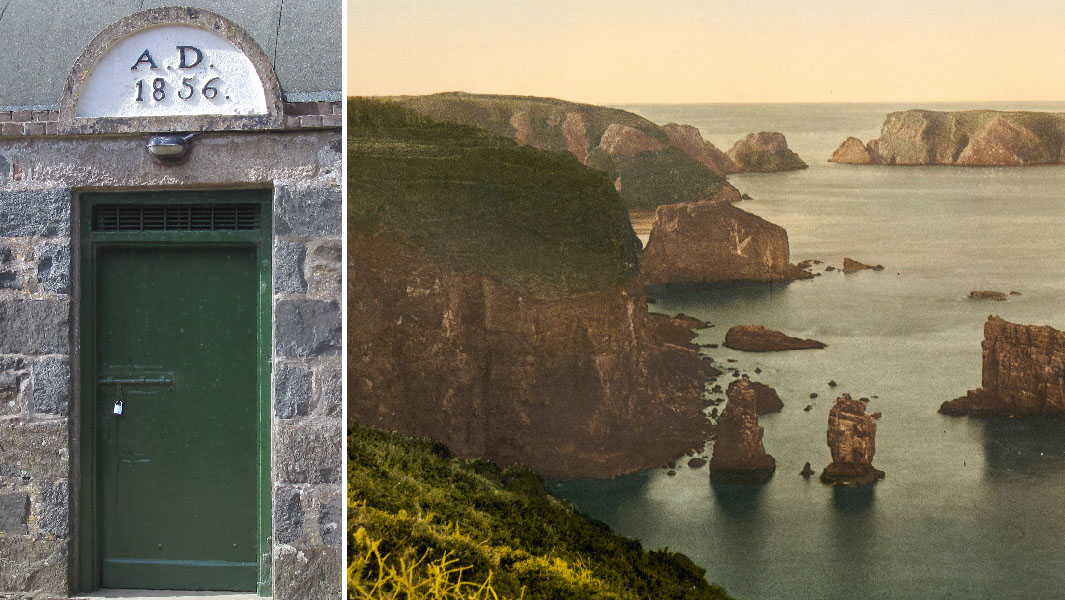
So small that it could be mistaken for a garden shed or a storage building, the world's smallest prison is hidden away in a diminutive but fascinating island in the English Channel, just off the coast of Normandy.
However, despite its unassuming appearance, the one-of-a-kind building continues to serve as the sole penitentiary for the island of Sark, in the Channel Islands archipelago.
 Man vyi / Wikimedia Commons
Home to a community of roughly 600 people, Sark is one of the smallest settlements in the archipelago.
There are no cars, no streetlights, and few tourists. Thanks to the lack of artificial lights, the nighttime on the island is so stunning that Sark was appointed in 2011 as Europe's first Dark Sky Community, meaning that the sky is "sufficiently clear of light pollution to allow naked-eye astronomy".
In 2015, the Sark Observatory officially opened its doors.
Even Sark’s governing apparatus might generate curiosity: as a self-governing British Crown Dependency and part of the Bailiwick of Guernsey, Sark retains a certain degree of autonomy. The island operates with its own parliament, its own constitution and its unique set of regulations based on Norman law.
In 2008, the island held its first-ever general election, with several local candidates applying for the 28 seats in the parliament (or Chief Pleas).
Before 2008, the island was governed by a feudal lord, the Seigneur (Lord of the manor), a title dating back to the Elizabethan era. The first Seigneur was Hellier de Carteret, First Seigneur of Sark, appointed by Elizabeth I in 1563.
Interestingly, three Dames of Sark have governed the island in the last four centuries.
 Man vyi / Wikimedia Commons
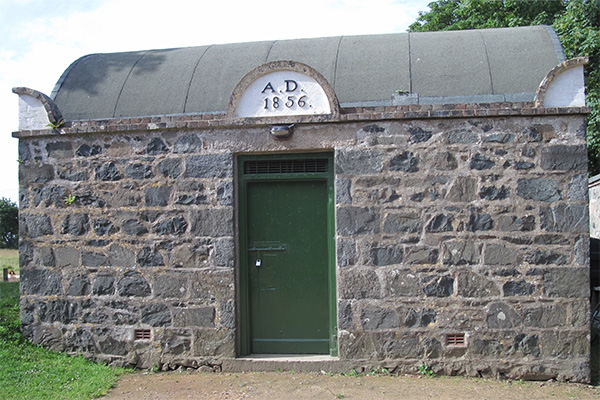
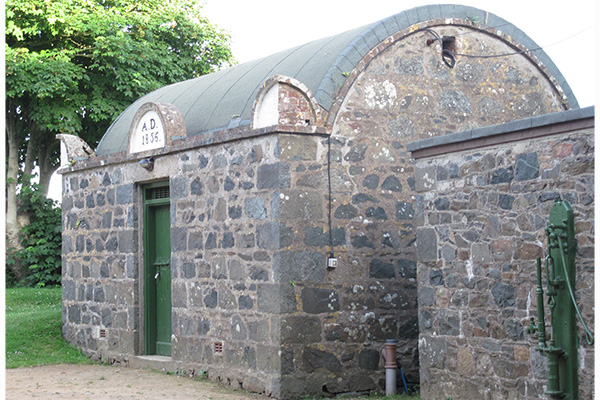
Despite its heavy green door and stone walls, the 19th-century building surely lacks the menacing aura of most detainment centres.
Built in 1856 and situated at the centre of the island, right next to the visitors' centre, the small barrel-roofed jail includes a long, narrow corridor that runs the length of the building and two cells: the first one measuring six feet by eight feet (about 1.8x2.4 metres) and a smaller one measuring six feet by six feet (1.8x1.8 metres).
There are no windows, and each tiny room is not exactly equipped for long-term imprisonment, as it's barely big enough for a bed and a bench.
Despite its unassuming appearance, the smallest prison is fully operational. However, in actuality, the cells are rarely used.
Far from being a facility where dangerous criminals spend months behind bars, Sark's prison is mostly used for overnight detention rather than actual incarceration, as serious offences are handled by Guernsey.
Generally, the two rooms provide a temporary confinement where drunkards (either locals, tourists or seasonal workers) can sober up before heading home.
Order on the island is ensured by a small team of local police officers: the Constable (senior officer) and the Vingtenier, also known as the Constable’s assistant, who is elected annually.
After one year, a new Vingtenier is elected, while the former Vingtenier is promoted to serve as the new Constable.
A fixed Deputy Constable helps run the day-to-day and takes care of the paperwork.
According to Sark Estate, the original prison was built in 1588 near the church.
Although most criminals would be sentenced to the stocks, where they were publicly ridiculed and judged by the community, some unfortunate lawbreakers still landed in prison for a maximum of two days.
The order to build a better and larger prison was given in the early 1830s, but the building wasn't completed until 1856 due to a lack of funds.
Reportedly, one of the earliest known occupants of Sark’s prison was a servant girl.
The poor girl, who was afraid of the dark, spent three full days inside the windowless cell for stealing a handkerchief from her mistress.
Knowing she would not attempt to escape, the residents didn't leave her side: they decided to let her put her chair in the open doorway, where local ladies sat outside the prison to keep her company. They stayed with the girl, knitting and chatting until the unfortunate servant had paid her dues and was finally free to leave.
Another – and perhaps the most famous – resident of Sark’s prison was André Gardes: a French nuclear physicist who became notorious in 1990 as one of the biggest criminals in Sark and, perhaps, the last individual to disrupt its peace.
 Man vyi / Wikimedia Commons
Convinced to be the rightful Seigneur of Sark, Gardes tried to single-handedly conquer the island.
On the day before the invasion, the Frenchman rowed to Sark for Phase One.
There, he put up posters with a detailed description of his plan. That included critical information, such as the time and location of his attack, and how he planned to restore his (self-proclaimed) reign. The decision didn't do him any favours. Made aware of the threat, the Constable and his officials had everything they needed to prepare a counterattack.
The following day, as promised, Gardes attacked: alone, and armed with a semi-automatic rifle.
However, the island was ready for him.
The local officer approached Gardes while he was waiting on a bench and complimented him on his weapon, causing the man to lower his guard. Reportedly, as Gardes showed him the rifle, the Constable promptly punched him on the nose and dragged him to prison.
Relentless, the former nuclear physicist tried the same stunt the following year.
Unluckily for him, he was recognized before he could set foot on the island. The self-proclaimed Seigneur was arrested and handed over to the French Government, thus putting an unceremonious end to his ambitious but poorly executed plan to take over the island.
Today, Gardes' weapon is showcased in Sark’s Museum.
 Library of Congress / Wikimedia Commons
Today, things may be slightly different, but not less peaceful.
A picturesque heaven that seems to exist out of time, untouched by modern-day chaos, Sark is only reachable by boat, and even cars are banned. For those who don't fancy a horseback ride around the small island, the only transport allowed is tractors, bicycles, and horse-drawn vehicles.
Although the Constable will occasionally pull over an intoxicated farmer driving their tractor under the influence of alcohol, the lack of vehicles surely limits road offences.
With the days of Gardes’s invasion long gone and mostly no criminality to worry about, life doesn’t seem too harsh at the smallest prison in the world!