


All the records still held by David Bowie 10 years after iconic singer's tragic death
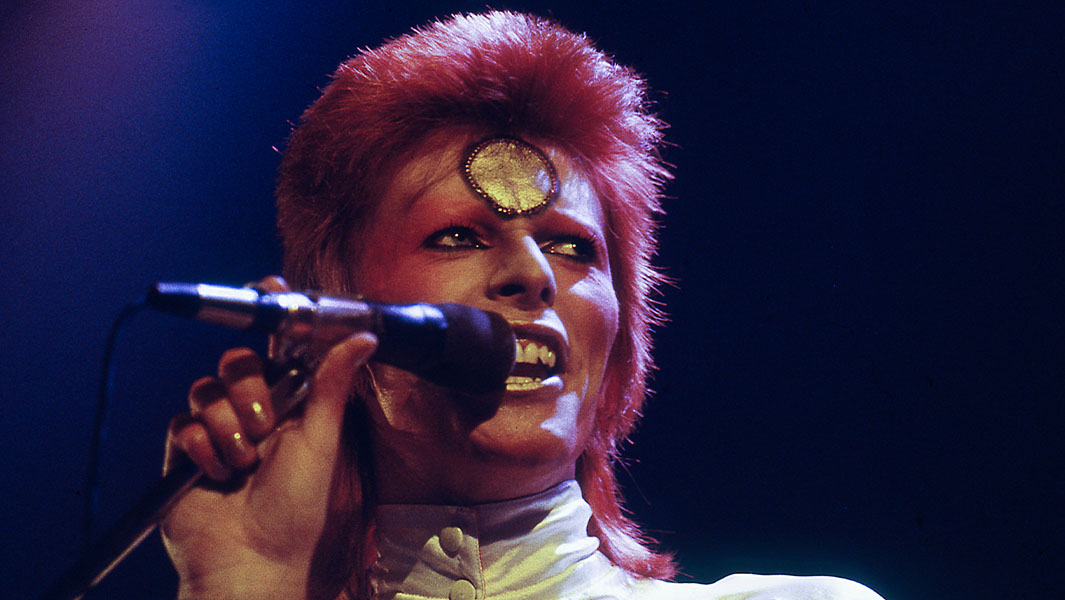
Right to the end, David Bowie had a flair for the dramatic. His career ended on a stellar high: his final album, Blackstar (2016), was released on 8 January – his birthday. Critics applauded its musical brilliance and praised it as a resounding return to form. But just two days later, this extraordinary rock star died, finally submitting to cancer. (Indeed, the album incorporated coded hints about his failing health and imminent demise.)
Outside a small circle of intimates, no one saw it coming. But looking back, it seemed entirely fitting, in its way: after all, Bowie had built a career on surprising his fans.
So today, ahead of the 10th anniversary of this groundbreaking musician’s passing this weekend (10 January), GWR offers its own tribute: a survey of the records that Bowie still holds to this day.
His unexpected passing inspired an outpouring of public grief, and a rush to revisit the music with which he changed the face of pop again and again. On the Official Albums Chart dated 21 January 2016, Bowie placed 19 albums in the UK Top 100 – the most simultaneous entries on the UK Official Albums Chart.
Incredibly, on that day, Bowie owned a quarter of the UK Top 40, including that 26th studio album, Blackstar, which debuted at No.1 with sales of 146,168 – enough to give “The Thin White Duke” a 10th chart-topper in the UK. More than 19 million audio streams counted towards that tally. Bowie also placed 13 tracks on the Official Singles Chart of the same date, including five in the Top 40. The highest-charting track was the anthemic “Heroes” (No.12).
Alongside numerous “best-ofs”, classic Bowie albums reappeared on the chart, including Hunky Dory (No.14), The Rise and Fall of Ziggy Stardust and the Spiders from Mars (No.17) and Aladdin Sane (No.23), the cover of the latter featuring the iconic red-and-blue lightning bolt on Bowie’s face that became a signature look.
In fact, the most expensive album artwork sold at auction is the original image used for Aladdin Sane, taken by British photographer Brian Duffy, which sold for £381,400 ($498,551) to an anonymous buyer at Bonhams auction house in London, UK, on 5 November 2025.
Read about more record-breaking musicians in our Arts and Entertainment section.
David Bowie: Aladdin Sane, 1973. Photo by Brian Duffy, makeup by Pierre LaRoche. The Aladdin Sane album followed Bowie's breakthrough album, The Rise and Fall of Ziggy Stardust and the Spiders from Mars. pic.twitter.com/NaR9RcWPqr
— Classic Rock In Pics (@crockpics) November 10, 2025
The day after his death, Bowie secured the most views for an act on VEVO in 24 hours, an astonishing 51 million. Led by the video for “Lazarus” – the second single from Blackstar – with 11.1 million views, Bowie smashed the previous record of 36 million views, achieved by Adele on 23 October 2015, the day her chart-topping single “Hello” premiered.
In his Seventies pomp, Bowie’s appetite for innovation and restless mind saw him change his image and musical style with every album, something that saw him dubbed the “chameleon of pop”. But his innovations weren’t limited to the recording studio.
In 1997, working with investment banker David Pullman, he created “Bowie Bonds”, which gave investors a share of his future royalties, for 10 years. This ground-breaking idea enabled him to generate a lucrative income from his back catalogue, and was seized on by other artists who also wanted to make the most of their royalty streams.
Always open to new ideas, on 1 September 1998 he launched the first musician-created internet service provider – BowieNet (USA, www.davidbowie.com) – in collaboration with Ultrastar Internet Services. Along with previously unreleased audio tracks, videos and photos, users could access a Ziggy-tastic smorgasbord of attractions, including a fully customisable home page, a davidbowie.com email address, news groups, chat rooms, online shareware and multi-player gaming.
There was always something otherworldly about David Bowie. Partly that was due to his physical appearance – a childhood fight with a friend resulted in the pupil of his left eye remaining permanently larger than that of the other. This made his left eye appear darker than the right, and seemingly a different colour.
But he also embraced the otherworldly, not least with his first hit single, 1969’s “Space Oddity”, which built upon the craze surrounding the first lunar landings to tell the tale of an astronaut, Major Tom, and a mission that takes a very unexpected left turn. He built on that with 1972’s Ziggy Stardust… album, the story of an alien rock’n’roll superstar who comes to Earth, summed up in its classic track “Starman”.
On 12 May 2013, Commander Chris Hadfield (Canada) posted a video to YouTube of him singing a modified version of “Space Oddity”, recorded during his last mission on board the International Space Station – the first music video filmed in space.
And it seemed only fitting that an idiosyncratically Bowie-esque concept – an automobile on an interstellar journey – should involve the man himself somewhere in the mix. On 6 February 2018 SpaceX’s Falcon Heavy performed its maiden flight, with lift-off at 3:45 p.m. (EST: 8:45 p.m. UTC) from Cape Canaveral Air Force Station in Florida, USA. As this was a test flight, the vehicle carried a dummy payload, rather than useful equipment. SpaceX owner Elon Musk decided to use one of his Tesla Roadster cars as the test cargo, resulting in the first mass-produced car sent into space.
Sitting in the driving position is a dummy astronaut, dubbed “Starman”, its hand on the steering wheel while the car’s sound system plays two Bowie tunes on a loop: “Life on Mars?” and “Space Oddity”.
The Tesla Roadster payload is now in an elliptical orbit around the Sun and will remain so for millions or perhaps billions of years, soundtracked by Bowie’s music.
On the 10th anniversary of his death, that seems an entirely appropriate way to remember Bowie: out of this world.
Header image: Ilpo Musto/Shutterstock