
Women’s ice hockey legend Hilary Knight breaks IIHF record for points, goal, and assists
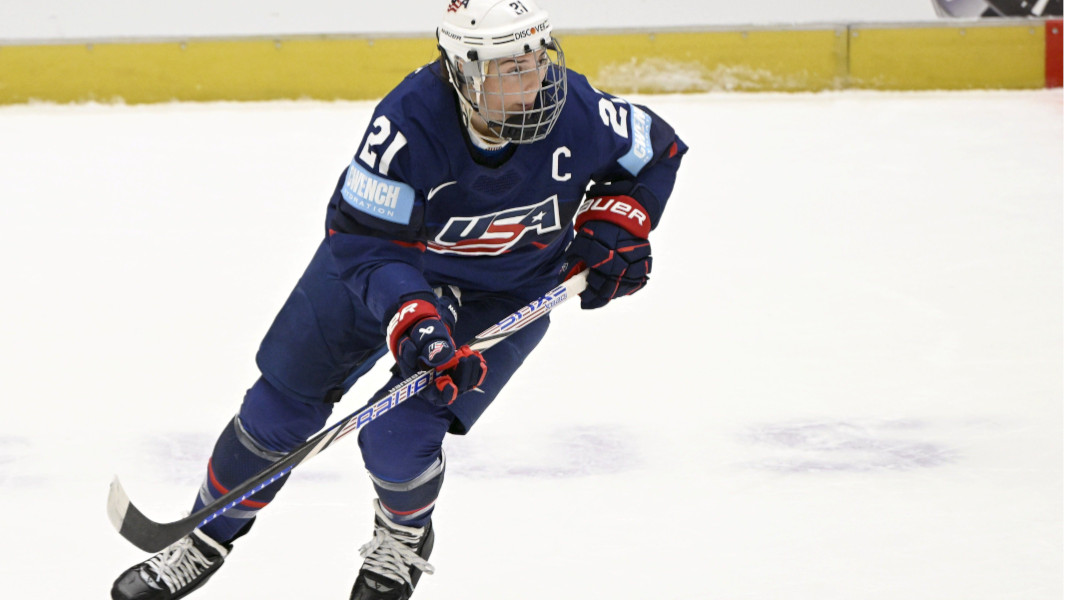
74 years after ice hockey was first introduced at the Olympics – but long before women’s teams were accepted at the competition – five-year-old Hilary Knight (USA) wanted to be an Olympian.
After moving from Idaho to the suburbs of Chicago when she was young, her mother enrolled Hilary and her brothers in ice hockey to make friends – and the talented forward grew up playing in boys and co-ed teams, taking to the ice like a fish to water.
“I wanted to be an Olympic hockey player since I was five. That is so rare and bizarre, especially since women’s hockey wasn’t even an Olympic sport at the time,” said Hilary in an interview with Redbull Sports in 2017. “But I was going regardless. I just wanted to play hockey and I wanted to be the best at it. And I continue to want to do that.”
Now, nearly 30 years after little Hilary first had her dream, she’s earned a reputation as a patron of her sport and one of the greatest women’s hockey players of all time – whose international titles turned into international attention when the four-time Olympian helped to establish the Professional Women’s Hockey League (PWHL) in 2023.
A dominant figure in the sport for nearly two decades, Hilary has served as captain of Team USA and helped her country win one gold (2018) and three silver (2010, 2014, 2022) medals at the Winter Olympics.
But arguably her playground is the International Ice Hockey Federation’s (IIHF) World Women’s Championships – of her 13 appearances, she has won nine gold and four silver medals with Team USA. And on 16 April, her legacy as IIHF legend was cemented when she surpassed previous record holder Hayley Wickenheiser (Canada) to take home the career record for assists – confirming her “triple-crown” of milestones at the event.
Contributing 67 goals, 50 assists, and 117 points for Team USA over the course of her IIHF career, the powerful forward is now a Guinness World Records title holder for most goals scored in the IIHF Ice Hockey Women's World Championship, most assists scored in the IIHF Ice Hockey Women's World Championship, and most points scored in the IIHF Ice Hockey Women's World Championship.
“I signed up for the sport of hockey because I wanted to have fun, and shortly after I always dreamed of being the best player in the world,” she told Guinness World Records. “While I continue to pursue my greatest potential, I am honoured with the opportunity to break records and be a part of some amazing teams.”
Yet despite all of her accomplishments, part of her still feels connected to that childhood excitement of lacing up your skates, hearing the crowd cheering and heckling, and celebrating with your teammates.
“There is something about the way the wind goes around your helmet and through your hair when you skate that makes you feel like you are superhuman,” she once said to Redbull. “When I put on all that equipment and go out on the ice, I feel like we are superheroes duking it out. And then you can go back to your normal life. There is something so magical about that.”
From player to hero
But it wasn’t always easy.
When Hilary was growing up in the 1990s, women’s hockey was still in its developmental stages. Although female players were finally allowed to compete at the Winter Olympics in Nagano in 1998, and Team USA took gold, at a youth level many girls still played with boys or on co-ed teams, lacking the infrastructure to support their own leagues.
“There are years that I’ve just blocked out of my memory,” she admitted. “I was playing an all-boys sport – there weren’t as many opportunities as there are now for young girls and women. I’d get harassed by the parents on opposing teams. Even some parents on my own team weren’t happy that a girl was taking a spot from their boy. They didn’t think I was good enough.”
But the stigma around a girl playing boy’s sports only encouraged Hilary to be better than her competitors – facing bullying in school, the rink was a form of escapism, where “everything between the glass stayed there and everything outside of it left.”
She would spend hours training and firing shots at a target, before falling asleep at night while dressed in her full kit, with pucks tucked under her pillow for good luck.
“When I think back to that, I realize all the things that we accomplish as young children,” she said. “We didn’t even know what we were going through, but we were pioneers of the sport. But when I was living it, I just wanted to be the best teammate and the best player I could be – and I wanted to have fun. We all strive to be better when the odds are stacked against us.”
Her talent and hard work started to show in high school, and her dream to become an Olympian advanced closer and closer. After playing high school hockey for Choate Rosemary Hall, she was scouted by the University of Wisconsin-Madison and invited to play on their elite women’s squad. The school was well-known as an incubator for hockey greats – including Tony Granato, the Suter brothers, Joe Pavelski, and Olympians Meghan Duggan and Brianna Decker.
But she never lost her dream of going to the Olympic games, so in 2006 she made her first attempt at the team. She was cut.
“I've always wanted to go to the Winter Games,” she recalled. “It has always been my objective, but it was only in high school that I realized I had the talent to do it. I was so immersed in the sport, I loved playing and, as a result, I hadn't taken the time to compare myself to other players.
“I think something clicked at the time the selections were made for the Olympic team in 2006, when I didn't make the cut. I said to myself then, 'Okay, this is the last time I fail. I am going to make sure that I am chosen for the next Olympic team.'”
And that she did. After months of training, at age 17 she became the youngest-ever player for Team USA when she represented the red-white-and-blue at the Four Nations Cup. She donned the jersey again at the IIHF Women’s Worlds the following year, taking silver, and playing for the same coach that she would play with at Wisconsin.
After diving headfirst into her collegiate career, Hilary quickly made a name for herself as a fast and dynamic player – in her 2007-2008 freshman season, she ranked second on the team for goals (20) and fifth for assists (15). As a sophomore, she dominated the NCAA Division I, ranking first in goals (45), power-play goals (16), and points (83), and setting a new school record.
All her effort was rewarded in 2010, when she was selected to represent Team USA at the Vancouver Winter Olympics. She took a year off from Madison to prepare, and helped the team to a silver medal after a tough loss to the Canadians.
And her play only improved as she spent more time in Madison – by her senior year, in 2012, Hilary graduated with 262 career points and as the Badgers all-time leader in goals (143), game-winning goals (30), power-play goals (37), and short-handed goals (8). The team even lifted the championship trophy twice, in 2009 and 2011.
But upon graduating university as a 23 year old, Hilary had to make a choice. Most young athletes as outstanding in their field as she is are quickly scooped up by professional leagues – but women’s ice hockey still didn’t have an equivalent to the National Hockey League, where their best players would play. Their only professional outlet were senior leagues, where talented older players would migrate after college careers or successful stints in the minors.
Hilary chose to sign fourth overall to the Boston Blades in the 2012 CWHL (Canadian Women’s Hockey League) draft, top-level senior league. She spent three years terrifying the Canadians up north, and in her freshman season became the first American-born player to win the CWHL's Most Valuable Player Award.
Yet even though she had finally achieved her goal of being an Olympic hockey player, Hilary and the rest of her teammates had to struggle with the fact that living their dream wasn’t enough to make ends meet.
At the time, NCAA contracts forbid talented collegiate players from making money off sponsorships, so Hilary couldn’t make any money off her name when she was in school. But because there was no professional avenue for these players, by the time they graduated, there was essentially no way of earning money from hockey because they didn’t have a market. ‘Senior leagues’ like the CWHL were non-profit and covered team costs, but they could only offer bonuses/incentives and not salaries.
“Just after graduating college, I had recently moved from Wisconsin to Boston, and my stipend for the Boston Blades had been decreased,” she said. “And this was after I’d already competed in one Olympics. I was scraping by and didn’t know if I could make ends meet. I was living off peanut butter and jelly sandwiches.
“One day when I was in a Stop & Shop parking lot, I called my mom and said, ‘I need help. I can’t make enough money.’ She sternly barked back and said, ‘You need to get a job.’ And I was like, ‘You don’t understand what we have to do in order to perform and compete at our best.’ I was upset with that conversation, so I hung up the phone and realized I needed to figure out how to make ends meet.”
Concurrently, more people were watching women’s hockey than ever before. In 2018, Hilary captained Team USA to gold in the PyeongChang Winter Olympics in an incredible 3-2 overtime win against longtime rival Team Canada. Nearly 3 million people tuned in to the final on NBC, even though the game occurred between 11:00 p.m. - 2:15 a.m. ET.
“Finally,” she had said, after her achievement. “That’s something any elite athlete sort of obsesses over. That sort of end goal, the perfection, the trophy at the end, the sort of culmination of the work that allows you to get there.”
And at the same time, more and more girls were beginning to pick up skates. The IIHF reported that between 2007 and 2022 the number of registered female players worldwide grew from 153,665 to 229,754. Thousands of these young players had dreams of playing professionally, or in the Olympics, and they wanted role models they could look up to.
This energy culminated in 2015 with the founding of the National Women’s Hockey League, the first official professional league for female hockey players in North America and the first ever to pay its players salaries. In September 2015, Hilary signed with the Boston Pride, and finished the season as the NWHL’s first scoring champion.
Unfortunately, despite avid support from fans, the league was having problems – after salaries were cut in 2017 to a minimum of $5,000/year and the CWHL unexpectedly dissolved in 2019, many players made it clear they were dissatisfied with the operations of professional women’s hockey.
“We need help not only on the funding side but on the programming side. We need to have more games. The world needs to see the women’s US team. It’s electrifying when you can watch us take the ice,” said Hilary.
“Knowing that we’ve got this amazing product that we can share with people, but we are missing that connection, was one of the big driving forces of why we need to fight for equitable support. We aren’t necessarily going to see the benefits of it immediately, but this fight is also for future generations. Knowing that, makes our fight feel that much more noble.”
In 2019, over 200 players – including Hilary, Team USA stars Meghan Duggan and Kendall Coyne-Schofield, and Canadian legend Marie Philip-Poulin – released a joint statement declaring their intent to boycott all professional women’s hockey leagues for the 2019-2020 season.
“We are fortunate to be ambassadors of this game that we revere so deeply, and yet, more than ever, we understand the responsibility that comes with that ambassadorship: to leave this game in better shape than when we entered it,” the statement read.
“We cannot make a sustainable living playing in the current state of the professional game. Having no health insurance and making as low as two thousand dollars a season means players can't adequately train and prepare to play at the highest level.”
We may represent different teams, leagues and countries but collectively we stand as one. #ForTheGame pic.twitter.com/O9MOOL8YOt
— Hilary Knight (@HilaryKnight) May 2, 2019
For many players, it was a difficult decision to make.
“I’m such a stubborn person, so I felt either the funding is going to go through or we’re not playing in the World Championship. That was the bottom line,” Hilary said. “It was tough. For some girls, it was their first World Championship. We knew with everything on the line this definitely needed to be worth it.
“I want the next generation to have a different experience than we had, so I knew it was the right thing to do. We all did. Whether you are first on the roster or the one hundredth, you are still a part of this.”
Luckily, all their efforts paid off in 2023 after years of negotiations between the PWHPA (Professional Women’s Hockey Players Association) and the Premier Hockey Federation. The NWHL was bought out by organizations belonging to American tennis star Billie Jean King and Los Angeles Dodgers owner Mark Walter, and the result was a new league named the Professional Women’s Hockey League (PWHL). At long last, players were able to be paid full salaries with benefits and incentives.
Hilary was one of the first players to sign with the league in 2023 when she joined the Boston Fleet, becoming its inaugural captain. During that first 2024-2025 season, her 29 points tied Sarah Fillier for the PWHL Points Leader award, as Boston narrowly lost the championship to Minnesota.
And thanks to the PWHL, fans are able to interact with their favourite players more than ever before – in their inaugural year, 392,259 people attended the games, setting six new attendance records for women’s hockey, and causing over 238 million media impressions.
Now entering the 2025-2026 season, Hilary became the first to sign with the new PWHL Seattle team as the league added two new expansion teams. The 35-year-old also announced that the upcoming 2026 Winter Olympics would be her last, though she hopes to keep playing hockey for the PWHL for years to come.
And of course, she’ll never stop being an advocate for the sport she loves so much.
“We are so far from where we need to be and where the sport should be at this time, so I think that’s what keeps me hungry,” she said. “I want to make sure we leave the sport better off than how we entered it.”
So for those seeking to accomplish their dreams like Hilary, she provided some simple advice to Guinness World Records: “Start. Have a vision or dream and set goals to help guide your way there. Enjoy the journey.”
Header image: Alamy