


Man voluntarily buries himself alive, emerges nine days later: "it’s smelly down there"
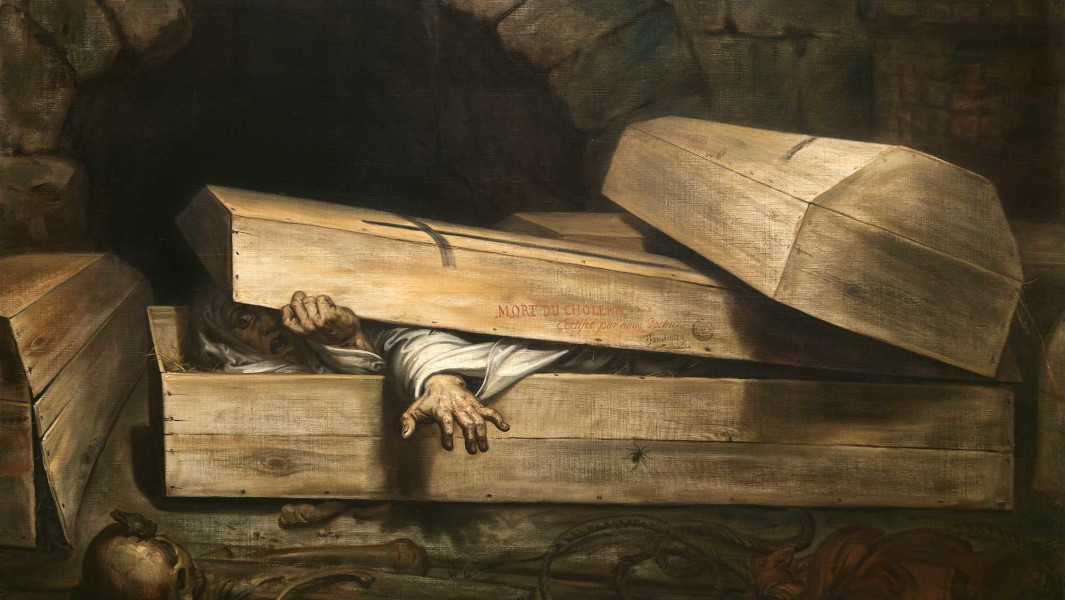
In 1898, 78-year-old Faroppo Lorenzo (Italy) climbed into a coffin, laid down, and waited as the lid was shut snugly above him and workers shoveled piles of dirt on to his grave.
Nine days later, the workers dug up the dirt above his tomb, and Faroppo climbed back out, alive, to the gasps of an excited audience. It wasn’t a magic trick, or a Halloween hoax, but rather a shocking test of a 19th-century invention designed to ease the common fear of a premature burial.
Faroppo was entombed in a security coffin named ‘Le Karnice’, designed by Count Michel de Karnice-Karnicki, an eccentric chamberlain to Russia’s Nicholas II. After apparently witnessing a young Dutch girl nearly buried alive, only to be awoken by the thud of dirt landing on her coffin, the Count was haunted by her screams and spent four years shut up in a castle designing a contraption to prevent these appalling deaths.
The result of his work was the eponymously dubbed Karnice, which was an altered coffin featuring a long tube that would emerge from the ground and allow a person buried alive to survive and signal for help.
A ball dangling above the interred person’s chest would trigger a spring-loaded trap door above ground upon any movement, and air and light would flood in through the tube, allowing the person to breathe. To attract attention to the grave, an above-ground box housed a ringing bell and a 4-ft tall flag that would deploy, and the buried person could even shout for help through the tube.
Seeking test subjects, the Count found one in Faroppo, who consented to bury himself in the contraption in Turin between 17 and 26 December in 1898. He survived nine days in Le Karnice for the longest voluntary burial – and upon disinterment, his only comment about his dismal underground Christmas vacation was that it had been “damned smelly down there”.
The fear of being buried alive – otherwise known as taphephobia – was part of a broader Victorian obsession with death, as medical science was in its infancy and sudden fatalities from illness or injury were common.
A historian at the US Patent and Trademark Office, Adam Bisno, said the first patents for security coffins started appearing in the 1790s in central Europe as intellectuals sought to understand “the 'gray areas' in our experience, like the gray area between life and death.”
“People were asking, 'Are the dead really gone? Are they still here with us?'" he continued. “The fear of live burial really tapped into that fascination. It's a figure underground who is with us and not with us, alive and not alive, dead and somehow not dead.”
He estimates that more than 100 security coffin patents were granted in America by the USPTO during the 19th century, such as Eisenbrandt’s jack-in-the-box coffin, or an “improved burial case” featuring a tube with a ladder from which the interred could climb to safety.
Nevertheless, these safety coffins like Le Karnice never really caught on, despite the public’s obsession at the time. They could be costly to make and install, and there are no reported cases of the coffins ever even saving a life – furthermore, the ‘detection’ features on many of the devices were triggered by movement, which happens naturally during bodily decomposition.
“People didn't buy it,” said Bisno. “Funeral directors weren't interested and the public wasn't interested either. In fact, none of these inventions ever caught on.”
The chance of disinterring someone actually dead was often too great a risk for cemetery workers to take, as unnecessarily unearthing a decomposing body is nearly as horrifying as the thought of being buried alive.
Header image: Antoine Wiertz / Wikimedia Commons