


The “Plastic King” who assembled a four-storey castle out of 40,000 recycled bottles
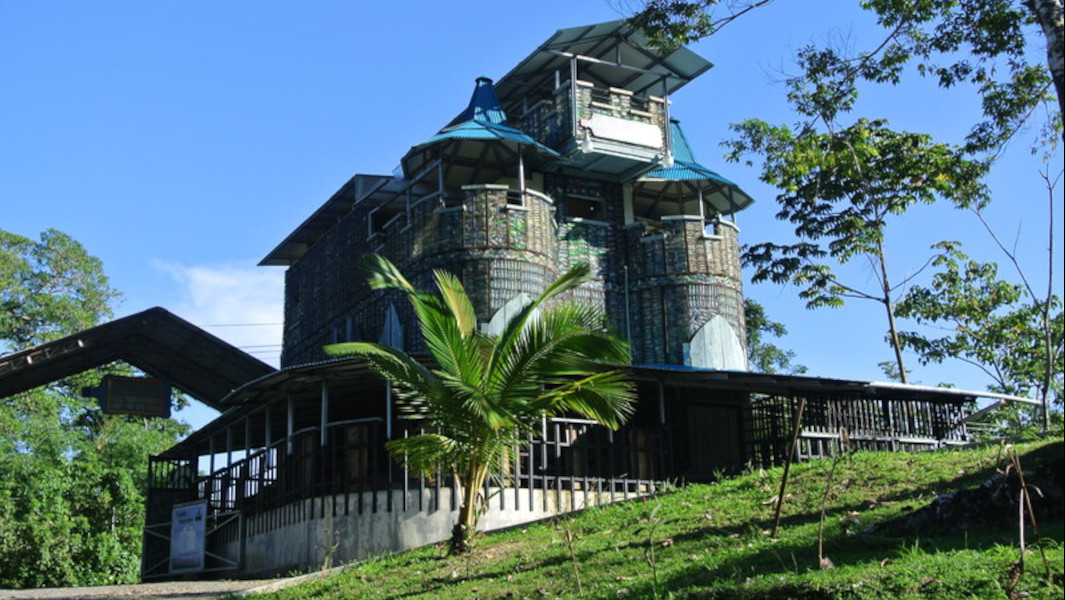
Once upon a time, a Canadian man seeking to cleanse the world from useless waste, electrified the people of Panama to collect thousands of plastic bottles discarded on the roads and beaches of the magnificent isthmus, thus turning the trash into an impressive castle that shines in the light of the Caribbean sun.
And no, this isn’t a fairytale – this is the life’s work of Montreal native Robert Bezeau, the aptly named “Plastic King”.
Back in 2012, Robert was living in Isla Colón in Bocas del Toro, Panama, and spending his time with the Bocas Recycling Program, who sought to clean up trash on the country’s beaches and communities. Yet the Canadian was shocked to find that in the year and a half he was working, they collected an estimate of over one million plastic bottles – which were accumulating in huge piles of recyclable waste.
To minimize this pollution, he thought of a wild idea… what if they could use the bottles instead of recycling them, by turning them into a massive structure that could provide housing and serve as a monument to human waste and eco-friendly solutions?
From this seed, the largest castle made from plastic bottles was built – the four-storey, 46 ft (14 m)-high Castillo Inspiración, fabricated from around 40,000 plastic bottles.
“At first, residents and officials of the island thought I was crazy – even my wife and son did!” said Robert in the 2022 edition of Guinness World Records. “Then they were curious and let me continue to see what I was going to do next. As it grew, so did their intrigue.”
Soon enough, the building began to take shape. Structured around concrete and steel supports, Robert and his team of workers used the bottles as an “eco building material” or form of insulation, whose plastic form protected the castle from the elements and added a unique aesthetic that almost looks like plastic stained-glass.
“The challenge was that we had no plans – we improvised day by day,” he said. “It rose one day at a time, one floor at a time, until we had reached four storeys!”
In all, the castle boasts four guest rooms, a feasting area, and a viewing platform on the roof – as well as numerous educational materials for visitors intrigued by his creation and curious about the effects of plastic waste on the planet.

Robert in his castle
And throughout it all, Robert promotes the importance of “upcycling” PET plastic rather than “recycling” – which means reusing the plastic bottles for another purpose without altering their chemical structure. Whereas recycling can often result in plastic fibres entering the ecosystem, upcycling is considered a more environmentally friendly reuse of waste material.
“One man’s trash is another man’s castle,” he once said. “Dinosaurs were extinguished by a meteor, humanity will be extinguished by plastic.”
Read more stories about sustainability and the environment in our Science and Technology section!
A few years after he built the castle, Robert received an Energy Globe Award for his sustainable projects, which he said made him “feel incredible.”
Yet despite receiving the accolade, he didn’t stop there. In 2021, he expanded his operations to build an entire Plastic Bottle Village, which features many other buildings built from the same discarded materials that he collected from the Bocas Del Toro islands. In these houses, the bottles serve as insulation, and are covered in a concrete exterior so those who live there can be fully protected from the elements.
Robert also extended his castle to add a massive dungeon, which has a total floor area of 1,500 sq ft (139 sq m) and stands 12 ft (3.7 m) tall.
The dungeon is made from 10,000 plastic bottles, and has six “cells” that can sleep up to 16 guests/prisoners, who would be “repenting” for their plastic waste crimes and pledging to improve their consumption and upcycling habits after they have “served their time” in a plastic prison.
As of 2022, he estimates that the entire village used 200,000 plastic bottles, which significantly helped clean up the local environment.
And for those inspired by Robert’s incredible creation, he offers a few simple words of advice.
“We need to convince our politicians to regulate packaging. How can it be right that we drink water from a PET bottle for eight minutes and discard it in nature for 800 years?” he said.
“If bottles are shaped so that they interlock together, it would allow us to reuse them and build all kinds of structures, useful or decorative, such as benches, tables, fountains, storage boxes, dog houses… the possibilities are endless.”