


New heights: the first astronaut to summit Mt. Everest left moon rock at the peak
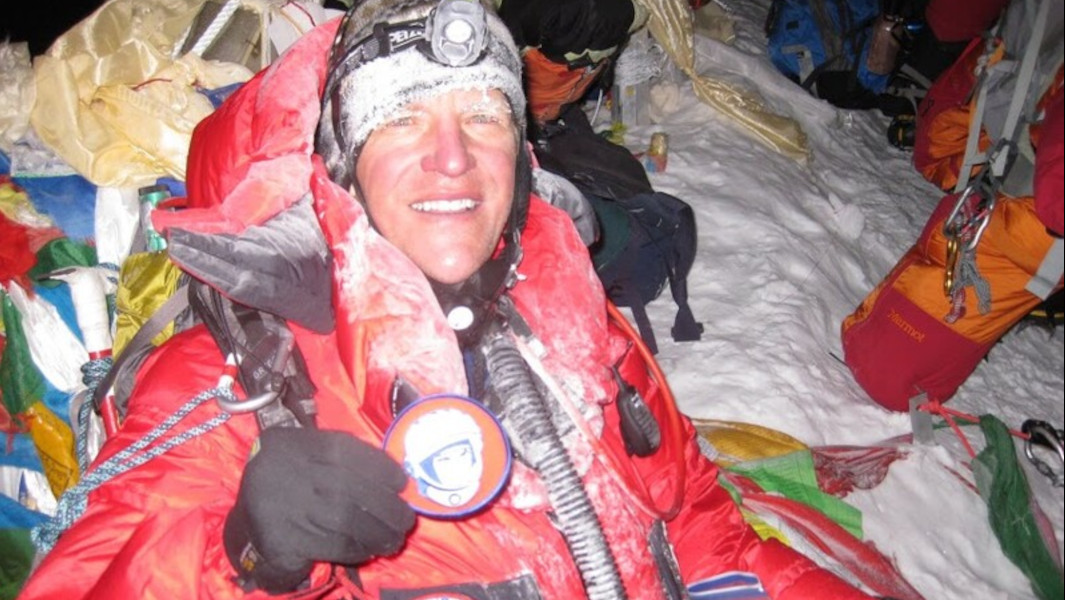
Very few people have had the opportunity to climb the highest mountain in the world – and fewer still have looked down on that peak from space.
But on 20 May 2009, former NASA astronaut Scott Parazynski (USA) became the first person to complete both incredible accomplishments, as he climbed up the famous Himalayan peak and claimed the Guinness World Records title for the first astronaut to summit Everest.
“For me, what Everest means is achieving a personal goal that is very, very difficult…” Scott said to Stanford University Magazine. “The ability to stand in a place where very few people can go.”
Back in 1992, Scott – then working as an emergency medicine resident – was two months into planning his first attempt up Everest when he received a phone call from NASA requesting him to start astronaut training.
And for nearly two decades, he put his dream of climbing the mountain to the side, as he completed the vigorous physical and mental trials required for spaceflight.
After graduating from the Johnson Space Center, he was qualified as a mission specialist and began his 17-year career for NASA, where he travelled more than 23 million miles in the stars and conducted seven space walks.
Yet the intelligent explorer never gave up on his childhood passion for climbing, and after he retired from the administration, he knew he had to give the mountain one more shot.
“I'd been climbing since I was about 15 years old,” Scott said to CBS This Morning. “Just the challenge of going to the world's highest peak, I had seen it from orbit. And I took this beautiful photograph looking straight down on the summit of Mount Everest and I conjured up in my mind, 'What would it look like to actually have my boot prints down there on that beautiful summit?'”
In 2008, he made his first attempt at the peak, but severe back pain forced him to turn back just before the summit.
But Scott was undeterred, and he returned the following year as a team physician for the Discovery Channel – and on 20 May 2009, he finally made it to the highest point on Earth, leaving behind an offering of a small Moon rock that had been collected by the crew of Apollo 11.
During an interview with Alastair Humphreys, the mountaineer explained the differences between space flight and climbing, saying that even though the physical and mental preparation, training, and equipment are similar, each experience brings its own threats and rewards.
“...When I crawled out the vestibule of the tent, I felt almost as if I was floating out of the hatch of the space shuttle or the international space station, because you’re really going out into the void,” he said. “The vacuum of space is not that dissimilar from high on Everest. There’s not much atmosphere up there. It’s extremely cold…
“There are a lot of dissimilarities as well, though. When you’re in space or on a shuttle mission or any type of spacecraft, you feel the threat of the launch in particular. It’s seven million pounds of thrust to get you off the planet and up to the space station.
“So the launch is a very high-threat environment,” he continued. “But once you get up into space, you’re floating around…You don’t really appreciate the fact that on the other side of that thin aluminum hull is the vacuum of space. So you feel very comfortable and secure.
“However, when you’re in the Himalayas or on any other big mountain, it’s very cold. There’s hypoxia. You’re very far away from any kind of rescue. You feel an element of threat all the time.”
Read more stories about record-breaking adventurers in our Hobbies and Skills section!
And even though most people would be satisfied with a life as fulfilling as Scott’s (who wouldn’t want the accolades of being an astronaut, doctor, and Everest-conquerer!), surprisingly, the accomplished explorer still has a long bucket list filled with new adventures.
Since his space and Himalayan exploits, Scott has worked as a pilot, studied volcanic lakes and set the first bootprints inside the crater of Massaya Volcano in Nicaragua, and even visited the wreck of the Titanic with OceanGate.
He also plans to join a trip to Dean’s Hole in the Bahamas – one of the world’s deepest ocean sinkholes.
“As I’ve grown older I’m also convinced of the great value of pursuing human performance at extreme, challenging environments,” he said to Popular Science. “In fact, I think it’s a great catalyst for innovation in health care and other areas.”
So here’s to hoping we see more record-breaking adventures with Scott in the future!