


How conjoined twins were separated centuries ago by revolutionary surgeon

The rare births of conjoined twins have been recorded throughout history, with anecdotal reports dating back over a thousand years.
However, the world’s first successful separation of conjoined twins didn’t occur until the late seventeenth century.
On 23 November 1689 in Basel, Switzerland, a 42-year-old woman named Clementia Meinin gave birth to conjoined twin girls Elisabet and Catherina, who were fused together between the xiphoid process (a section of cartilage at the base of the sternum) and the navel.
Their umbilical cords, containing three large blood vessels from each child, were also fused.
After some deliberation among a group of physicians, it was decided that one of them, Swiss surgeon Johannes Fatio, would separate the newborn girls.
Fatio was a pioneering paediatric surgeon who documented procedures for dealing with numerous birth defects, as well as guidance for giving a newborn baby mouth-to-mouth resuscitation.
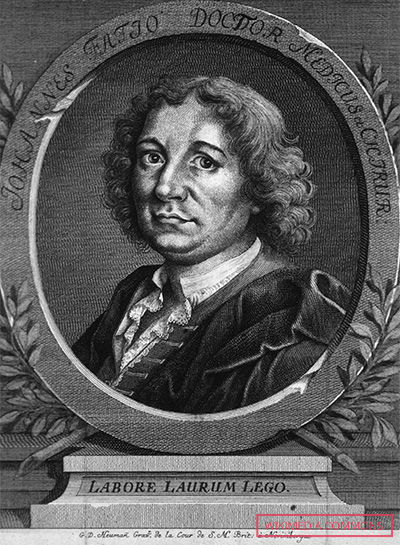
Johannes Fatio
The surgery was performed in three parts, beginning a day after the twins’ birth.
It was witnessed by several high-profile professors, doctors and other distinguished members of Basel society.
Fatio first dissected the umbilical cords, cutting the shared blood vessels and ligating them with silk thread.
Following this, he looped a silk ligature around the connecting band of tissue between the girls and gently tightened it.
The ligature was progressively tightened over the next days, with the necrotizing tissue being treated with an ointment containing alcohol.
Eventually, on 3 December – nine days after the procedure began – the connecting band of tissue spontaneously separated.
The stumps were treated and dressed, and the twins reportedly fully recovered within 10 days.
Two eminent physicians and eyewitnesses to the event, Emanuel König and Theodor Zwinger, each published accounts of the procedure in 1689 and 1690 respectively.
It’s unknown what became of Elisabet and Catherina in their later lives, though they likely lived a lot longer than Fatio, who was executed in 1691 for his role in the Basel revolution.
Fatio’s own account of the separation surgery went unread until 1752, when it was published as part of a handbook aimed at midwives titled Der Arzney Doctor, Helvetisch-Vernünftiche Wehe-Mutter.
There is an earlier recorded case of conjoined twins being surgically separated, but it was only partially successful.
As described by Byzantine Greek chronicler Leo the Deacon, there existed a pair of conjoined twins in the mid-10th century who travelled around the Byzantine Empire. In the year 945, one of the twins died during a visit to Constantinople (present-day Istanbul) and physicians severed the connection between the two, but the living twin only survived for three days before dying.
If you love watching records being broken you should check out our Records Weekly series on YouTube...